






Definition & Meaning
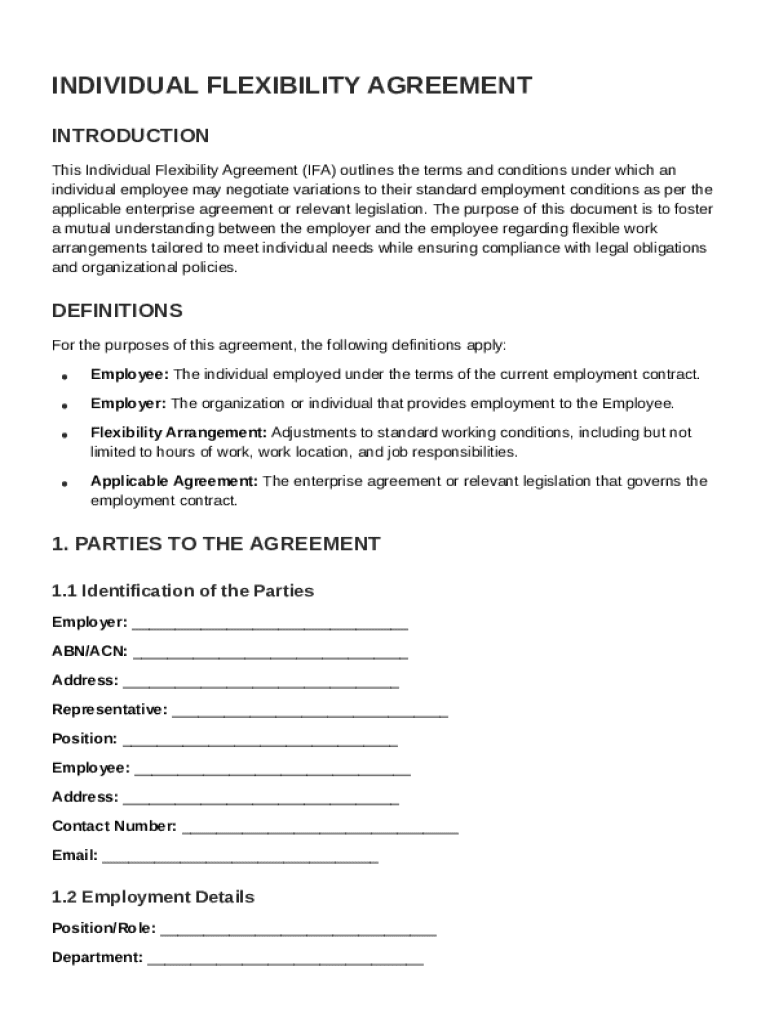
The Individual Flexibility Agreement (IFA) is a document that allows employers and employees to customize standard employment conditions to better suit individual needs. By negotiating specific terms, both parties can agree on flexible work arrangements that align with personal or business objectives while maintaining legal compliance. This template is especially valuable in promoting work-life balance and accommodating unique circumstances that might arise in various professional environments.
Key Elements of the Individual Flexibility Agreement Template
An effective Individual Flexibility Agreement Template must include several essential components to ensure completeness and legal validity.
- Parties Involved: Clearly identify the employer and employee, specifying their roles and contact information.
- Purpose and Scope: Outline the intentions behind the agreement and the specific terms to be modified.
- Flexibility Arrangements: Detail the specific changes to standard conditions, such as work hours, location modifications, or duties.
- Obligations: Highlight responsibilities each party must adhere to under the new terms.
- Review and Amendment Process: Specify how the agreement can be monitored and amended if necessary.
- Termination Conditions: Define how and when the agreement can be terminated by either party.
Steps to Complete the Individual Flexibility Agreement Template
Completing the Individual Flexibility Agreement Template involves a methodical approach to ensure all aspects are covered.
- Initial Discussion: Begin by discussing potential modifications with your employer or employee.
- Draft the Agreement: Utilize the template to draft specific changes and obtain initial feedback.
- Legal Review: Consider consulting a legal advisor to ensure compliance with federal and state laws.
- Finalize the Document: Incorporate any feedback received and agree on a final version.
- Agreement Signing: Both parties should sign the agreement to signify their consent and understanding.
- Storage: Keep a copy on file for future reference and potential audits.
Why Use the Individual Flexibility Agreement Template
Utilizing an Individual Flexibility Agreement Template can offer numerous advantages for both employers and employees.
- Custom Solutions: Tailor work conditions to meet unique needs, improving satisfaction and productivity.
- Improved Retention: Flexible arrangements can reduce turnover by increasing job satisfaction.
- Compliance: Ensure that all modifications are legally binding and meet regulatory requirements.
- Transparency: Clearly document agreed-upon terms, minimizing misunderstandings or disputes.
Who Typically Uses the Individual Flexibility Agreement Template
The template is broadly applicable across various sectors and employment types.
- Corporate Employees: For remote work or adjusted schedules.
- Small Businesses: To adapt roles in a dynamic environment.
- Freelancers and Contractors: Often use IFAs to outline specific project-based terms.
- Organizations with Diverse Workforces: Accommodate differing employee needs for diversity and inclusion.


Legal Use of the Individual Flexibility Agreement Template
The legality of using an Individual Flexibility Agreement Template is supported by various regulations that govern employment conditions.
- Adherence to Fair Work Act: Modifications must comply with broader labor laws and cannot disadvantage employees.
- Documentation Requirements: Maintain a clear, signed document outlining modifications.
- Periodical Reviews: Regularly assess agreements to ensure they continue meeting legal standards.
State-Specific Rules for the Individual Flexibility Agreement Template
While the overall framework for IFAs is similar across the U.S., state-specific variations can exist.
- State Labor Laws: Each state may have unique requirements that need to be integrated.
- Industry-Specific Regulations: Some industries may have additional rules governing work conditions.
- Union Agreements: In states with strong union representation, additional approvals may be needed.
Examples of Using the Individual Flexibility Agreement Template
Real-world scenarios illustrate the adaptability and effectiveness of the template.
- Retail Sector: Adjusting work hours for students needing flexible schedules during exam periods.
- Tech Industry: Employees opting for remote work to better balance job performance and personal time.
- Healthcare Professionals: Scheduling adaptations for varying shift demands and individual well-being.
These examples demonstrate how the Individual Flexibility Agreement Template can be utilized to effectively address various employment challenges.