






Definition & Key Elements of the B2B Partnership Agreement Template
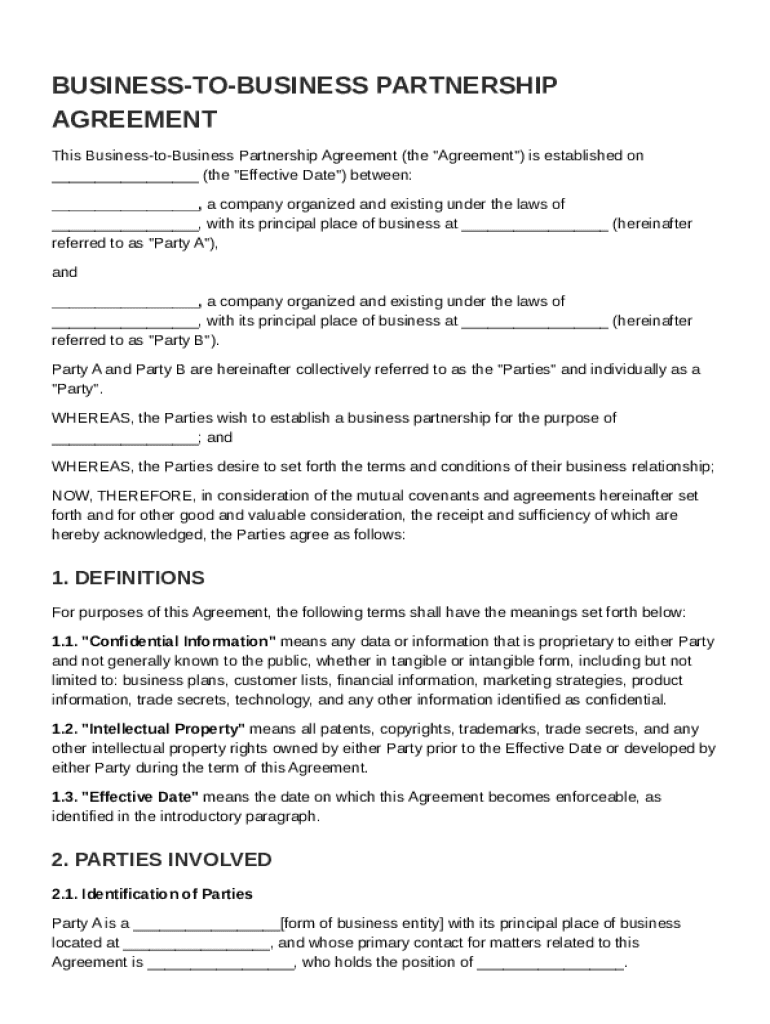
A Business-to-Business (B2B) Partnership Agreement Template is a structured legal document that outlines the terms and conditions of a partnership between two business entities. The template typically includes details such as:
-
Roles and Responsibilities: Clearly defines the duties and obligations of each party involved. For example, Party A may be responsible for product development while Party B handles marketing and sales.
-
Financial Arrangements: Specifies the financial commitments, revenue sharing, and investment contributions expected from each partner.
-
Confidentiality Obligations: Includes clauses to protect sensitive information exchanged between the parties, ensuring that proprietary data and trade secrets remain confidential.
-
Intellectual Property Rights: Addresses the ownership and usage rights of any intellectual property created or shared during the partnership.
-
Duration and Termination Clauses: Sets the timeframe for the partnership and outlines the procedures for terminating the agreement if necessary.
-
Dispute Resolution Processes: Establishes the methods for addressing and resolving disagreements, such as mediation or arbitration.
These key elements help establish clear expectations and protections for both parties, fostering a productive and legally compliant partnership.
Steps to Complete the B2B Partnership Agreement Template
Completing a B2B Partnership Agreement Template involves several critical steps to ensure that the document is thorough and legally binding. The process typically includes:
-
Identify the Parties: Clearly state the legal names and addresses of the entities entering into the partnership.
-
Detail the Partnership Objectives: Outline the specific goals and purposes of the partnership, ensuring that both parties are aligned on the expected outcomes.
-
Define Roles and Responsibilities: Specify the duties and obligations of each party, including any specific project deliverables or timelines.
-
Establish Financial Terms: Include terms of investment, profit sharing, and financial responsibilities, along with payment schedules and methods.
-
Set Confidentiality and IP Terms: Address how confidential information will be protected and define the ownership and rights of intellectual property used or created.
-
Outline Duration and Termination Conditions: Clearly define the length of the partnership, as well as the conditions under which it can be extended or terminated.
-
Include Dispute Resolution Terms: Establish procedures for conflict resolution, detailing whether issues will be resolved through negotiation, mediation, or arbitration.
-
Obtain Approvals and Signatures: Ensure that the agreement is reviewed and signed by authorized representatives from both parties to formalize the partnership.
Each step should be approached with attention to detail to create a comprehensive and enforceable agreement.
Legal Use of the B2B Partnership Agreement Template
The B2B Partnership Agreement Template serves as a legal framework that governs the collaboration between two companies. Its legal use ensures that:
-
Clarity and Consistency: Both parties understand their roles, obligations, and rights, reducing the potential for misunderstandings or disputes.
-
Risk Mitigation: The agreement addresses potential risks and liabilities, protecting both parties from unforeseen circumstances that could impact the partnership.
-
Compliance with Laws: The template helps ensure that the partnership adheres to relevant local, state, and federal regulations, including tax obligations and business practices.
-
Dispute Resolution: Provides established pathways for resolving conflicts, reducing the likelihood of costly litigation.
-
Binding Agreement: The signed document is legally binding, ensuring that both parties are committed to fulfilling their obligations as outlined in the agreement.
Legal professionals often assist in drafting and reviewing the agreement to align with applicable laws and to address specific needs of the partnership.
Who Typically Uses the B2B Partnership Agreement Template
The B2B Partnership Agreement Template is utilized by a variety of business entities seeking to formalize their collaborative efforts. Common users include:
-
Corporations: Large companies that partner to leverage each other's resources for mutual growth.
-
Small to Medium Enterprises (SMEs): These businesses use the agreement to collaborate on projects that require combined expertise or resources.
-
Startups: Often partner with established businesses to gain market access, technological support, or investment.
-
Non-Profit Organizations: May enter partnerships with corporations or other non-profits to advance social initiatives or programs.
-
Professional Services Firms: Entities like law or accounting firms that collaborate on complex projects needing multidisciplinary expertise.
The template provides a versatile framework that can be adapted to suit diverse business partnerships across various industries.


Important Terms Related to B2B Partnership Agreement Template
Understanding specific terms is essential for effectively utilizing the B2B Partnership Agreement Template. Key terms include:
-
Partnership: A formal agreement between two or more parties to pursue a shared business objective.
-
Joint Venture: A temporary partnership for a specific project or venture.
-
Confidential Information: Sensitive business data that is shared under restrictions to prevent unauthorized disclosure.
-
Intellectual Property (IP): Creations of the mind, such as inventions, literary and artistic works, that are legally protected.
-
Non-Disclosure Agreement (NDA): A contract that outlines the confidentiality of shared information between parties.
These terms help define the structure and scope of the agreement, ensuring clarity and specificity in the partnership's legal framework.
State-Specific Rules for the B2B Partnership Agreement Template
While the B2B Partnership Agreement Template provides a broad framework, state-specific rules may influence its content and execution. Key considerations include:
-
Governing Laws: The agreement should specify which state's laws will govern the partnership, based on where the businesses are registered or operate.
-
Business Licensing Requirements: Each state may have different requirements for setting up and operating a business partnership, such as registration fees and annual reporting.
-
Tax Implications: States may have varying tax structures that affect how income from the partnership is reported and taxed.
-
Employment Regulations: State-specific labor laws could impact how employees are managed within the partnership, especially if cross-state operations are involved.
Business partners should consult legal professionals familiar with state laws to tailor the agreement accordingly, ensuring compliance and legal validity.
Practical Examples of Using the B2B Partnership Agreement Template
The practical application of a B2B Partnership Agreement is diverse across industries. Examples include:
-
Technology Sector: Two software companies may partner to develop an innovative product, with one providing the backend technology and the other the user interface design.
-
Retail Industry: A retailer could partner with a logistics firm to enhance distribution channels and improve supply chain efficiencies.
-
Healthcare Partnerships: A pharmaceutical company might collaborate with a research institution to conduct clinical trials for new medications.
-
Manufacturing: A machinery manufacturer could partner with a parts supplier to streamline production processes and reduce costs.
These examples underline the template's adaptability to facilitate partnerships that leverage complementary strengths for collective benefit.
Digital vs. Paper Version of the B2B Partnership Agreement Template
In today's digital age, the choice between digital and paper versions of the B2B Partnership Agreement Template can impact its execution and management:
-
Digital Version: Allows for easy editing, distribution, and storage. Features like electronic signatures and cloud storage can streamline the agreement process, making it faster and more efficient.
-
Paper Version: Preferred for those who require a physical document. Some businesses might still see this as a more formal or traditional method, providing a tangible record of the agreement.
-
Environmental Impact: Digital versions reduce paper use, aligning with sustainability goals.
-
Security: Utilizing platforms like DocHub for digital agreements can enhance security with encryption and access controls.
Digital versions offer convenience and efficiency, while paper versions may suit businesses with traditional preferences or technological limitations.