






Definition & Meaning
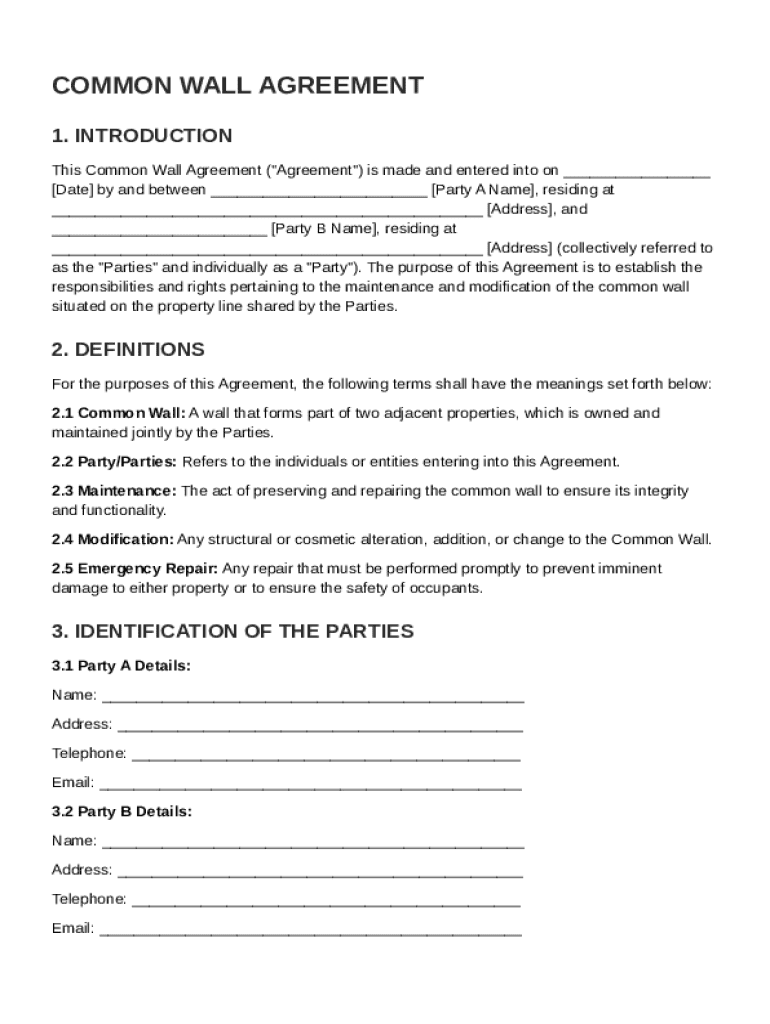
A Common Wall Agreement defines the responsibilities and rights related to a shared wall between two properties. This legal document establishes guidelines to manage the maintenance, modification, and use of the wall. It serves to prevent disputes by clearly outlining each party's obligations. Often critical for residential or commercial properties with adjoining walls, this agreement ensures both parties can access and maintain the wall properly without infringing on each other's rights.
Key Elements of the Common Wall Agreement Template
Description of the Common Wall
- Defines the location and physical characteristics of the shared wall.
- Outlines the wall's boundaries to ensure clarity on ownership and maintenance responsibilities.
Maintenance and Cost-Sharing Provisions
- Establishes how maintenance tasks and related costs are split between the parties.
- Includes detailed procedures for routine and urgent repairs.
Access and Modification Rights
- Details the access rights each party has to the wall for maintenance or modification.
- Specifies the extent to which modifications are permitted, ensuring both parties agree on changes.
Dispute Resolution Mechanisms
- Provides a framework for resolving disagreements without legal conflict.
- May include mediation or arbitration procedures as a first step before litigation.
Steps to Complete the Common Wall Agreement Template
Preparation and Information Gathering
- Collect necessary information such as property boundaries, legal descriptions, and owner details.
- Identify and outline any specific needs or conditions that must be included in the agreement.
Drafting the Agreement
- Complete the template sections with accurate information about the wall and involved parties.
- Review legal guidelines or seek legal counsel to ensure compliance with local laws.
Review and Agreement
- Both parties should review the draft together to ensure mutual understanding and acceptance.
- Make revisions if necessary and have the document reviewed by a legal professional.
Signing and Storing
- Once finalized, both parties should sign the agreement.
- Store copies of the signed document for future reference and legal protection.
How to Use the Common Wall Agreement Template
Customization and Adaptation
- Personalize the template to reflect specific arrangements between the parties.
- Ensure that unique property details and maintenance agreements are accurately documented.
Legal Considerations
- Make sure the template complies with local jurisdiction laws regarding shared property structures.
- Always consider having the agreement reviewed by a property or real estate attorney for validity and enforceability.
Important Terms Related to the Common Wall Agreement Template
Shared Boundary
- Refers to the demarcation line dividing two properties that the common wall straddles.
Easement Rights
- These are legal rights permitting one property owner to use a portion of another's property for a specific purpose, such as maintenance access.
Liability
- Defines the responsibilities of each party concerning potential damage to the common wall or surrounding property.
Legal Use of the Common Wall Agreement Template
Compliance with Local Laws
- Ensure that the agreement is drafted in accordance with state and local laws and regulations on shared structures.
Enforceability
- Legal provisions within the agreement must be clear and precise to uphold enforceability in court should disputes arise.
State-Specific Rules for the Common Wall Agreement Template
- Different states may have unique laws regarding shared structures; therefore, consulting state codes or a local attorney is advisable.
- Compliance with state-specific requirements can ensure the agreement holds up in legal disputes.
Who Typically Uses the Common Wall Agreement Template


Residential Property Owners
- Neighbors with adjoining homes who share a boundary wall.
Commercial Real Estate
- Businesses occupying units in a shared building, such as a strip mall or office complex.
Real Estate Developers
- Companies developing properties where shared walls will be constructed and maintained.