






Definition & Meaning
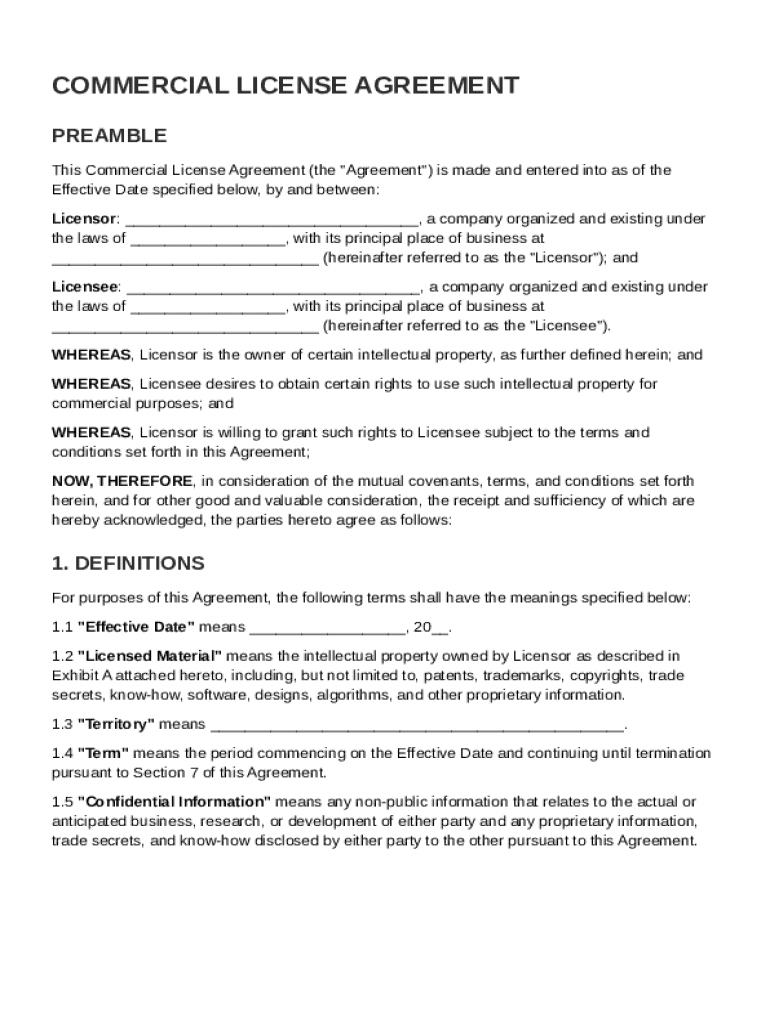
A "Commercial License Agreement Template" serves as a foundational legal document that outlines the specific terms under which a licensor provides permission to a licensee for using certain intellectual property for commercial purposes. This agreement typically covers the ownership details of the intellectual property, the licensee's rights and limitations, payment obligations such as fees and royalties, and confidentiality clauses. Understanding these elements is crucial for any entity wishing to engage in a business relationship involving intellectual property, ensuring that both parties are clear on their rights and responsibilities.
Key Elements of the Commercial License Agreement Template
This template encompasses several critical components that need to be addressed to create a legally sound agreement.
- Designation of Parties: Clearly defines the roles and identities of the licensor and licensee.
- Scope of License: Details what rights are granted, such as manufacturing, distribution, or sales, and under what conditions.
- Compensation and Royalties: Specifies payment terms and potential royalties, payment schedules, and calculations.
- Duration and Termination: Indicates the time frame of the agreement and the conditions under which it can be terminated.
- Confidentiality Obligations: Outlines the responsibilities concerning the handling of confidential information.
- Dispute Resolution: Provides mechanisms for resolving conflicts that might arise during the term of the license.
These elements collectively ensure a comprehensive understanding between the contractual parties, reducing the possibility of future conflicts.
Steps to Complete the Commercial License Agreement Template
Filling out this template involves a series of well-defined steps, ensuring accuracy and completeness.
- Identify the Parties: Clearly state the legal names of both the licensor and licensee.
- Define the Scope: Specify detailed descriptions of what the license covers, including any restrictions.
- Determine Compensation: Calculate any fixed fees, royalty percentages, and set the payment schedule.
- Set the Duration: Determine the start date, duration, and conditions for renewal or termination.
- Add Confidentiality Terms: List all confidential information and outline how it should be protected.
- Detail Dispute Resolution Methods: Specify mediation, arbitration, or litigation as the means for conflict resolution.
- Analyze and Review: Have legal professionals review the drafted agreement to ensure compliance with all applicable regulations.
Why Use a Commercial License Agreement Template
Utilizing a commercial license agreement template is beneficial for both licensors and licensees, serving as a practical guide to structuring their business relationships effectively.
- Clarity of Terms: Provides clear demarcation of rights and duties, preventing misunderstandings.
- Legal Protection: Establishes legally binding terms that protect both parties.
- Efficiency: Saves time by providing a ready framework that only needs specific details filled in.
These advantages make the template an essential tool for businesses involved in the commercial utilization of intellectual property.
Business Types That Benefit Most from Commercial License Agreement Template
Certain business types find particular benefit from using a commercial license agreement template:
- Technology Companies: For software licenses and patents.
- Entertainment Industry: Licensing of media content, such as films, music, and artwork.
- Manufacturing Firms: Production rights and technology patents.
- Franchisors: Allowing franchisees to use business processes and trademarks.
These business categories leverage such agreements to safeguard their interests while facilitating the growth potential offered by licensing arrangements.
Legal Use of the Commercial License Agreement Template
In the U.S., the legal enforceability of a commercial license agreement hinges on the accurate drafting and execution within the framework provided by applicable federal and state laws.
- Compliance with the Uniform Commercial Code (UCC): Ensures the contract complies with relevant UCC provisions.
- Adherence to Intellectual Property Laws: Aligns with the laws governing copyrights, patents, trademarks, and trade secrets.
- State-Specific Laws: Considers variances in state laws that might affect contractual obligations and rights.
Awareness and understanding of these legal nuances are crucial to ensure the template fits the specific legal needs of the parties involved.
Who Typically Uses the Commercial License Agreement Template
A variety of parties may find themselves needing to utilize such a template:
- Corporations: Especially those involved in technology and innovation.
- Individuals: Artists, authors, and inventors seeking to license their creations.
- Startups: Companies launching products that rely on patented technologies.
Engaging through this template helps these parties secure and outline their respective roles and interests within a legally recognized context.


Examples of Using the Commercial License Agreement Template
Real-world scenarios help illuminate typical applications of the template:
- Software Licenses: A company licenses its software to a governmental organization for use in various departments, outlining use limitations and support provisions.
- Manufacturing Rights: A machinery company grants rights to another business to manufacture parts using its patented designs, specifying quality standards and royalty payments.
- Music Publishing: An artist licenses their song for commercial use in advertising, setting parameters around usage and distribution rights.
These examples show the practical application and advantages of having a well-structured commercial license agreement in place.