




01. Edit your form online
Type text, add images, blackout confidential details, add comments, highlights and more.

Type text, add images, blackout confidential details, add comments, highlights and more.

Draw your signature, type it, upload its image, or use your mobile device as a signature pad.

Send it via email, link, or fax. You can also download it, export it or print it out.
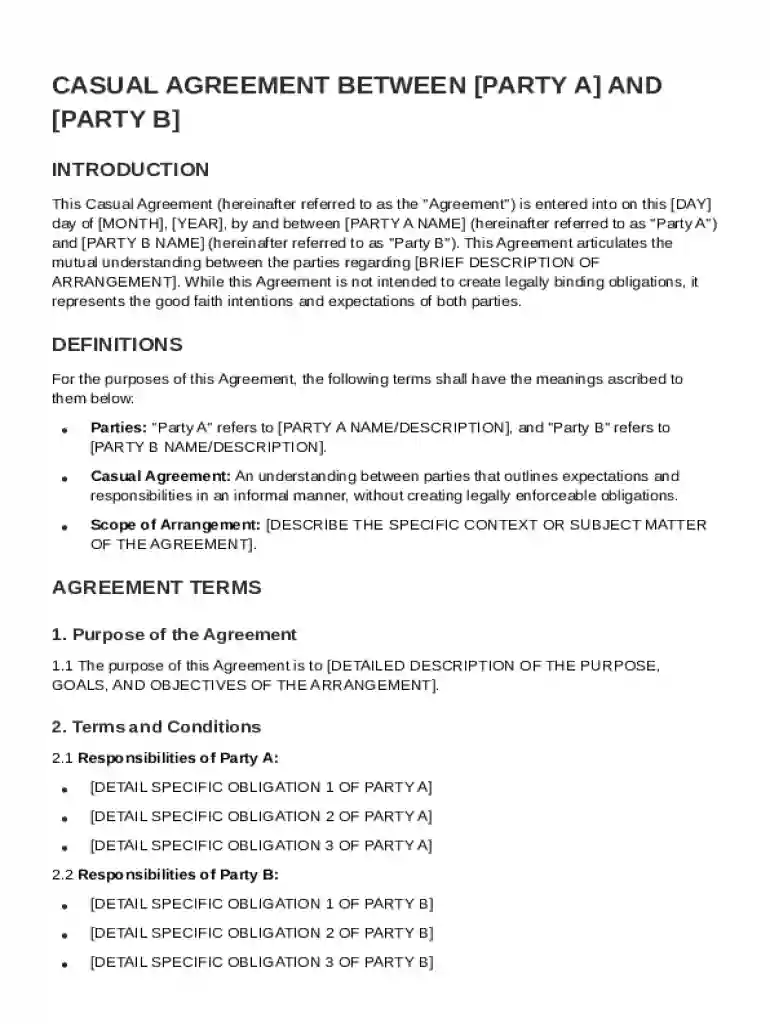
A Casual Agreement Template serves as a foundational document designed to outline the mutual agreements between two parties. This unofficial contract does not carry legal enforceability but provides a structured format for partners wishing to delineate roles and responsibilities clearly. It often includes the agreement's purpose, the responsibilities assigned to each party, and communication protocols, ensuring that both parties have a shared understanding of their involvement in the partnership.
Using the Casual Agreement Template requires a careful approach to detail and clarity. Start by identifying each party involved in the agreement, then proceed to outline the specific obligations and responsibilities each will handle. It’s imperative to include sections that address communication guidelines and dispute resolution procedures. By utilizing the template, both parties can ensure all relevant topics are systematically covered, reducing misunderstandings and fostering a cooperative working relationship.
Each Casual Agreement Template incorporates key elements crucial to its effective use:
By including these elements, the template ensures a comprehensive understanding between parties of their roles and expectations.
Identify the Parties: Begin by listing the parties involved in the agreement.
Define the Agreement's Purpose: Articulate the objectives and goals of the casual partnership.
Outline Responsibilities: Clearly describe each party's duties and roles.
Set Communication Guidelines: Develop a framework for communication, including frequency and mediums used.
Detail Dispute Resolution Methods: Provide a mechanism for amicably resolving disputes, should they arise.
Specify Terms for Modification and Termination: Craft clauses detailing how changes can be made or how the agreement may be ended.
Finalize and Review: Review the completed agreement with all involved parties, making revisions if necessary to ensure clarity before acknowledgment and signing.
The Casual Agreement Template is commonly employed by independent contractors, freelancers, and small business owners who engage in temporary or informal partnerships. It is also popular among creative collaborators, such as artists and writers, who want a documented understanding with partners without the rigidity of a formal agreement. Its flexibility and simplicity make it a preferred choice for those seeking efficient and understandable documentation of mutual agreements.


While a Casual Agreement Template is inherently informal and not legally binding, it can serve as a reference point that parties can use in resolving disagreements. It reflects the good faith intentions of both parties involved. In legal contexts, it may help demonstrate that parties had established expectations and communicated clearly about their roles, although it cannot be enforced like a formal contract.
Several key terms are frequently associated with the Casual Agreement Template:
Understanding these terms helps users effectively draft and comprehend their agreements.
Consider several scenarios where a Casual Agreement Template might be used:
Freelance Collaborations: When a graphic designer and a copywriter collaborate on a project, they can use a casual agreement to define each person's role and share revenue.
Temporary Partnerships: Entrepreneurs can draft a casual agreement to outline terms for a short-term joint venture, such as hosting a joint event.
Creative Endeavors: Artists working together on an exhibition can document their contributions and shared responsibilities through a casual agreement to prevent future misunderstandings.
Each example illustrates how a Casual Agreement Template can serve multiple professional fields, providing flexibility and clarity.
State laws can influence the application and efficacy of casual agreements. While the document itself remains informal, variations in state laws regarding the recognition of such agreements might exist. For example, some states may have stricter guidelines on what constitutes partnership agreements. It's advisable for parties using a Casual Agreement Template to be aware of specific state regulations that might impact their agreement's interpretation and ensure it aligns with their local jurisdiction.
At DocHub, your data security is our priority. We follow HIPAA, SOC2, GDPR, and other standards, so you can work on your documents with confidence.


