




01. Edit your form online
Type text, add images, blackout confidential details, add comments, highlights and more.

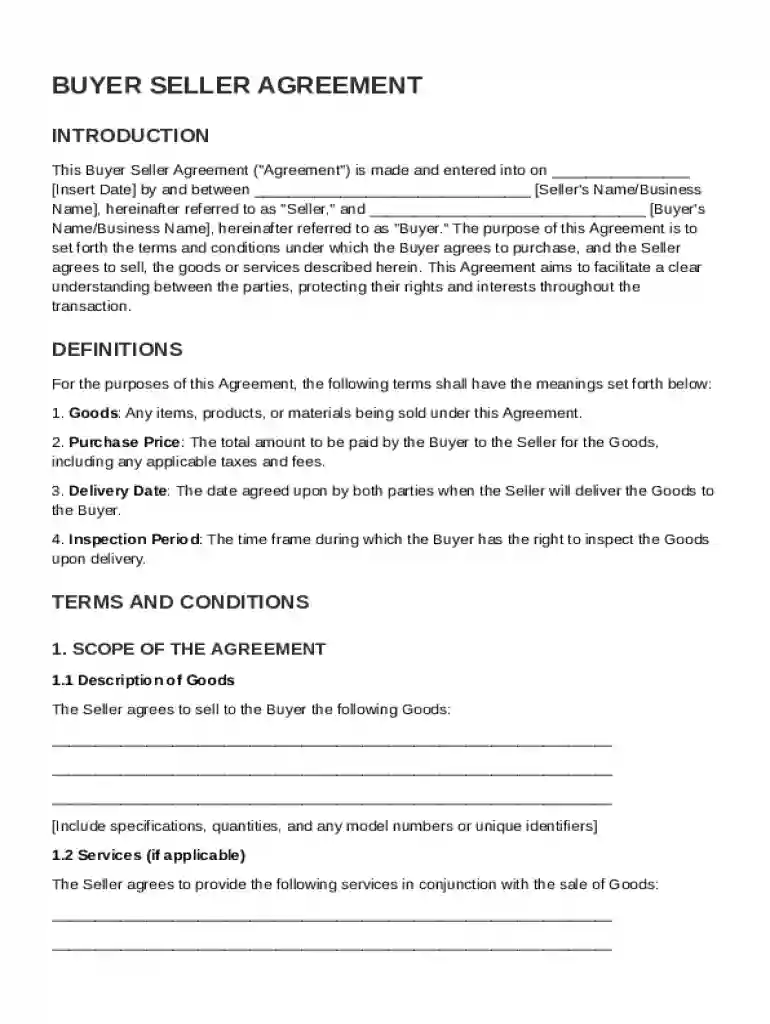
Type text, add images, blackout confidential details, add comments, highlights and more.

Draw your signature, type it, upload its image, or use your mobile device as a signature pad.

Send it via email, link, or fax. You can also download it, export it or print it out.
A Buyer Seller Agreement Template serves as a foundational legal document outlining the specific terms and conditions of a transaction between a buyer and a seller. This agreement typically includes pertinent details such as purchase price, payment terms, delivery schedules, inspection rights, warranties, liabilities, termination clauses, governing law, and dispute resolution procedures. Its primary function is to protect the interests of both parties involved in the transaction, ensuring clarity and mutual understanding of the obligations and rights throughout the process. Variations can occur based on the nature of the transaction—whether it involves goods, services, or both—but the core purpose remains the same: facilitating a seamless and legally enforceable exchange.
Review and Customize the Template: Begin by thoroughly reading the template to understand the standard terms and provisions. Modify sections as necessary to reflect the specific details of your transaction. Ensure that all aspects of the sale, from pricing to delivery conditions, are accurately detailed.
Add Specific Terms: Incorporate any additional terms or conditions particular to your transaction, such as custom payment plans or unique delivery requirements. Clearly outline these conditions to prevent misunderstandings.
Obtain Mutual Consent: Both parties should review the amended document to ensure mutual understanding and agreement. Any revisions should be discussed, agreed upon, and documented explicitly in the agreement.
Finalize and Sign: Once both parties are satisfied with the document, signatures from all involved parties are required to make the agreement legally binding. Consider obtaining electronic signatures for efficiency and record-keeping.
Identification of Parties: Clearly state the names and contact information of the buyer and seller involved in the transaction.
Description of Goods or Services: Provide a detailed description of the goods or services being exchanged, including quantity, quality, and specifications to avoid ambiguity.
Purchase Price and Payment Terms: Outline the agreed purchase price, along with payment methods and timelines. Include any installment plans or late payment penalties if applicable.
Delivery and Inspection Terms: Specify delivery methods, locations, and timelines. Include provisions for inspection rights and procedures for acceptance or rejection of goods.
Warranties and Liabilities: Detail any warranties offered by the seller and outline the extent of liability for defects or other issues arising post-sale.
Termination Conditions: Define the circumstances under which the agreement may be terminated by either party, including breach of contract or mutual agreement.
A Buyer Seller Agreement Template must align with applicable state and federal laws to be enforceable. This includes adhering to the Uniform Commercial Code (UCC) for goods transactions and understanding any state-specific variations. Both parties should ensure that the agreement's terms comply with legal standards to protect their rights and allow for legal recourse if necessary. Consulting with a legal professional during the drafting phase can help identify potential compliance issues and mitigate risks.
Gather Information: Collect necessary details about the buyer, seller, and the goods or services involved in the transaction.
Draft Initial Agreement: Using the template, draft the initial agreement by filling in basic information and standard terms.
Customize Provisions: Modify sections to suit your transaction specifics, ensuring all unique terms are included.
Review with Stakeholders: Share the draft with involved parties (and legal advisors if applicable) for review and feedback.
Finalize Agreement: Incorporate agreed changes, ensuring accuracy and completeness before finalizing.
Sign and Distribute Copies: Once signed by both parties, retain copies of the agreement for record-keeping and future reference.
Different states may have specific regulatory requirements and standards that affect the enforceability of buyer-seller agreements. These could include additional consumer protection laws, specific disclosure requirements, or unique tax implications. Consequently, parties engaged in interstate commerce should verify that their agreement addresses state-specific legal nuances to prevent disputes and ensure full legal compliance.
Real Estate Transactions: A buyer-seller agreement can be used to outline terms for purchasing residential or commercial properties, detailing aspects like property condition, closing dates, and contingencies.
Business Acquisitions: For acquiring a business, the agreement will cover complex elements like asset transfers, intellectual property rights, and employee agreements.
Service Contracts: Service providers and clients can use this form to specify scope of work, deadlines, and payment schedules for professional services rendered.
DocHub's flexibility allows integration with various software platforms, ensuring streamlined workflow across different systems. Users can import the Buyer Seller Agreement Template into DocHub from cloud storage services or directly from their devices, enabling quick edits and collaboration. The platform's compatibility with major file formats, such as PDF, DOC, and XLS, ensures seamless integration and document management, enhancing productivity and reducing technical barriers when creating and finalizing agreements.
At DocHub, your data security is our priority. We follow HIPAA, SOC2, GDPR, and other standards, so you can work on your documents with confidence.


