Definition and Meaning
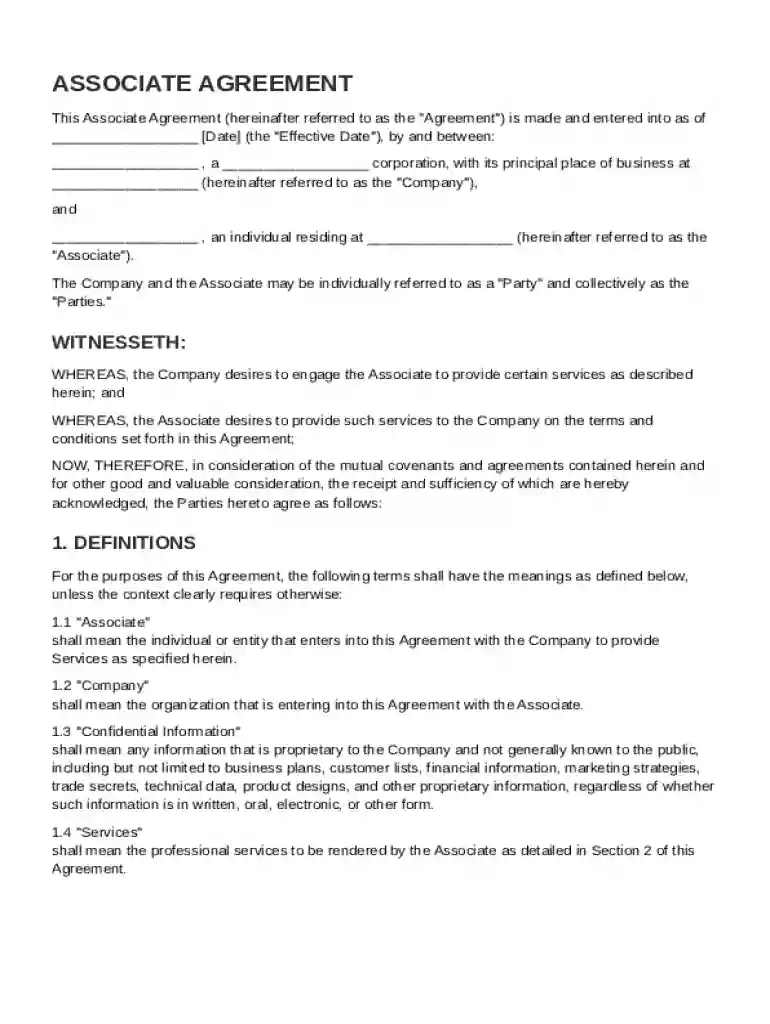
The Associate Agreement Template serves as a formal document that outlines the specific terms under which an individual, referred to as the Associate, provides services to a corporation. It distinguishes the relationship as one of independent contractor rather than employment. This template is vital in setting clear expectations and legal obligations, providing clarity on roles, responsibilities, and the working relationship between the parties involved.
Key Components
- Terms and Conditions: The document includes comprehensive terms and conditions necessary for outlining the agreement's framework.
- Scope of Services: It defines the nature and scope of services that the Associate will provide and may include a timeline for delivery.
- Relationship Designation: Clearly states that the arrangement is not an employment relationship but an independent contractor role.
This foundational information ensures that both parties are aware of their commitments and the contractual nature of the engagement, deterring possible misconceptions or legal disputes.
Key Elements of the Associate Agreement Template
The template comprises various sections that address different aspects of the agreement process, ensuring a balanced approach to the professional relationship.
Main Sections
- Compensation Details: Outlines how and when the Associate will be compensated for their services, including payment structure and any potential bonuses or incentives.
- Confidentiality Obligations: Details the confidentiality expectations to safeguard any sensitive or proprietary information shared during the course of the agreement.
- Intellectual Property Rights: Specifies the ownership of any intellectual property created during the engagement, clarifying rights and permissions.
- Dispute Resolution Procedures: Establishes the method and process for resolving any disputes that may arise, often recommending mediation or arbitration as first steps.
These elements are crucial in protecting the interests of both the Associate and the Company, encouraging transparency and professional integrity.
Steps to Complete the Associate Agreement Template
Completing the template involves several focused steps that ensure all aspects of the agreement are thoroughly addressed.
Step-by-Step Process
- Gather Information: Collect all pertinent details, including personal information, scope of services, start and end dates, and payment terms.
- Fill Out the Template: Enter the required information into the sections of the template, ensuring clarity and accuracy for all terms listed.
- Review Legal Requirements: Verify that all legal obligations, particularly concerning confidentiality and intellectual property, are correctly incorporated into the document.
- Collaborative Review: Both parties should review and discuss the agreement to ensure mutual understanding and consensus about the terms.
- Sign and Date: Upon agreement, both the Associate and Company representative should sign and date the document for it to take effect officially.
Taking these steps guarantees that the agreement is both comprehensive and enforceable, minimizing potential risks or oversight.
How to Use the Associate Agreement Template
Using the template effectively requires understanding its format and how to integrate the provided terms with company-specific requirements.
Practical Application
- Customization: Tailor the template's sections to fit specific working arrangements or unique project requirements.
- Integration: Coordinate with existing company policies and procedures to ensure alignment and consistency across documents.
- Record Keeping: Maintain a filed copy of the completed agreement for reference, legal purposes, and compliance verification.
By adhering to these practices, users can ensure that the template is used optimally within the operational framework of the business environment.
Why Should You Use an Associate Agreement Template
Employing this template brings multiple advantages, notably in aligning expectations and legally safeguarding the engagement.
Benefits for Both Parties
- Clarity and Precision: Provides clear definitions and specific terms, reducing ambiguity around responsibilities and expectations.
- Legal Protection: Offers enforceable clauses that protect both parties against breaches or misunderstandings.
- Efficiency: Saves time and resources by providing a standardized document that requires minimal customization.
These benefits underline the template’s importance as an essential tool for professional collaborations.
Important Terms Related to the Associate Agreement Template
Several crucial legal terms are typically included within the template to ensure thoroughness and enforceability.
Legal Terminology
- Governing Law: Stipulates which jurisdiction’s laws will apply in the event of a dispute.
- Termination Clause: Details the conditions under which the agreement can be terminated by either party.
- Amendments: Describes the process for making changes to the agreement, ensuring that all modifications are documented and agreed upon by both parties.
These terms solidify the contractual commitments and provide mechanisms for addressing potential changes to the agreement.
State-Specific Rules for the Associate Agreement Template
Although the template can be broadly used, variations in state laws must be considered to ensure compliance and validity.
Jurisdictional Considerations
- State Compliance: Verify that the agreement adheres to all relevant state labor and contract laws where the services will be performed.
- Variation in Terms: Some states may require specific terms or language to be included or excluded, such as non-compete or non-solicitation clauses.
- Consultation with Legal Experts: Engaging legal counsel familiar with state-specific rules can help modify the template appropriately.
These considerations ensure that the agreement is not only robust but also legally compliant across different jurisdictions.
Examples of Using the Associate Agreement Template
Real-world scenarios illustrate the template’s practical application and utility in varied business contexts.
Practical Scenarios
- Freelance IT Consultant: An IT consultant providing specialized technical services to a startup may use the agreement to detail project milestones and payments.
- Marketing Specialist: A marketing specialist engaged to lead a short-term campaign for a company can define deliverables and timeline specifics in the agreement.
- Creative Design Services: A freelance designer hired to develop branding assets for a corporation would benefit from clearly outlined intellectual property terms.
These examples show how the template can be adapted across industries and professional relationships, emphasizing its versatility and usefulness.