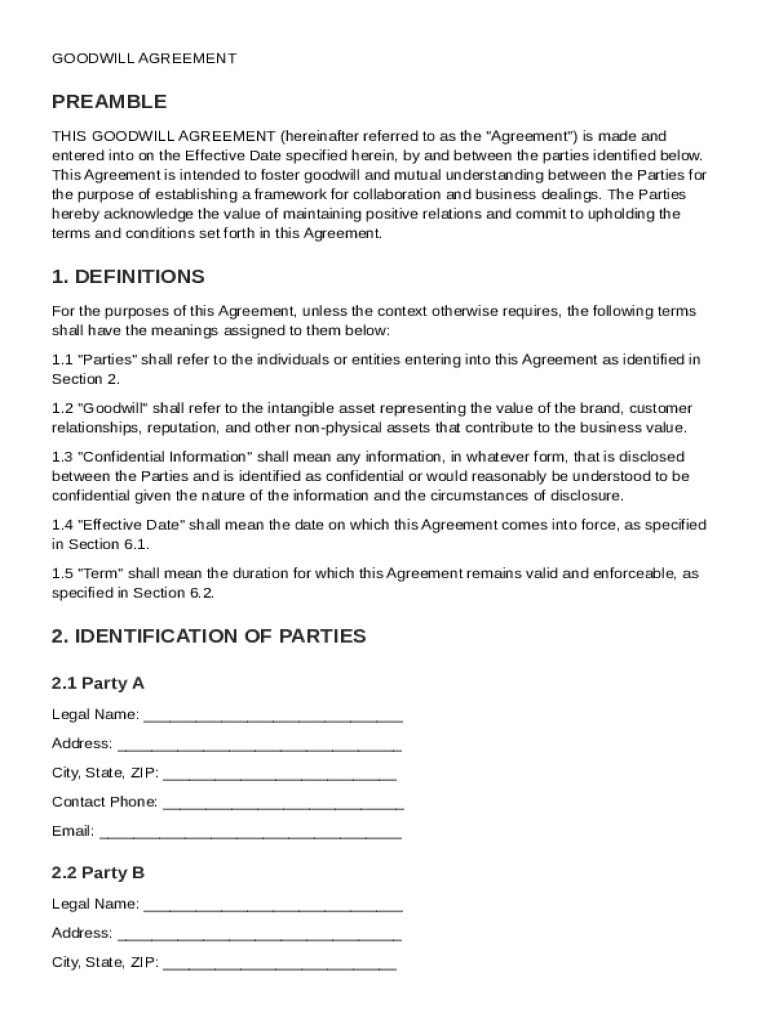







Definition & Meaning
A Goodwill Agreement Template is a structured document that outlines the framework for positive business relationships between two or more entities. Its primary focus is to maintain goodwill by defining roles, responsibilities, and mutual expectations. This agreement often includes clauses for confidentiality, support, and cooperation while serving as a guide for resolving disputes amicably. It is essential in ensuring that all parties involved have a shared understanding of the terms during the course of their collaboration, thereby fostering trust and transparency in business dealings.
Key Aspects of Goodwill
- Mutual Support: Emphasizes the importance of cooperation and assisting each other's business goals.
- Confidentiality: Stipulates non-disclosure of sensitive information to protect the interests of each party.
- Dispute Resolution: Provides mechanisms for resolving conflicts without damaging the relationship.
- Governing Law: Specifies the jurisdiction under which the agreement will be interpreted.
How to Use the Goodwill Agreement Template
When utilizing a Goodwill Agreement Template, parties should customize it to reflect their specific business needs and relationships. The template serves as a foundational document but requires tailored entries to suit unique circumstances.
Customization Steps
- Identify Parties: Clearly list all parties involved in the agreement.
- Define Terms and Responsibilities: Outline the specific roles and obligations of each party within the agreement.
- Set Conflicts Parameters: Include methods for resolving disagreements to maintain a positive relationship.
- Draft Closing Clauses: Finalize the document with signatures, indicating a formal commitment to the terms.
Practical Scenarios
- Partnership Establishment: A company and its supplier use the template to pledge mutual support and collaboration.
- Business Expansion: Companies entering new markets sign a goodwill agreement with local partners to ensure a smooth transition.
Steps to Complete the Goodwill Agreement Template
Completing a Goodwill Agreement Template involves a sequential process to ensure all essential components are accurately addressed and agreed upon by all parties.
Sequential Process
- Review and Understand Template: Thoroughly analyze the template to ensure familiarity with all sections and terminology.
- Gather Necessary Information: Compile details about the parties involved, including company names, addresses, and roles.
- Complete Initial Sections: Fill in introductory sections with accurate and comprehensive information about the parties involved.
- Detail Responsibilities: Clearly outline responsibilities and expectations from each party.
- Include Dispute Resolution: Define processes for resolving potential disputes.
- Final Review and Adjustments: Double-check all entries for accuracy and ensure that all parties agree with the terms.
- Formalize and Secure Signatures: Sign the document to signify agreement and enforceability.
Key Elements of the Goodwill Agreement Template
The Goodwill Agreement Template is comprehensive, covering several essential elements that contribute to its effectiveness in maintaining business relations.
Core Components
- Identified Parties: Lists all entities involved in the agreement.
- Term Duration: Specifies the period during which the agreement will be effective.
- Obligations: Details the specific duties and obligations of each party.
- Confidentiality Clause: Outlines expectations for non-disclosure of proprietary information.
- Dispute Resolution Methods: Establishes ways to amicably resolve disagreements.
Supplementary Sections
- Amendment Process: Describes how changes to the agreement can be made post-signature.
- Termination Conditions: Outlines under what circumstances the agreement can be ended.
Legal Use of the Goodwill Agreement Template
Legally, a Goodwill Agreement serves to formalize expectations and maintain cordial business relations. It is recognized in many jurisdictions as a binding document that carries legal obligations for the parties involved.
Legal Considerations
- Jurisdictional Compliance: Ensure the agreement aligns with local and national laws.
- Enforceability: The agreement must be clear, precise, and signed by all parties to be enforceable.
- Modifications: Any changes to the agreement should be documented and signed to maintain legal standing.
Examples of Using the Goodwill Agreement Template
Real-world usage of the Goodwill Agreement Template demonstrates its utility in various business settings.
Business Scenarios
- Corporate Alliances: Companies forming alliances to tackle projects or markets collaboratively.
- Supplier Agreements: Retailers and suppliers agreeing on terms to ensure steady supply and support.
- Joint Ventures: Multiple businesses agreeing on terms to collaborate on a specific project or product development.
Case Studies
- Technology Partnerships: Two tech firms use the template to manage joint software development projects.
- International Trade: Companies entering foreign markets with local enterprise support.
State-Specific Rules for the Goodwill Agreement Template
While the Goodwill Agreement Template is versatile, it may need modifications to comply with state-specific regulations in the U.S.
State Considerations
- Jurisdiction-Specific Laws: Variations in contract laws from state to state can affect the agreement's application and enforceability.
- Compliance Requirements: Certain states may require additional clauses related to business practices or dispute resolution.
State-by-State Differences
Each state may impose unique requirements that influence how a Goodwill Agreement Template is used and enforced. Recognizing these differences can help ensure compliance with local regulations and avoid potential legal issues.
Noteworthy Variations
- California: Emphasis on employee-related clauses might be more pronounced due to stringent labor laws.
- New York: Additional focus might be required for financial disclosure and obligations to meet state commerce regulations.
Understanding and addressing these state-specific nuances can lead to more robust and legally sound goodwill agreements.