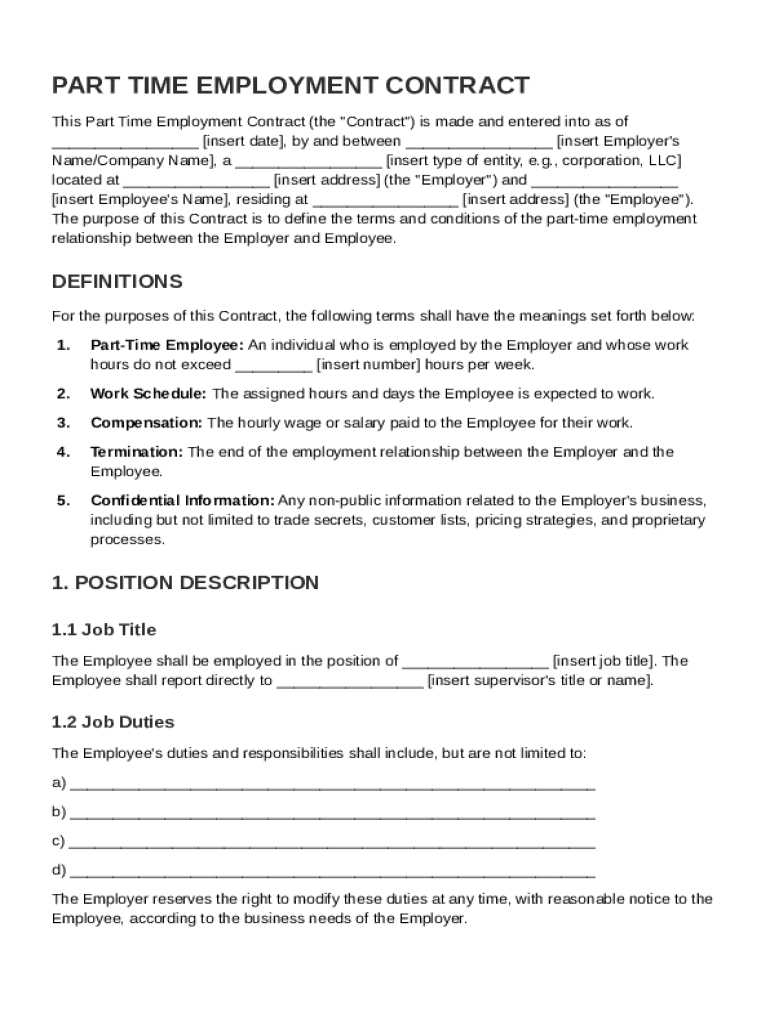







Definition and Meaning
A Part Time Employment Contract Template is a formal agreement outlining the terms of employment for an individual working part-time with an organization. This document serves to establish the rights and responsibilities of both the employer and the part-time employee. By clearly defining the nature of the working relationship, it helps prevent misunderstandings and disputes. Key elements of this contract include the job description, work hours, compensation, benefits eligibility, confidentiality obligations, and termination grounds. The objective is to ensure clarity and mutual understanding regarding the employment conditions and expectations.
How to Use the Part Time Employment Contract Template
Using a Part Time Employment Contract Template involves several straightforward steps to customize the document to fit specific employment situations. First, employers must accurately fill out both personal and organizational details. Next, the template should be adapted to explicitly outline the part-time employee’s role and responsibilities. This includes specifying work hours and locations, whether remote or on-site. Employers should also carefully define payment terms, such as hourly wages, pay periods, and methods of payroll processing.
- Identify Key Components: Review sections of the template such as job duties, employment period, and terms of part-time work.
- Customize Details: Tailor specific provisions like compensation rates, benefits, and the probationary period to match the employment agreement.
- Include Legal Disclaimers: Ensure your legal team evaluates the contract to incorporate essential legal language relevant to your industry or state.
- Final Review and Approval: Once all information is populated, both parties should review the document to ensure accuracy before finalizing.
Key Elements of the Part Time Employment Contract Template
The Part Time Employment Contract Template comprises several critical elements critical for constructing a comprehensive agreement:
- Job Description: Clearly outline the employee’s duties and responsibilities.
- Work Schedule: Specify the time commitment expected from the employee, including daily hours and part-time work days.
- Compensation: Detail salary expectations, how compensation is calculated, and the payroll schedule.
- Benefits Eligibility: Indicate any benefits the employee is entitled to, such as paid time off or health insurance.
- Confidentiality and Non-Disclosure: Include clauses ensuring the confidentiality of company information.
- Termination Conditions: Provide grounds on which the employment can be terminated and notice requirements.
This template serves as a flexible tool adaptable to various organizational needs while ensuring compliance with industry standards and legal regulations.
Legal Use of the Part Time Employment Contract Template
This template is legally binding and designed to conform to U.S. employment laws. It's essential to ensure that it complies with federal and state employment regulations, which may dictate specific disclosures or terms. Consulting with a legal professional is advised to modify particular clauses to align with state-specific labor laws. The contract helps safeguard employer interests by solidifying expectations and facilitating legal recourse if terms are breached.
- Compliance with Labor Laws: Ensure adherence to minimum wage standards and anti-discrimination laws.
- Adaptation for State Laws: Modify for variations in state-specific employment requirements, such as overtime rules and break policies.
Steps to Complete the Part Time Employment Contract Template
Completing the Part Time Employment Contract Template involves several steps, each critical for ensuring that the document comprehensively outlines the employment terms and is legally sound:
- Gather Information: Obtain all necessary personal and professional details of the employer and employee.
- Entry of Details: Input job title, duties, and hours, ensuring alignment with company policy.
- Specify Terms: Elaborate on remuneration and employment duration particulars.
- Include Confidentiality Clause: Add any proprietary or sensitive business information clauses as necessary.
- Review Regulations: Cross-check compliance with labor regulations specific to your state.
- Finalization and Signing: Ensure both parties review and sign the document to validate mutual understanding of terms.
Important Terms Related to Part Time Employment Contract Template
Understanding the critical terminology associated with a Part Time Employment Contract Template is essential to properly managing the document:
- Probationary Period: A set duration at the start of employment during which assessment of the employee's suitability occurs.
- At-Will Employment: Employment status implying that the employer or employee may terminate the arrangement at any time.
- Non-Compete Clause: A provision that restricts the employee from working with competitors for a specified period after leaving employment.
- Remuneration Package: Includes the total compensation, covering salary and benefits offered to the employee.
State-Specific Rules for the Part Time Employment Contract Template
State laws can significantly impact the particulars of a Part Time Employment Contract, requiring careful consideration of regional employment rules. States may impose unique provisions or conditions regarding employment contracts, such as:
- Minimum Wage Requirements: Each state may have different standards that surpass federal requirements.
- Overtime Laws: States like California have specific rules on how overtime is calculated for part-time employees.
- Rest Breaks and Meal Periods: Some states mandate specific rest and meal periods depending on the work hours scheduled.
- Paid Leave: Variations exist in laws governing sick leave and family medical leave, which can affect part-time arrangements.
Who Typically Uses the Part Time Employment Contract Template
This template is used by a wide range of stakeholders in the business environment:
- Small to Medium Enterprises (SMEs): Frequently use part-time contracts to manage staff flexibility and economic efficiency.
- Retail and Hospitality Sectors: Industry sectors with fluctuating demands often employ part-time workers to accommodate peak periods.
- Non-Profits and Charities: Organizations balancing limited budgets and volunteer roles may find part-time contracts beneficial.
- Educational Institutions: Utilize part-time positions for adjunct teaching roles and administrative assistants.
Employers and HR departments leverage these contracts to define clear roles, leading to increased employee satisfaction and reduced turnover rates.