




01. Edit your form online
Type text, add images, blackout confidential details, add comments, highlights and more.

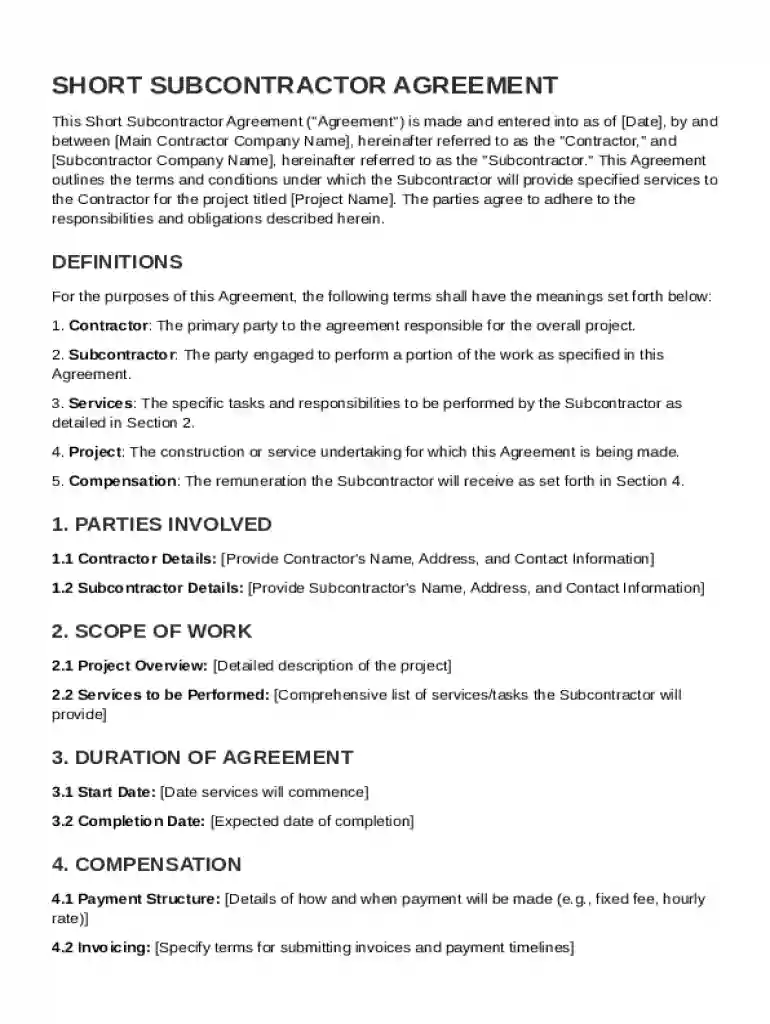
Type text, add images, blackout confidential details, add comments, highlights and more.

Draw your signature, type it, upload its image, or use your mobile device as a signature pad.

Send it via email, link, or fax. You can also download it, export it or print it out.
The Short Subcontractor Agreement Template is designed to formalize the relationship between a contractor and a subcontractor for specific services related to a project. The agreement spells out the terms and conditions such as the scope of work, compensation, duration of the contract, and obligations of both parties. It aims to establish clear expectations and protect the interests of both the contractor and the subcontractor.
A well-defined subcontractor agreement helps prevent misunderstandings and disputes by making sure both parties are on the same page regarding their responsibilities and expectations.
Understanding the essential components of the Short Subcontractor Agreement Template is crucial as they define the framework of the contractor-subcontractor relationship.
Completing a Short Subcontractor Agreement Template involves several important steps to ensure both parties' obligations are clearly documented.
By carefully completing each of these steps, both the contractor and subcontractor can establish a strong basis for a working relationship.
The Short Subcontractor Agreement Template serves as a legally binding document, ensuring that both parties are legally obliged to follow the terms outlined within it.
The proper use of this template can help secure legal protection and provide a clear recourse in case of disputes.
Different states may have specific requirements that must be considered when drafting a subcontractor agreement.
Understanding and incorporating state-specific rules can prevent future legal challenges and ensure compliance with local laws.
Using a Short Subcontractor Agreement Template is crucial for several reasons.
This template is especially important for projects where clear communication and precise terms are necessary for success.
This type of agreement is commonly used by various parties across different sectors.
Entities across many industries leverage this template to formalize working relationships with subcontractors.


Tools like DocHub enhance the efficiency of handling subcontractor agreements through seamless document management features.
Using software like DocHub can simplify the process of managing subcontractor agreements, improving both efficiency and accessibility.
At DocHub, your data security is our priority. We follow HIPAA, SOC2, GDPR, and other standards, so you can work on your documents with confidence.




Contractor acknowledges that Owner reserves the right to reject Contractors proposed subcontractors on any reasonable basis, with no adjustment in the ContractRead more
Jul 3, 2026 Use this beginner guide to review a clothing manufacturing agreement, from specs and lead times to payment, QC, bDocHub terms, and IP.


