Definition & Meaning
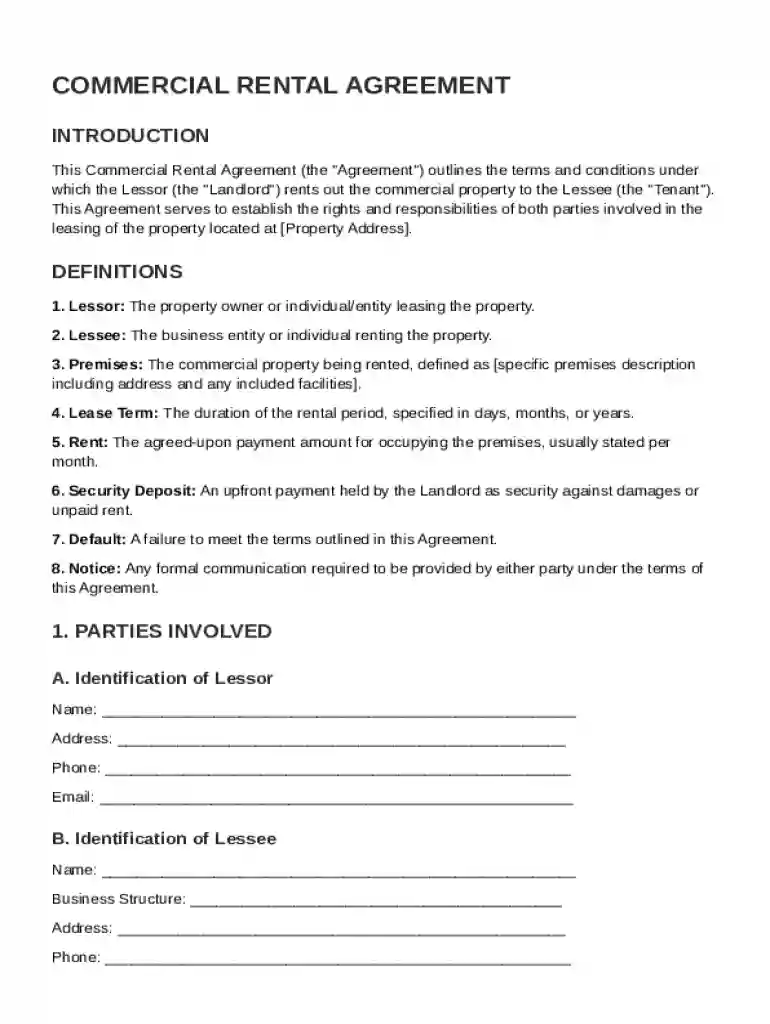
A Commercial Rental Agreement Template is a legal document that outlines the terms and conditions for leasing a commercial property, including the obligations of the landlord (lessor) and the tenant (lessee). It serves as an essential framework to define the relationship between both parties and includes crucial details such as rental terms, space usage, and other critical provisions. This template is particularly useful for creating a consistent and legally sound agreement that both parties fully understand and acknowledge.
Key Elements in the Template
- Parties Involved: Clearly identifies the landlord and tenant.
- Property Description: Details of the commercial space being leased.
- Lease Term: Specifies the duration of the lease.
- Rent Payment Details: Outlines payment amounts, due dates, and acceptable payment methods.
Steps to Complete the Commercial Rental Agreement Template
The process of completing a Commercial Rental Agreement Template requires attention to detail to ensure all legal and financial aspects are covered. Follow these steps for an effective completion:
- Gather Information: Collect all pertinent data, including contact information for both the landlord and tenant as well as specifics about the commercial property.
- Fill in Lease Terms: Detail the start and end dates of the lease, along with any renewal options if applicable.
- Specify Rent Details: Include rent amount, frequency, and any adjustments or late fees.
- Include Security Deposit Information: State the deposit amount and conditions for its return.
- Outline Responsibilities: Define which party is responsible for repairs and maintenance.
Example Scenarios
- A small business owner leasing retail space in a mall can ensure clarity on rent increases over the lease term.
- A startup renting an office can use the template to specify access to shared facilities.
Key Elements of the Commercial Rental Agreement Template
A comprehensive Commercial Rental Agreement Template should include several key elements to safeguard the interests of all parties involved:
- Insurance Obligations: Details which insurance policies the tenant must carry.
- Indemnification Clauses: Protects each party from liabilities due to the other's actions.
- Use of Property: Specifies allowable uses of the leased premises, ensuring no unauthorized use.
- Termination Conditions: Outlines conditions under which the lease may be terminated prematurely.
- Governing Law: Indentifies the jurisdiction that will govern the agreement.
Detailed Overview
- Maintenance Responsibilities: Specifies who covers routine maintenance costs.
- Default Conditions: Defines what constitutes a breach and subsequent repercussions.
State-Specific Rules for the Commercial Rental Agreement Template
To ensure the template complies with local laws, it’s crucial to recognize that requirements may vary from one state to another in the U.S. The Commercial Rental Agreement Template should be tailored for:
- Security Deposit Regulations: Each state has specific rules about the maximum amount and handling of security deposits.
- Notice Periods: Varies by state for lease termination or renewal.
- Permitted Clauses: Some states prohibit certain clauses that might be allowed elsewhere.
Considerations
- Review specific state laws before finalizing the agreement to prevent legal discrepancies.
- Consult a local attorney if uncertain about any state-specific requirements.
Legal Use of the Commercial Rental Agreement Template
Compliance with legal standards is paramount when using a Commercial Rental Agreement Template. Its use must align with the following:
- ESIGN Act and Uniform Electronic Transactions Act (UETA): Ensuring signatures and electronic transactions meet legal requirements.
- Fair Housing Laws: Adhering to regulations that prevent discrimination in leasing agreements.
Practical Examples
- Ensuring proper disclosures are included, such as zoning laws or property conditions.
- Utilizing electronic signatures that are binding and recognized nationwide.
Software Compatibility with the Commercial Rental Agreement Template
For a seamless document workflow, this template should be compatible with various software solutions, ensuring easy editing and sharing:
- DocHub Integration: Allows importing and exporting from platforms like Google Drive.
- Formats Supported: Ensure compatibility with formats like PDF, DOC, and TXT, making it adaptable for various business needs.
Benefits
- Efficiency: Streamlines document edits and signature collections.
- Accessibility: Provides multi-platform accessibility, supporting collaborative arrangements.
Business Types That Benefit from Using the Commercial Rental Agreement Template
Different business entities can greatly benefit from a well-structured Commercial Rental Agreement Template:
- Retail Chains: Require standardized agreements for multiple locations.
- Office Spaces: For shared spaces or single-tenant facilities.
- Industrial Facilities: Offer clarity on storage and operational use conditions.
Examples
- A franchise might use a consistent template for leases across various states.
- Tech startups can customize templates to fit co-working space agreements.
Why Use the Commercial Rental Agreement Template?
The importance of utilizing this template cannot be overstated for both legal and practical reasons:
- Clarity: Provides a clear understanding of each party’s duties and rights.
- Risk Management: Minimizes disputes by outlining all terms explicitly.
- Legal Protection: Ensures all contractual aspects are enforceable under law.
Advantages
- Time-Saving: Reduces the time needed to draft a new agreement from scratch.
- Consistency: Maintains uniformity across multiple agreements within a portfolio.