






Understanding the Employee Free Choice Act
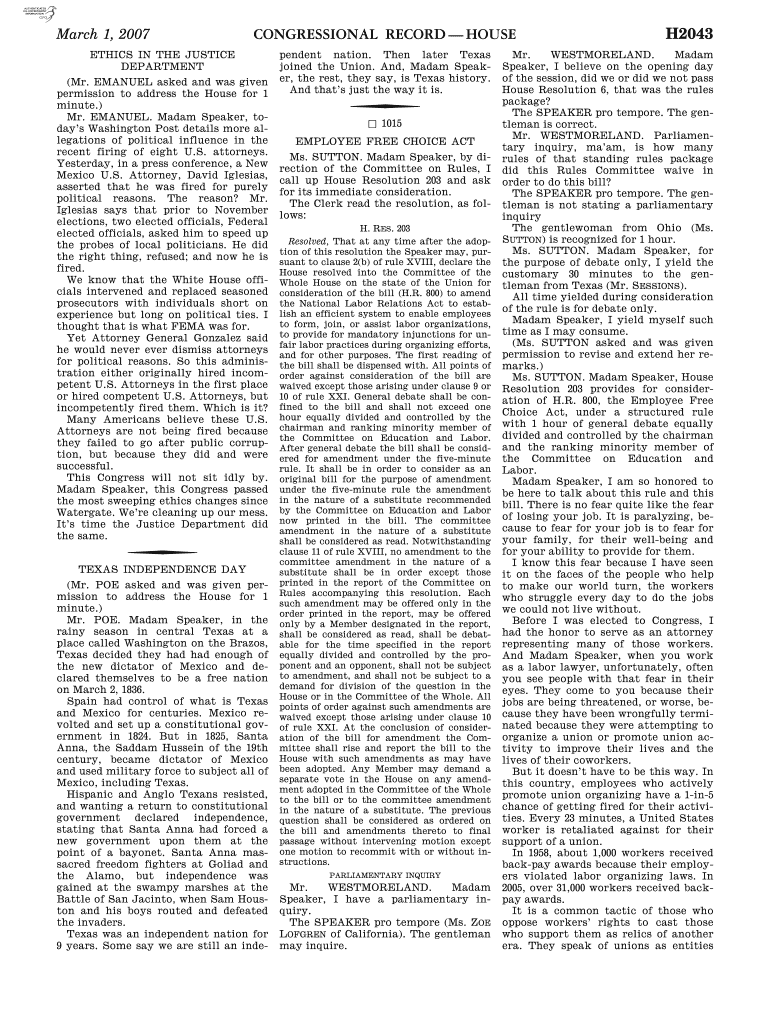
The Employee Free Choice Act, officially known as H.R. 800, is a significant legislative proposal aimed at strengthening workers' rights to organize and engage in collective bargaining. Its primary focus is on facilitating a majority sign-up process for union recognition, which allows workers to form a union if a majority expresses support through signature collection. This provision is intended to streamline union formation, making it easier for employees to collectively bargain for better wages and working conditions.
Key Elements of the Employee Free Choice Act
Several vital components define the Employee Free Choice Act, each designed to address specific hurdles faced by workers seeking unionization. Notably, the act proposes increased penalties for employers who engage in practices that violate labor laws, such as intimidation or retaliation against employees participating in union activities. The legislation also introduces provisions for mediation and arbitration in situations where employers and newly formed unions encounter difficulties negotiating a first contract.
- Majority Sign-Up Process: Enables union certification based on majority support.
- Increased Penalties: Stricter consequences for employers violating labor rights.
- Mediation and Arbitration: Intervention options to facilitate first contract negotiations.
Steps to Implement the Employee Free Choice Act
Should the act become law, its implementation would require several procedural steps. First, workers interested in forming a union would need to gather signatures from a majority of the workforce. Upon meeting this requirement, the union could request certification from the National Labor Relations Board. Employers would then need to recognize the union and commence negotiations. If an agreement on a first contract is not reached within a specified timeframe, mediation or arbitration would be mandated.
- Collect Worker Signatures: Demonstrate majority support for union formation.
- Seek Union Certification: Submit collected signatures to the appropriate authorities.
- Engage in Negotiations: Employers and the union begin contract discussions.
- Utilize Mediation/Arbitration: Enlist external help if negotiations stall.
Importance of the Employee Free Choice Act
The act plays a critical role in empowering workers and encouraging fair labor practices. By simplifying the unionization process and holding employers accountable for unlawful conduct, it aims to mitigate intimidation tactics commonly faced by employees. Proponents believe the act will lead to strengthened unions, improved worker conditions, and a fortified middle class through elevated bargaining power.
Target Audience for the Employee Free Choice Act
Primarily, the constituents that benefit from the act are workers in industries where unionization is feasible yet hindered by management resistance. This includes sectors such as manufacturing, retail, and services. Additionally, the act is supported by labor unions, worker advocacy groups, and some policymakers seeking to advance workers' rights and improve economic conditions.
Sectors Benefiting Most:
- Manufacturing
- Retail
- Services
Common Terms Associated with the Employee Free Choice Act
Understanding the act requires familiarity with several core terms that frequently appear in discussions:
- Collective Bargaining: Negotiation process between employers and a group of employees aimed at agreements to regulate working conditions.
- Union Certification: A legal recognition that grants a labor union the right to represent a group of workers.
- Mediation: A voluntary process involving a neutral third party helping disputing parties to reach a mutual agreement.
- Arbitration: A binding process where an arbitrator imposes a solution after considering both sides.
Legal Framework Surrounding the Employee Free Choice Act
The legal implications of the Employee Free Choice Act are significant, particularly in how it modifies existing labor laws. By compelling adherence to fair practices and instituting enhanced employer penalties, the act seeks to reinforce compliance with the principles of the National Labor Relations Act. Legal experts foresee potential challenges to the act, particularly around its provision concerning the majority sign-up process, which some critics argue could marginalize the role of secret ballot elections.
Examples of the Employee Free Choice Act in Practice
While the act has yet to be enacted into law, hypothesized scenarios illustrate its potential impact:
- Case of Suppressed Unionization: In workplaces where management aggressively prevents union activities, the act would serve as a corrective measure by penalizing such tactics.
- Streamlined Union Formation: Employees in a retail chain successfully sign up the majority, leading to efficient union establishment and subsequent negotiating power for better wages.
Business Entity Impacts and Considerations
Businesses, particularly larger corporations, may experience varying implications with the enactment of the act. For some, this means adapting to increased compliance needs and preparing for potential union negotiations. Companies must evaluate current employee relations practices and make necessary adjustments to align with the proposed legal framework.
Business Types:
- Large Corporations
- Multinational Enterprises
- Union-Sensitive Industries
Navigating State-Specific Rules
The application of the Employee Free Choice Act could vary by state due to differing legislative environments. While federal law provides a uniform baseline, states may have additional stipulations affecting the specifics of union formation and labor disputes. Businesses and employees must stay informed about local labor regulations to ensure compliance and leverage the act's provisions effectively.
- Federal vs. State Dynamics
- Supplementary Regulations in Union-Friendly States