






Definition & Purpose of TR-235 Officer's Declaration
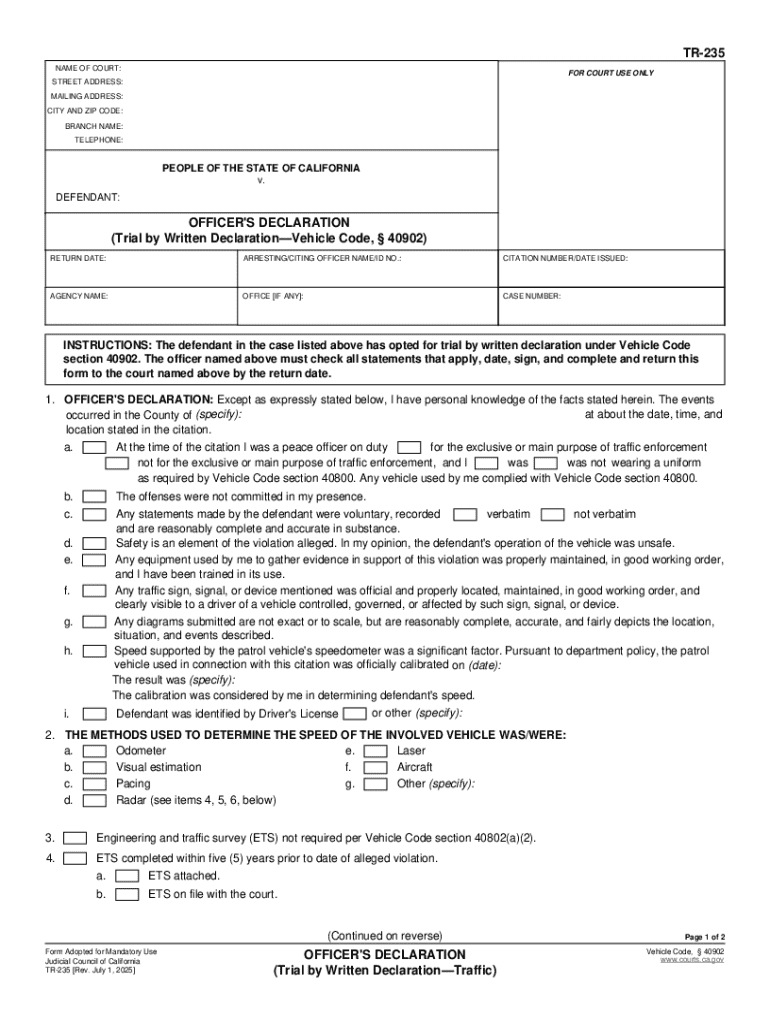
The TR-235 form is an Officer's Declaration utilized in California for a trial by written declaration process, as outlined under Vehicle Code section 40902. This form requires the arresting officer to detail their personal knowledge concerning a traffic violation. It must capture critical information such as enforcement methods, equipment used, and evidence supporting the citation. The officer must submit this completed form to the court by a specific date, thereby replacing the need for an in-person court appearance.
Obtaining the TR-235 Officer's Declaration Form
Securing the TR-235 Officer's Declaration form can be straightforward for those involved in traffic cases within California. Typically, law enforcement agencies provide this form to officers for compiling details of traffic citations. This form may also be available through the court for defense attorneys or individuals wishing to understand the documentation used against them. Access might require contacting local traffic courts or relevant state judicial websites.
Key Elements of the TR-235 Officer's Declaration
The TR-235 form contains essential components that ensure thorough legal documentation:
- Officer Identification: Name, badge number, and department are crucial for accountability.
- Event Description: Detailed narrative of the incident, including the date, time, and location.
- Evidence and Enforcement Techniques: Information on the equipment used, such as radar guns, and any physical evidence observed.
- Officer's Statement: The officer's account of events substantiated by their observations or measurements.
Steps to Complete the TR-235 Officer's Declaration Form
- Provide Personal and Case Information: Begin by entering personal data, including the officer's name, badge number, and department.
- Detail the Incident: Include accurate descriptions of the event, clearly indicating the time, place, and conditions at the time of the violation.
- Include Evidence: Document any evidence, such as radar readings, to support the citation.
- Finalize the Declaration: Sign and date the form, ensuring accurate completion before submission to the court.
Importance of using the TR-235 Officer's Declaration Form
The TR-235 Officer's Declaration is indispensable in ensuring that trials by written declaration uphold fairness and transparency. By requiring officers to provide a comprehensive account of the citation, the form supports defendants' rights to dispute tickets without appearing in court. It allows for an evidence-based assessment of the case, offering a chance for the citation to be dismissed if the officer's declaration fails to substantiate the charges.
Legal Framework Governing the TR-235 Form
The TR-235 operates under the legal auspices of California's Vehicle Code section 40902, which supports trials by written declaration. This legislation provides a legal channel for contesting traffic citations through documentation rather than in-person hearings. Adherence to this legal framework is critical, as any deviation in procedure could render the complaint void.
Filing Deadlines and Important Dates for Submission
Specific deadlines govern the submission of the TR-235 form and are typically contingent on the citation's issuance date and the designated trial date. Officers are obliged to submit their declarations in advance of the date set for deciding the trial by written declaration. Adjustments and extensions are rarely granted, emphasizing the importance of adhering to court-imposed timelines to avoid complications.
Who Issues and Uses the TR-235 Form
The TR-235 form is issued by California law enforcement agencies and is predominantly used by traffic officers who cite motorists for violations. Other users include defense attorneys and individuals representing themselves in written declaration trials. Understanding this form’s utility assists legal professionals and defendants alike in preparing for these specialized hearings.
Differences in State-Specific Requirements
While the TR-235 is specific to California, variations exist in other states' approaches to written declarations in traffic cases. California’s emphasis on detailed officer declarations aligns with its vehicle code, but other states may require alternative forms or processes. Those involved in interstate litigation should be aware of these differences and consult relevant state-specific laws.