






Definition and Meaning of Roll Call Present Form
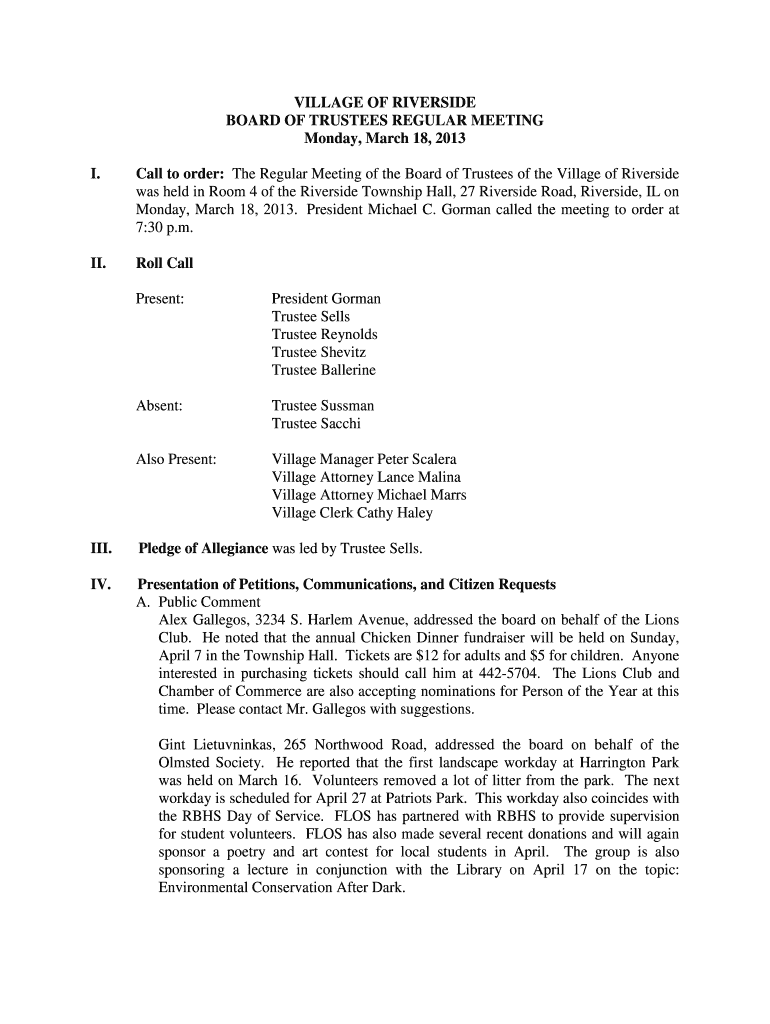
The "Roll Call Present" demonstrates a procedural aspect where specified individuals, namely President Gorman and Trustees Sells, Reynolds, Shevitz, and Ballerine, confirm their presence. This formality often occurs at official meetings, ensuring a quorum is met. The roll call presence is critical to legitimizing decisions made during meetings and ensuring that officials are accountable and informed about the proceedings.
- Purpose: Certifies who is attending a meeting, specifically identifying President Gorman and the trustees.
- Use Case: Legal verification for meeting minutes and enabling decision-making processes.
How to Use the Roll Call Present Form
Understanding the usage of a roll call form is vital for maintaining order and documentation in formal meetings. Each member's presence is acknowledged, and it becomes a part of the official record.
- Initiation: Usually conducted by a designated official such as a meeting secretary or chairperson.
- Acknowledgment: Upon the roll call, each named individual confirms presence verbally or via signature.
- Documentation: Recorded in the meeting minutes for transparency and legal purposes.
- Validation: Ensures decisions made have participant legitimacy.
Steps to Complete the Roll Call Present Form
Filling out the roll call present form accurately ensures complete transparency of the meeting participant status.
- Preparation: List all the required attendees as per the meeting schedule.
- Execution:
- Announce the roll call at the start of the meeting.
- Each listed individual confirms their presence.
- Documentation: Record the confirmations in meeting minutes, noting any absences.
- Verification: Review at the end of the meeting to ensure accurate records.
Legal Use and Importance
Ensuring a meeting's procedural correctness is achieved through the roll call presence, establishing a quorum and legitimizing board actions. This form supports compliance with statutory requirements for public meetings, such as open meetings laws that apply to government or corporate entities.
- Quorum Confirmation: Determines if enough participants are present to make the proceedings valid.
- Accountability: Serves as proof of attendance, protecting organizations legally.
Key Elements of Roll Call Present Form
A well-structured roll call form should contain the names of key participants and roles they play within the meeting's context.
- Participants Listed: Names such as President Gorman and Trustees Sells, Reynolds, Shevitz, Ballerine.
- Role Identification: Each name is associated with their respective role or title.
- Confirmation Method: Space for verbal acknowledgment or signature.
- Date and Time: Ensures records are specific to the given meeting.
Examples of Using Roll Call in Meetings
Throughout various organizational types, from village boards to corporate entities, the roll call form serves numerous critical functions.
- Village Board Meetings: Validate attendance of city officials in municipal decision-making processes.
- Corporate Board Meetings: Confirm director presence for resolutions.
- School Board Sessions: Track educational administrators' participation.
State-Specific Rules
Different states may impose additional requirements on the execution of official roll calls for meetings. Understanding these nuances ensures compliance with local regulations.
- Variance in Requirements: Some states might require roll calls to be public or published in minutes.
- Digital Records: Certain regions encourage digital methods for roll call affirmation.
Important Terms Related to Roll Call
Understanding specific terminology enhances the effective application of roll calls within legal and procedural frameworks.
- Quorum: Minimum number necessary for proceeding.
- Minutes: Official record of meeting discussions.
- Agenda: Program outlining the meeting's intended topics.