




01. Edit your form online
Type text, add images, blackout confidential details, add comments, highlights and more.

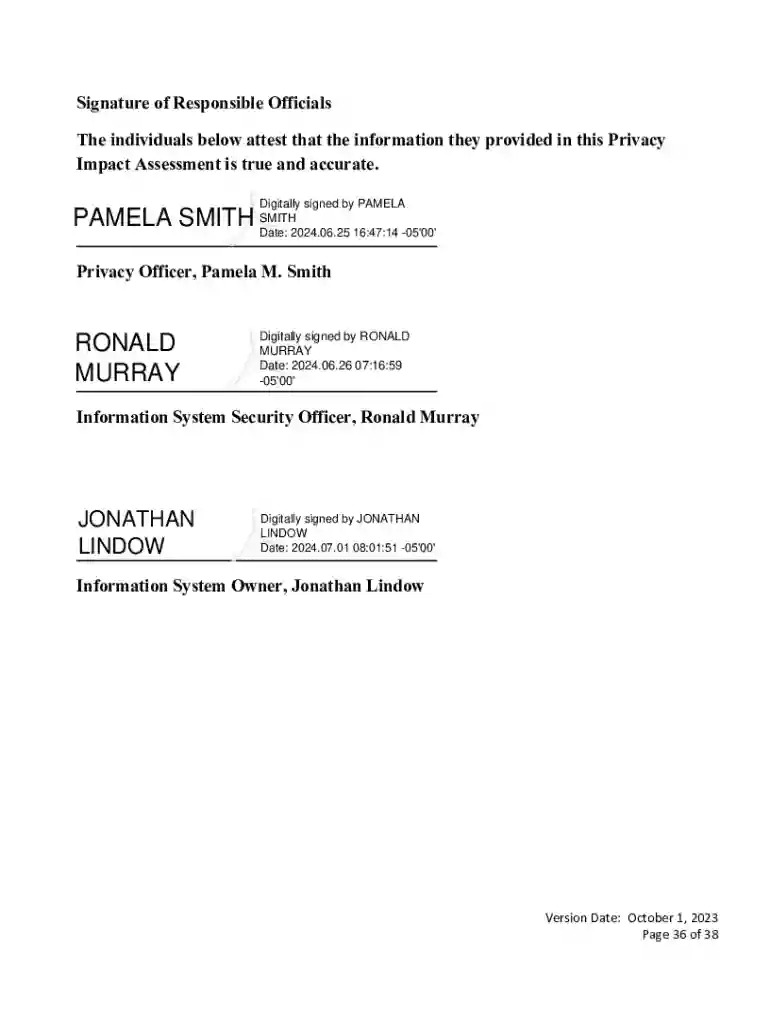
Type text, add images, blackout confidential details, add comments, highlights and more.

Draw your signature, type it, upload its image, or use your mobile device as a signature pad.

Send it via email, link, or fax. You can also download it, export it or print it out.
The Privacy Impact Assessment (PIA) for the VA IT System is a critical document designed to evaluate how personal data is handled within the Veterans Affairs Central Office's Non-Community Care Network (Non-CCN) IT system. The system's primary function is to adjudicate medical claims using the Electronic Claims Adjudication and Management System (eCAMS). A PIA serves as a tool to analyze information collection practices, data sharing protocols, and the mitigation strategies for privacy risks related to the sensitive personal information of veterans and other members of the public. It ensures compliance with privacy regulations and emphasizes the security measures that protect personally identifiable information (PII).
Identify Personal Information: Begin by determining what categories of personal data are collected, used, or shared by the system. This includes, but is not limited to, names, social security numbers, or health records.
Assess Data Collection Mechanisms: Evaluate how the information is collected. This includes assessing technologies like electronic forms or data entry systems and verifying that these methods minimize data collection to what is necessary.
Evaluate Data Usage and Sharing: Understand the use cases for the data and any sharing protocols with third-party entities. It's crucial to ensure that these practices align with legal and ethical standards.
Determine Legal Authorities: Verify the legal frameworks and policies that authorize data collection and use. This often involves cross-referencing federal privacy laws relevant to data collection.
Risk Analysis and Mitigation: Analyze potential risks to the privacy of personal data and document strategies to mitigate these risks. This includes technical, administrative, and physical controls.
Documentation and Review: Complete the PIA document, ensuring all sections are filled accurately. Submit the assessment for internal review and approval before implementation.
The lawful use of this PIA involves adhering to a comprehensive legal framework that mandates privacy and data protection standards. This framework includes adherence to:
Violation of these laws and regulations could result in severe penalties, including fines and legal action.
Consider a scenario where a new module is added to the eCAMS to simplify the claims process. Before its implementation, a PIA is conducted to:
Another example involves revising and optimizing the existing data-sharing practices between the VA and third-party medical service providers. The PIA provides a detailed analysis required to safeguard privacy during these interactions.
The primary users of the PIA include:


Completing a PIA is essential to:
By following these guidelines and thoroughly conducting a PIA, organizations can safeguard individuals' privacy and maintain compliance with applicable laws and standards.
We've got more versions of the Privacy Impact Assessment for the Va It System form. Select the right Privacy Impact Assessment for the Va It System version from the list and start editing it straight away!
| Versions | Form popularity | Fillable & printable |
|---|---|---|
| 2023 | 4.8 Satisfied (25 Votes) |
At DocHub, your data security is our priority. We follow HIPAA, SOC2, GDPR, and other standards, so you can work on your documents with confidence.




2 days ago Privacy Impact Assessments are consistently reviewed to ensure they are accurate and up to date. Below is a list of VA Privacy ImpactRead more
Cohesity gives you both data security and data management. A single, secure platform to protect 1,000+ workloads, accelerate recovery, and unlock insights from
A Privacy Impact Assessment (PIA) must also be provided to the COR and approved by VA Privacy Service prior to approval to operate.


