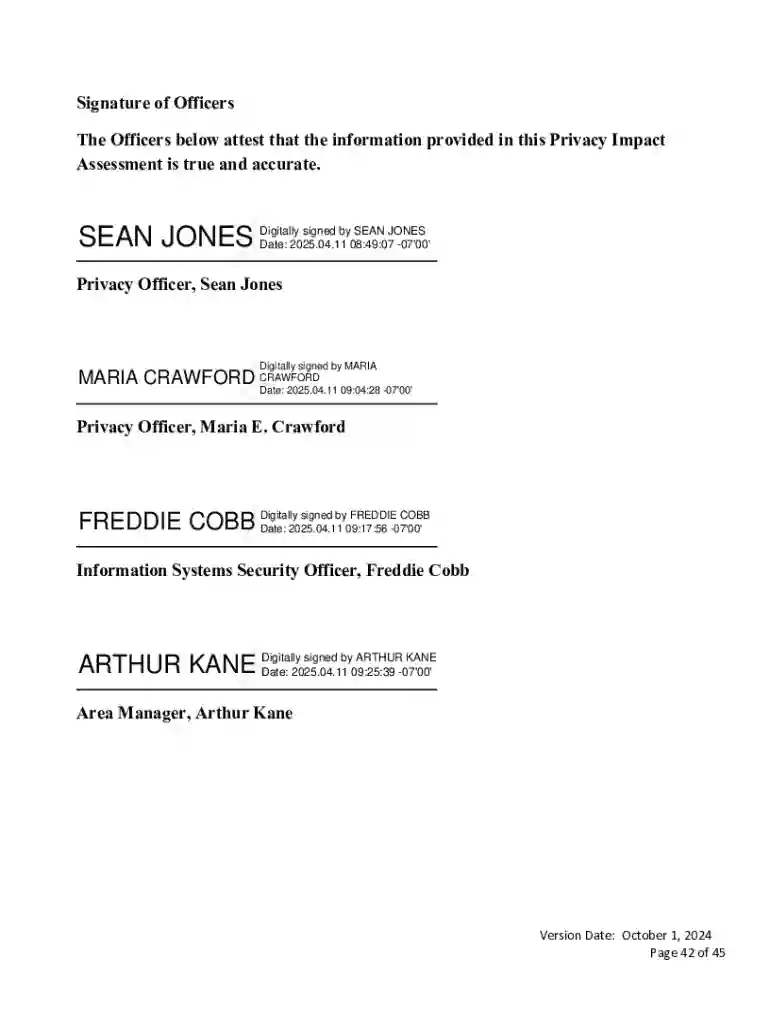
Privacy Impact Assessment for the Va Area Las Vegas 2026

Get Form
Privacy Impact Assessment for the Va Area Las Vegas Preview on Page 1

Here's how it works

01. Edit your form online
Type text, add images, blackout confidential details, add comments, highlights and more.

02. Sign it in a few clicks
Draw your signature, type it, upload its image, or use your mobile device as a signature pad.

03. Share your form with others
Send it via email, link, or fax. You can also download it, export it or print it out.

Definition & Meaning

A Privacy Impact Assessment (PIA) for the VA Area Las Vegas is a document used to evaluate the potential effects on privacy when handling Personally Identifiable Information (PII) and Protected Health Information (PHI) in various healthcare facilities. It ensures compliance with the E-Government Act of 2002 and VA directives, focusing on safe data practices while addressing any privacy risks involved. This assessment is crucial for maintaining the integrity of the VA's information systems and the privacy rights of individuals whose data is collected and managed.

Key Elements of the Privacy Impact Assessment for the VA Area Las Vegas

The PIA for the VA Area Las Vegas encompasses several key elements that determine its structure and purpose:

  • Data Collection and Usage: Details what type of PII and PHI are collected, and how this data is utilized within the VA's information systems.
  • Legal Mandates: Compliance with relevant laws such as the E-Government Act and VA directives is a primary focus.
  • Operational Environment: Describes the settings where data handling occurs, including the processes and technology involved.
  • Stakeholder Identification: Pinpoints who is involved in data management, from users to IT staff and administrators.
  • Risk Mitigation Strategies: Explores measures to minimize privacy risks, such as encryption and access control.

Steps to Complete the Privacy Impact Assessment for the VA Area Las Vegas

Completing a PIA involves multiple steps, ensuring comprehensiveness and adherence to legal guidelines:

  1. Identify the Information Systems: Determine which systems are involved in handling PII and PHI.
  2. Conduct Data Flow Analysis: Understand how data moves within the organization and identify potential vulnerabilities.
  3. Assess Privacy Risks: Evaluate potential risks associated with data handling and propose appropriate mitigation strategies.
  4. Engage Stakeholders: Collaborate with relevant parties to gather insights and validate assessment findings.
  5. Draft the Assessment: Compile data and findings into a formal document for review.
  6. Obtain Approval: Submit the completed PIA for evaluation and approval by relevant authorities.

Why You Should Conduct a Privacy Impact Assessment for the VA Area Las Vegas

Conducting a PIA is vital for safeguarding sensitive information within healthcare facilities:

  • Legal Compliance: Ensures that data practices align with federal and VA-specific privacy regulations.
  • Risk Reduction: Identifies and mitigates privacy risks, protecting patient data from potential breaches.
  • Transparency Improvement: Enhances the clarity of data handling practices to stakeholders and the public.
  • Trust Building: Fosters trust among patients and stakeholders by demonstrating a commitment to data privacy.
  • Operational Efficiency: Streamlines data processes, reducing potential delays caused by privacy concerns.

Legal Use of the Privacy Impact Assessment for the VA Area Las Vegas

The primary legal application of the PIA for the VA Area Las Vegas is to ensure that data handling practices comply with U.S. federal laws. The assessment adheres to the mandates of the E-Government Act of 2002, VA directives, and other applicable regulations. By systematically identifying and addressing privacy risks, the PIA aids in avoiding legal repercussions and maintaining operational integrity in data management practices.

Who Typically Uses the Privacy Impact Assessment for the VA Area Las Vegas

The PIA is mainly used by professionals and organizations handling PII and PHI in the VA Area Las Vegas:


  • Healthcare Facilities: Hospitals and clinics that manage patient data are primary users.
  • IT Staff: Responsible for implementing technical safeguards and ensuring data security.
  • Compliance Officers: Ensure adherence to legal and organizational privacy standards.
  • Administrators: Oversee the integration of privacy practices within operations.
  • Policy Makers: Develop and adjust data handling policies based on assessment findings.
decoration image ratings of Dochub

Examples of Using the Privacy Impact Assessment for the VA Area Las Vegas

Various real-world scenarios highlight the utility of the PIA:

  • Healthcare System Upgrades: Assessing privacy implications before implementing new IT systems.
  • Data Breach Reviews: Evaluating existing privacy measures and strengthening them post-breach.
  • New Data Collection Initiatives: Ensuring compliance with privacy mandates when launching new health programs.

State-Specific Rules for the Privacy Impact Assessment for the VA Area Las Vegas

While the PIA follows federal guidelines, state-specific regulations may also apply:

  • Nevada Privacy Laws: Aligning PIA practices with state laws on data protection and privacy.
  • VA Directives: Illustrating how regional differences within the VA framework can impact PIA procedures.
  • Collaboration with Local Authorities: Ensuring that state-specific requirements are met through cooperative efforts.

Important Terms Related to the Privacy Impact Assessment for the VA Area Las Vegas

Understanding key terminology is essential when dealing with a PIA:

  • PII (Personally Identifiable Information): Data that can uniquely identify an individual, such as social security numbers.
  • PHI (Protected Health Information): Health data that is protected under privacy regulations like HIPAA.
  • Mitigation Strategies: Measures put in place to minimize identified privacy risks.
  • Stakeholders: Individuals or groups invested in the PIA process, including patients, healthcare professionals, and regulatory bodies.
be ready to get more

Complete this form in 5 minutes or less

Get form

Got questions?

We have answers to the most popular questions from our customers. If you can't find an answer to your question, please contact us.
Contact us
During a medical emergency, VA encourages all Veterans to seek immediate medical attention without delay. It is, however, important for you to promptly notify VA within 72 hours of a Veteran presenting to the your emergency room.
VA Wasted $223 Million on Transport Services, Failed to Pay Veterans Medical Bills Resulting in Denied Care. OSC has alerted the President and Congress to docHub financial mismanagement at the U.S. Department of Veterans Affairs, including more than $223 million in wasteful spending.
The 7 Types of Privacy Privacy of the Individual. You can think of privacy of the individual as bodily autonomy. Privacy of Behavior and Action. Privacy of Communication. Privacy of Personal Data. Privacy of Thoughts and Feelings. Privacy of Location and Space. Privacy of Association.
Merissa Larson currently serves as the Acting Deputy Chief Information Officer for Compliance, Risk, and Remediation and Chief Privacy Officer within the Office of Information Technology (OIT).
VA.gov will not disclose your personal information to third parties outside VA without your consent, except to facilitate the transaction, to act on your behalf at your request, or as authorized by law.

Security and compliance

At DocHub, your data security is our priority. We follow HIPAA, SOC2, GDPR, and other standards, so you can work on your documents with confidence.

Learn more
ccpa2
pci-dss
gdpr-compliance
hipaa
soc-compliance

People also ask

Federal agencies are required to conduct and draft a PIA with sufficient clarity and specificity to demonstrate that the agency fully considered privacy and incorporated appropriate privacy protections from the earliest stages of the agency activity and throughout the information life cycle.

Related links