







Definition & Meaning
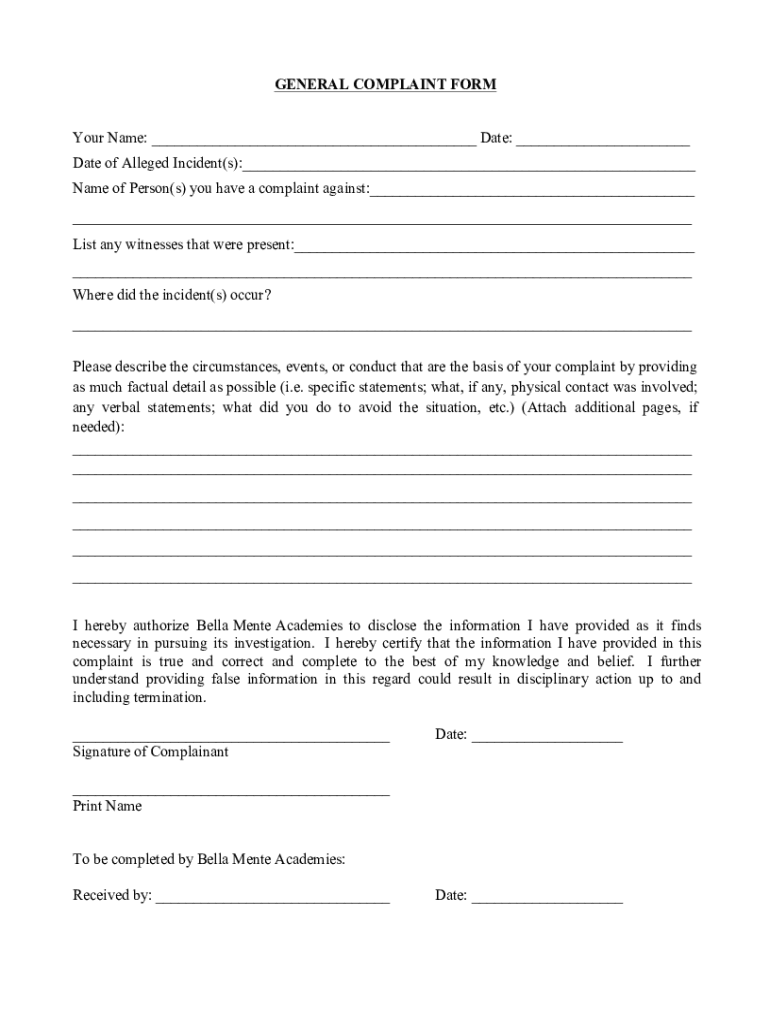
The "Complaint Form - Illinois" serves as a formal mechanism for individuals and entities to report grievances or issues within the state of Illinois. It is specifically designed to capture detailed information regarding the nature of the complaint, the involved parties, and any pertinent evidence or documentation. This form is commonly utilized by both private citizens and institutions to ensure that complaints are communicated accurately and officially, fostering transparency and accountability. While the core purpose of this form is to address a broad range of issues, its structured format ensures consistency in data collection, facilitating efficient review and handling by the appropriate authorities.
How to Use the Complaint Form - Illinois
Using the "Complaint Form - Illinois" begins by clearly identifying the issue at hand. The form requires users to fill out specific sections, each aimed at gathering comprehensive information. These sections include:
-
Personal Information: Provide your name, contact details, and any other identifying information required. This section ensures that the authorities have a point of reference and can follow up if needed.
-
Details of the Incident: Describe the complaint in detail, including dates, locations, and any specific actions or statements that are pertinent to the issue. Clarity and thoroughness in this section are crucial for an accurate assessment.
-
Involved Parties: List any individuals or entities related to the complaint, along with their roles and contact information, if available. This assists in triangulating data during investigations.
-
Evidence and Documentation: Attach any supporting documents, such as emails, photographs, or contracts, which can substantiate the claim. The inclusion of evidence significantly bolsters the credibility of the complaint.
Once all sections are completed accurately, review the information for completeness before submitting it through the designated channels highlighted on the form.
How to Obtain the Complaint Form - Illinois
You can access the "Complaint Form - Illinois" through various channels to accommodate different preferences and needs. The primary methods include:
-
Online Platforms: Visit official state websites or affiliated legal service resources where the form can be downloaded. This method offers convenience and easy access from any location.
-
In-Person: Obtain a physical copy by visiting relevant government offices or legal aid centers. This approach allows for immediate assistance if clarification or guidance is required during form completion.
-
Mail Request: For those preferring traditional methods, the form can be requested via mail from the issuing authority, which will send a paper copy to your designated address.
Regardless of the method chosen, ensure that you are accessing the most current version of the form to avoid submitting outdated or incorrect information.
Steps to Complete the Complaint Form - Illinois
Completing the "Complaint Form - Illinois" involves a systematic approach to ensure accuracy and completeness:
-
Start by Gathering Information: Collect all pertinent details and documents that relate to your complaint. This preparation facilitates a smoother completion process.
-
Fill Out Personal Details: Begin with entering your personal information, ensuring accuracy to avoid any miscommunication or delays in processing.
-
Detail the Complaint: Fill in the sections regarding the incident, ensuring to include specific dates, times, and locations. Clearly articulate the nature of the complaint and what resolution or outcome you are seeking.
-
Identify Parties Involved: List all individuals or entities involved, providing contact information where possible, which can assist in the investigatory process.
-
Attach Supporting Documentation: Ensure that all evidence relating to the complaint is attached or referenced, as this strengthens your submission.
-
Review and Submit: Carefully check the form for any errors or omissions, sign it where required, and then submit through the appropriate channel.
Key Elements of the Complaint Form - Illinois
The "Complaint Form - Illinois" is comprised of several critical elements that must be carefully completed to facilitate a thorough investigation:
-
Identifying Information: Collect specific details about the complainant and any other relevant entities to maintain clear and open communication.
-
Incident Description: A thorough narrative of the event or issue, highlighting key facts and observations, which forms the basis of the complaint.
-
Witnesses and Evidence: Inclusion of any witnesses' details and accompanying evidence such as photographs, recordings, or documentation to substantiate the claim.
-
Desired Outcome: A concise statement of what the complainant hopes to achieve through the submission of the form.
-
Acknowledgment and Consent: A section where the complainant consents to the processing of their information, often necessary for compliance with privacy regulations.
State-Specific Rules for the Complaint Form - Illinois
Illinois operates under specific legal frameworks that dictate how complaints are managed and resolved. Key rules include:
-
Privacy Considerations: Illinois law requires that information gathered for complaints is handled with strict confidentiality, ensuring personal data is protected.
-
Timely Submission: Complaints should be submitted within specific time frames to conform to the statute of limitations, which can vary based on the nature of the grievance.
-
Jurisdictional Limits: The complaint must pertain to issues within Illinois jurisdiction; otherwise, it may need to be referred to the appropriate state or federal body.
-
Resolution Protocols: Illinois provides defined paths for resolution, including mediation options or legal adjudication, depending on the severity and nature of the complaint.
Examples of Using the Complaint Form - Illinois
The "Complaint Form - Illinois" can be employed in various scenarios, demonstrating its versatility and necessity:
-
Consumer Protection: Individuals may use the form to report businesses engaging in fraudulent or deceptive practices, such as false advertising or failure to honor warranties.
-
Workplace Grievances: Employees can file formal complaints related to harassment, discrimination, or unsafe working conditions.
-
Landlord-Tenant Disputes: Tenants might report issues related to housing code violations or wrongful eviction attempts.
These examples highlight the broad applicability of the form across different contexts, providing a structured method for addressing grievances formally.
Legal Use of the Complaint Form - Illinois
The "Complaint Form - Illinois" holds legal significance as it serves as an official record of grievances submitted for investigation and potential redress. Essential legal considerations include:
-
Admissibility in Legal Proceedings: The form and its contents can be used as evidence if the complaint escalates to legal action, emphasizing the need for detailed and truthful submissions.
-
Investigation and Resolution: Once submitted, the complaint initiates a process where officials assess the issue, potentially leading to inquiries, remediation, or enforcement of regulations.
-
Rights and Responsibilities: Complainants should be aware of their rights, such as the right to anonymity in certain cases, alongside their responsibilities to provide accurate and complete information.
Understanding these legal implications ensures that complainants use the form appropriately and with awareness of the potential outcomes and processes it triggers.




