






Definition & Meaning
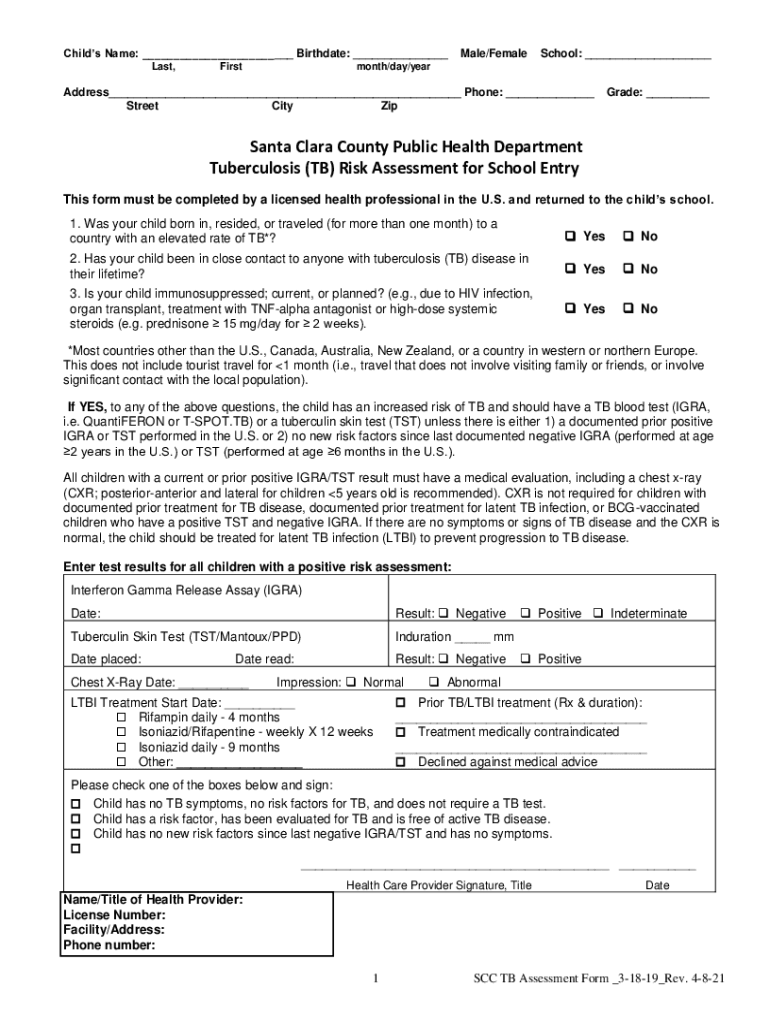
The Santa Clara County TB Risk Assessment Form is a document used by the Santa Clara County Public Health Department to evaluate the risk of tuberculosis (TB) in individuals, particularly children entering school. This form is essential for identifying exposure to TB risk factors, determining testing requirements, and outlining treatment options for latent TB infection. Schools require this form to prevent the spread of TB among students.
Key Components of the Form
- Exposure Assessment: Evaluates whether the individual has been in contact with someone diagnosed with active TB disease.
- Symptom Check: Assesses symptoms such as a persistent cough, weight loss, or fever that may indicate TB.
- Testing Recommendations: Decides if a TB skin test or TB blood test is necessary based on risk factors.
- Treatment Options: Offers guidelines for treating latent TB infection to prevent progression to active disease.
How to use the Santa Clara County TB Risk Assessment Form - Fill Online
Filling this form online offers a streamlined process for health professionals. The process involves:
- Accessing the Form: Health professionals can download the form from the Santa Clara County Public Health Department website or use DocHub for online completion.
- Completing the Information: Enter details about the individual's exposure to TB, symptom presence, and any history of TB testing.
- Professional Evaluation: A licensed health professional must evaluate the form to determine the necessity of testing or treatment.
- Submission: After completion and review, the form can be submitted electronically or printed and submitted in person.
Practical Example
A school nurse uses the form to assess a new student's TB risk. By evaluating the student's exposure and symptoms, the nurse can determine if further testing is necessary before the child joins school activities.
Steps to complete the Santa Clara County TB Risk Assessment Form - Fill Online
Completing the form online involves several steps, ensuring all necessary information is captured.
-
Initial Information Entry:
- Input child’s personal details, including name, date of birth, and school information.
-
Exposure Evaluation:
- Answer questions on recent contact with TB patients, travel history to TB-prevalent areas, and any prior positive TB tests.
-
Symptom Assessment:
- Record any symptoms such as chronic cough or unexplained weight loss that may suggest TB.
-
Risk Factor Identification:
- Highlight any immunocompromising conditions or medications taken that elevate TB risk.
-
Professional Recommendations:
- Include recommendations for TB testing or treatment based on the assessment.
-
Final Review and Submission:
- Review all entries for accuracy before submitting electronically or in print.
Why should you fill out the Santa Clara County TB Risk Assessment Form online
Filling out this form online provides several advantages for health professionals and parents.
Benefits
- Efficiency: Online completion reduces paper usage and speeds up processing.
- Accessibility: Available anytime, allowing flexibility for parents and health professionals.
- Accuracy: Digital platforms minimize errors with prompts and reminders for necessary fields.
- Convenience: Enables easy sharing and submission to relevant school authorities.
Real-World Utilization
Schools in Santa Clara County mandate the form to control TB, ensuring a safe and healthy environment for all students.
Who typically uses the Santa Clara County TB Risk Assessment Form
This form is essential for several groups within the community.
- School Health Officials: Require this form to ensure all enrolled students are free from TB risks.
- Pediatricians and Family Doctors: Utilize the form to assess and manage potential TB exposure in children.
- Parents and Guardians: Fill out the initial sections as part of school entry requirements.


Example Scenario
A family doctor uses the form to screen a new patient who has moved from a country with a high TB incidence rate. The form guides the doctor's decision on whether proactive testing is needed.
Key elements of the Santa Clara County TB Risk Assessment Form
Several key elements make this form vital for health and safety in schools.
- Comprehensive Assessment: Thoroughly evaluates exposure and risk factors.
- Professional Evaluation: Requires input and signature from a licensed health professional to validate findings.
- Testing and Treatment Guidance: Provides standardized recommendations for TB testing or treatment.
Form Submission Methods
The Santa Clara County TB Risk Assessment Form can be submitted in various ways, depending on institutional requirements.
Submission Options
- Online via Platforms: Completing and submitting through platforms like DocHub enhances speed and traceability.
- In-Person: Forms can be printed and submitted during school visits or health check-ups.
- Mail: For institutions accepting hard copies, forms can be mailed to designated health offices.
Submission Considerations
Ensure all entries are complete and accurate before choosing the submission method to avoid delays in processing.
Legal Use of the Santa Clara County TB Risk Assessment Form
This form serves a critical legal function in preventing TB spread within school settings.
Legal Context
- School Requirements: Legal mandates require schools to screen for TB before entry.
- Public Health Compliance: Meets public health guidelines for TB prevention.
- Privacy Protection: Ensure patient details are handled in compliance with health privacy laws.
Understanding the legal importance reinforces the role of this form in public health safety measures.
Who Issues the Form
The Santa Clara County TB Risk Assessment Form is issued by the Santa Clara County Public Health Department.
Issuing Authority
- Public Health Department: Oversees the distribution, use, and updates of the form to align with current health regulations.
- Schools and Health Facilities: Collaborate with the Public Health Department to ensure compliance with screening requirements.
This chain of issuance underscores the coordinated effort between health authorities and educational institutions to maintain community health.