




01. Edit your form online
Type text, add images, blackout confidential details, add comments, highlights and more.

Type text, add images, blackout confidential details, add comments, highlights and more.

Draw your signature, type it, upload its image, or use your mobile device as a signature pad.

Send it via email, link, or fax. You can also download it, export it or print it out.
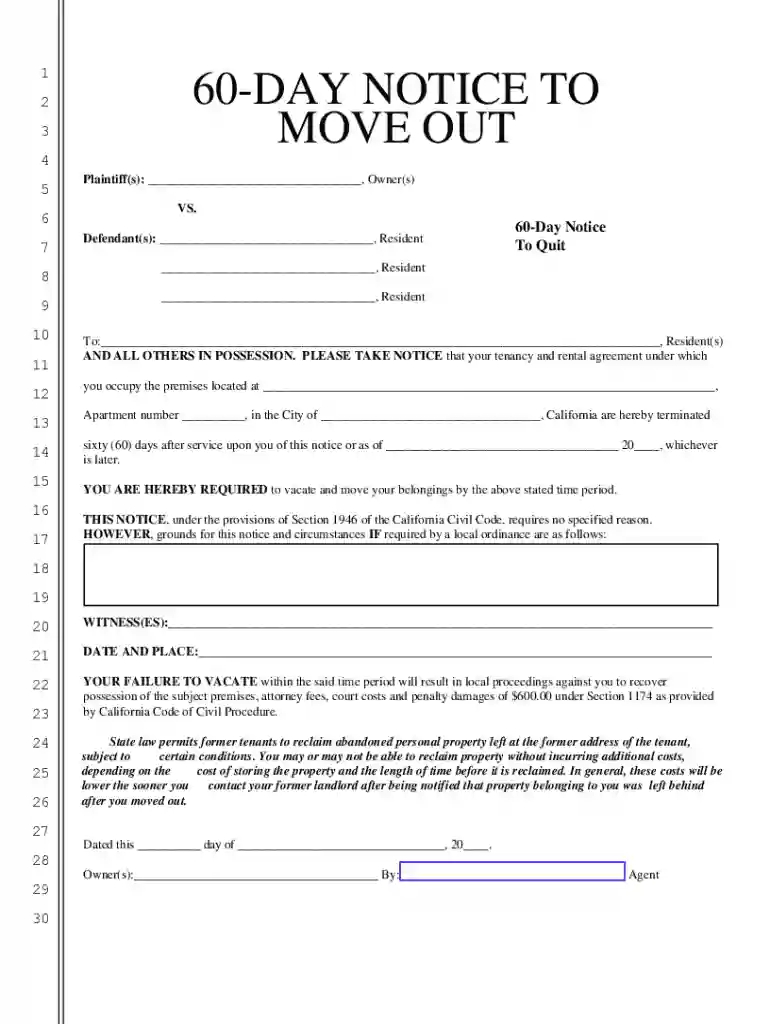
The California 60-Day Notice to Terminate Month-to-Month Tenancy is a legal document used by landlords to inform tenants that their month-to-month tenancy will end 60 days after the notice is served. This form is crucial for landlords who wish to regain possession of their property. The notice includes compliance with California Civil Code Section 1946, stipulating guidelines that both parties must adhere to for a lawful termination of tenancy. The notice also details potential legal consequences for tenants who do not vacate the premises by the specified date.
The document aims to provide a clear timeline and rationale for ending the tenancy. It protects landlords from tenant holdover and informs tenants of their rights and responsibilities, including instructions for reclaiming any abandoned belongings left on the property post-vacancy.
Using the California 60-Day Notice involves several critical steps that ensure compliance with legal regulations and proper communication between landlords and tenants.
Preparation: Before preparing the notice, ensure that you comply with California law by confirming that the tenancy exceeds one year. If not, a 30-Day Notice may be more appropriate.
Drafting the Notice: Clearly state the date when the notice is issued, the tenant’s name, and the property address. Include the specific end date, which should be exactly 60 days from the notice delivery date.
Detailing the Terms: Ensure the notice outlines the legal obligations of the tenant to vacate and any consequences if the tenant fails to do so. Include a proof of service section to note how and when the notice was delivered.
Delivery: Serve the notice through methods prescribed by California law—such as personal delivery, substituted service, or posting and mailing.
Documentation: Retain copies of the notice and any proof of service documentation to avoid legal disputes and verify compliance with all protocols.
Completing the notice requires attention to detail to ensure accuracy and legal conformity.
Fill in Basic Information: Include the complete names of the landlord and tenant, the property's full address, and the date of the notice issuance.
Specify the Termination Date: Clearly indicate the termination date, factoring in the 60-day period from the notice issuance date.
Outline Tenant Obligations: List any steps the tenant must take prior to moving out, such as vacating the property, removing personal belongings, and returning keys.
Proof of Service: Fill out this section meticulously. Specify the method used to deliver the notice (e.g., personal delivery, mail).
Sign and Date: The landlord or their agent must sign and date the notice, indicating its official status.
This notice is legally utilized under the California Civil Code Section 1946. Aimed at protecting both landlords and tenants, legal use of this form necessitates that landlords justify the termination legally without breaching housing anti-discrimination laws.
Landlord's Right to Terminate: Landlords can use this notice to reclaim their property for reasons such as selling the property, owner move-in, or to perform substantial renovations.
Tenant Protection: Tenants are protected under specific circumstances, such as retaliatory evictions or discrimination. Termination notices cannot be used to bypass these legal protections.
These aspects reinforce the importance of using the 60-Day Notice within its intended legal framework.
California's regulations offer unique distinctions for the 60-Day Notice that must be adhered to:
Property Occupancy Duration: A 60-day notice is required if the tenant has lived in the property for more than one year; for lesser duration, a 30-day notice suffices.
Rent Control Ordinances: Local jurisdictions may have rent control ordinances impacting or even superseding the general requirements of a 60-Day Notice.
Just Cause Provisions: In some cities, termination requires a just cause even for month-to-month tenancies, compelling landlords to comply with stricter regulations.
Several elements are included within the notice to ensure comprehensive communication with the tenant:
Notice Date: The date when the landlord issues the notice.
Termination Date: Clear indication of the tenancy termination effective date.
Tenant and Landlord Information: Full names and addresses to avoid ambiguity.
Property Description: Exact address for residential termination.
Tenant Instructions: Clear directives for tenant responsibilities, such as property cleanup.
Proof of Service: Detailing how and when the notice was served.
These components ensure that the notice is detailed and comprehensive.
The notice is an essential tool for different parties involved in a residential rental agreement:
Private Landlords: Individuals or entities renting out properties who aim to terminate tenancy agreements while ensuring legal compliance.
Property Management Companies: Firms that oversee rental properties and handle tenant agreements.
Real Estate Lawyers: Legal professionals offering consulting and logistical services for property-related terminative actions.
This varied usage underscores the form's widespread application across the real estate industry.


Real-world scenarios where the notice is applicable may include:
Property Sale: A landlord intends to sell their rental property and requires tenants to vacate in preparation.
Owner Move-In: Landlords planning to personally move back into their rental property.
Extensive Renovations: When major renovations necessitate an unoccupied property for safety and efficiency.
These examples demonstrate practical applications of the 60-day termination notice in everyday tenancy management.
At DocHub, your data security is our priority. We follow HIPAA, SOC2, GDPR, and other standards, so you can work on your documents with confidence.


There are 3-day, 30-day, 60-day, or 90-day Notices to Quit. The number of days in the notice is the deadline for when you have to do what the notice says.Read more
Your landlord can terminate with 60 days notice. give your landlord 30 days written notice of termination. at least eight giving. California Civil Code 1946


