
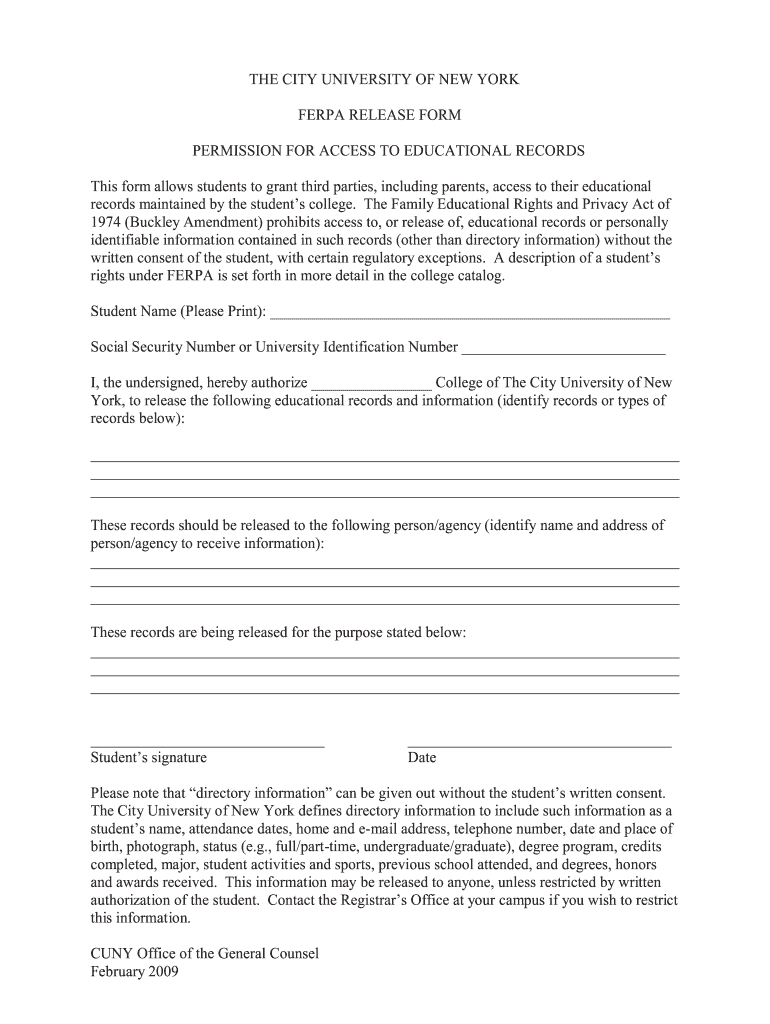







Definition & Meaning
The CUNY FERPA Release Form is a document used by The City University of New York students to grant third parties access to their educational records. This release form is designed to comply with the Family Educational Rights and Privacy Act (FERPA) of 1974, a federal law that protects the privacy of student education records. By using this form, students can specify the type of information that can be released and to whom it can be disclosed.
Key Features and Purpose
- Authorized Access: The form allows students to formally consent to share particular educational records with specified individuals or agencies.
- Privacy Compliance: Adheres to FERPA regulations, ensuring that student information is disclosed only with proper consent.
- Specificity: Students can indicate which parts of their educational records can be shared and for what purpose.
How to Obtain the CUNY FERPA Release Form
Students can obtain the CUNY FERPA Release Form from their respective college's registrar's office or online from the university's official website.
Methods to Access the Form
- Online Download: Visit the official website of The City University of New York to download the form in PDF format.
- In-Person Pickup: Go to the registrar’s office of the student's enrolled college for a physical copy.
- Email Request: Students may request the form to be sent by email through the registrar’s office.
Steps to Complete the CUNY FERPA Release Form
Filling out the CUNY FERPA Release Form requires attention to detail to ensure compliance with FERPA regulations.
- Personal Information: Begin by entering the student's full name and student identification number.
- Authorized Party Information: Clearly specify the name and relationship of the third party who will have access to the educational records.
- Records to be Released: Identify the specific records or types of information that are allowed to be shared.
- Purpose of Disclosure: State the reason for granting access to these records.
- Sign and Date: The student must sign and date the form to validate the consent.
Key Elements of the CUNY FERPA Release Form
Understanding the components of the CUNY FERPA Release Form is critical for accurate completion.
Essential Components
- Student Identification: Includes personal and enrollment details.
- Details of Third-Party: Information about who will receive the records.
- Scope of Disclosure: Specifies what information can be shared.
- Reason for Release: Provides a rationale for the disclosure.
Legal Use of the CUNY FERPA Release Form
The form is used within a legal framework to regulate the disclosure of educational records.
Compliance with FERPA
- Consent Requirement: Only allows record sharing after written consent from the student.
- Revocation Rights: Students must be informed that they can revoke consent at any time, providing a safeguard against misuse.
Who Typically Uses the CUNY FERPA Release Form
The form is predominantly used by current students at The City University of New York, but other parties may also find it relevant.


Typical Users and Scenarios
- Students: Grant access to parents, guardians, or potential employers for purposes such as academic evaluations or job applications.
- Parents/Guardians: Wish to access their child’s academic records for advisory purposes.
- Employers: Potential employers requesting verification of educational qualifications.
Important Terms Related to CUNY FERPA Release Form
Several terms are essential to understand when dealing with FERPA and its documentation.
Common Terms
- FERPA: Federal law protecting the privacy of educational records.
- Educational Records: Records that are directly related to a student and maintained by the university.
- Consent for Disclosure: Written permission that allows third parties to access a student's records.
Form Submission Methods
Completing the form is the first step; submission is also critical.
Available Options
- Online Submission: Some colleges may allow electronic submission through the university portal.
- Mail Option: Complete and mail the form to the designated office at the university.
- In-Person Submission: Students can submit the form directly to the registrar’s office for processing.
Quick Facts
Quick insights into the importance and process of the FERPA release.
Key Points
- Federal Requirement: Mandated by the Family Educational Rights and Privacy Act.
- Protection Focus: Ensures a student's educational records are kept confidential.
- Systematic Process: Allows for structured and secure sharing of educational data.
Incorporating practical examples, detailed context, and real-world scenarios not only enhances understanding but also ensures the comprehensive utility of the CUNY FERPA Release Form for all stakeholders involved.




