




01. Edit your proportional vs non proportional worksheet pdf online
Type text, add images, blackout confidential details, add comments, highlights and more.

Type text, add images, blackout confidential details, add comments, highlights and more.

Draw your signature, type it, upload its image, or use your mobile device as a signature pad.

Send proportional and nonproportional relationships worksheet via email, link, or fax. You can also download it, export it or print it out.
Proportional relationships are defined as those in which two quantities increase or decrease at the same rate. This means that as one quantity changes, the other changes by a consistent factor. For example, if a car travels for a duration at a constant speed, the distance traveled is directly proportional to the time spent traveling. Mathematically, this can be represented by the equation y = kx, where k is the constant of proportionality.
In contrast, non-proportional relationships do not maintain a consistent rate of change between two variables. These relationships may involve fixed costs or additional factors that alter the ratio, resulting in scenarios where the relationship is not linear. An example would be a phone plan where a fixed monthly fee applies, plus a variable charge based on usage. Such relationships often require additional calculations or adjustments to understand the underlying patterns.
Understanding these concepts is essential in analytical settings, such as in Mathematics, Economics, and various scientific disciplines, as they play a critical role in interpreting data and making informed decisions.
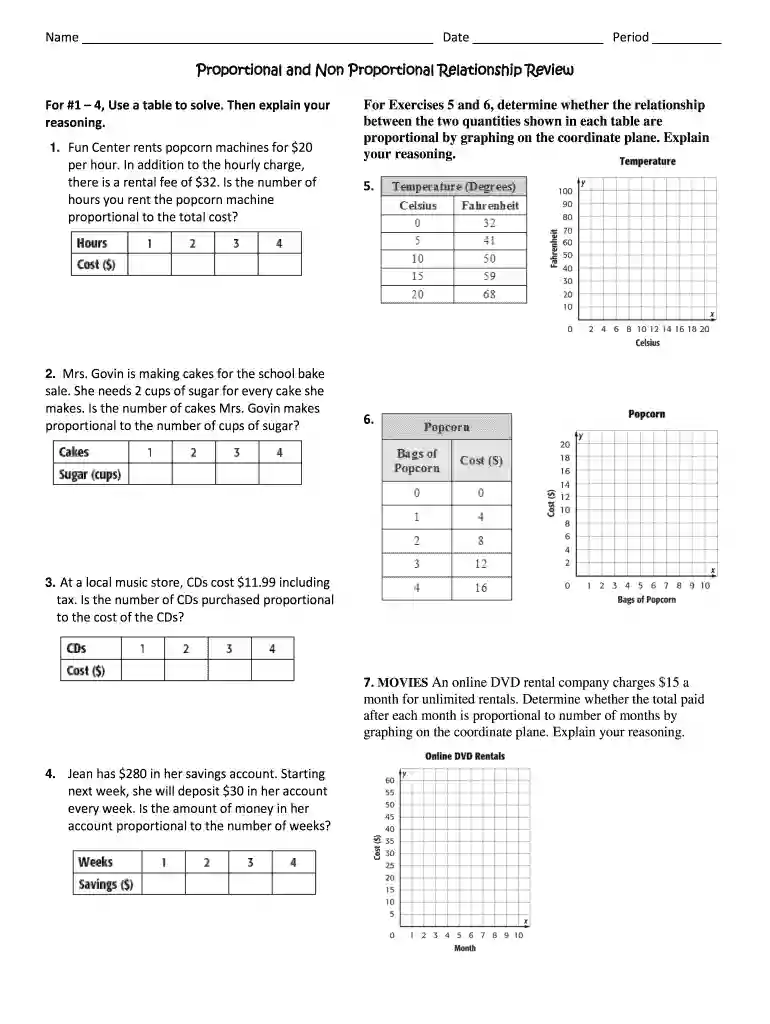
The "Proportional and Non Proportional Relationship Review.pdf" serves as an educational tool designed to assist students in understanding and distinguishing between these types of relationships. To effectively utilize the document:
Identify Key Concepts: Begin by reviewing the definitions and differences outlined in the document. Ensure you have a solid grasp of what makes a relationship proportional or non-proportional.
Engage with Practice Problems: The document typically includes a range of problems, such as those involving costs, quantities, and rates. Work through these problems systematically to apply the terminology and concepts learned.
Utilize Graphs and Tables: Many exercises may require the creation of tables or graphs to visualize the relationships. This step enhances comprehension by allowing visual representation of the data.
Review Explanation Sections: After solving problems, consult the explanations provided to ensure understanding of the rationale behind each solution.
Collaborate with Peers: If applicable, discuss the problems with classmates or study groups for diverse perspectives and solutions, enhancing the learning experience.
Using the review PDF in a structured manner will reinforce understanding and applicability of proportional versus non-proportional relationships.
Completing the exercises and assessments within the "Proportional and Non Proportional Relationship Review.pdf" involves several structured steps:
Access the Document: Open the PDF on your preferred device, ensuring the necessary apps for viewing PDFs, such as Adobe Acrobat, are installed.
Read Instructions Carefully: Start with the introductory sections, paying careful attention to any specific instructions related to the exercises.
Organize Your Workspace: Have paper and writing tools ready for calculations, and ensure you have a quiet environment to focus.
Work Through the Exercises: Begin with the simpler problems, progressively tackling more complex scenarios. Make use of any provided examples as a guide.
Document Insights and Solutions: Write down your thought process for solving each problem, as this feedback can be helpful for studying.
Review and Crosscheck Answers: After completing the exercises, compare your answers with any provided solutions if available, and correct any misunderstandings.
Reflect on Learning: Take a moment after completing the document to summarize what you learned about proportional and non-proportional relationships, ensuring retention of key concepts.
The "Proportional and Non Proportional Relationship Review.pdf" includes several essential elements that enhance the learning experience:
Clear Definitions: The document starts with concise definitions of proportional and non-proportional relationships, establishing a solid groundwork.
Diverse Problem Sets: It offers various problems that reflect real-world applications, such as financial scenarios, rates of consumption, and comparative activities.
Graphing and Tabulating Guidelines: Instructions for creating tables and graphs are provided, which serve as vital skills for analysis in various fields including mathematics and science.
Step-by-Step Solutions: Frequently, the document may offer detailed solutions to select problems, providing a pathway to understanding common mistakes and correct reasoning.
Visual Aids: Charts or diagrams may illustrate concepts more vividly, helping to break down complex ideas into digestible parts.
These elements together make the review document a comprehensive educational resource that enables learners to effectively master the concepts of proportional and non-proportional relationships.
Practical examples presented in the "Proportional and Non Proportional Relationship Review.pdf" significantly aid comprehension. Below are a few scenarios showcased in the exercises:
Rental Costs: If a business charges a fixed monthly fee plus a variable cost per hour of usage (i.e., renting equipment), students can analyze whether the relationship between time rented and total cost is proportional or non-proportional. Here, students calculate total costs for varying rental periods to see how the charges evolve.
Grocery Shopping: A problem may involve buying different quantities of the same product on sale—for example, one at a promotional price per item. Calculating the total cost for these items allows students to see how the individual price changes affect the total, identifying whether the relationship remains proportional.
Speed and Time: An exercise may require students to calculate how far a car travels over time when moving at a constant speed. Students are tasked with graphing this relationship, clearly showing a proportional relationship where speed correlates directly to distance.
These practical examples help students grasp the distinction between proportional and non-proportional relationships, fostering better analytical skills and real-world application.
Familiarity with specific terminology is crucial in understanding proportional and non-proportional relationships. Below is a glossary of relevant terms:
Proportionality Constant (k): The constant value that relates two variables in a proportional relationship, illustrating how one quantity changes in relation to another.
Linear Relationship: A type of relationship characterized by a constant rate of change, often represented graphically by a straight line.
Non-Linear Relationship: A relationship where the rate of change varies, represented by curves on a graph, indicating that the relationship is not proportional.
Direct Variation: A specific type of proportional relationship where one variable is a constant multiple of another, such as y = kx.
Slope: In the context of graphing, the slope represents the rate of change between two variables, essential for distinguishing between proportional and non-proportional relationships.
Understanding and utilizing these terms in exercises enhances clarity and precision in discussions and solutions related to proportional relationships.
According to eSignature laws, forms approved electronically have the same validity as those approved with pen and paper. You can electronically sign almost any business and private documentation. Four types of paperwork still call for handwritten signatures only - wills and testamentary trusts, court orders and other court papers, state statutes regulating divorce, adoption, or other family law, and notice of cancellation of utility services. If you adhere to the regulations and utilize a reliable and compliant software solution, like DocHub, you can eSign your proportional vs non proportional worksheet without printing it.
When you edit your proportional relationship worksheet pdf with DocHub, you simply will not need to look for other software or services to eSign it. An electronic signature is part of DocHub’s comprehensive editing toolset, which allows you to implement changes in your form without switching between websites. Just complete your form, double-check the correctness of the information and place your electronic signature at the end to make it submission-ready quickly.
At DocHub, your data security is our priority. We follow HIPAA, SOC2, GDPR, and other standards, so you can work on your documents with confidence.


