






Definition and Meaning of the Utah History Encyclopedia - eq uen
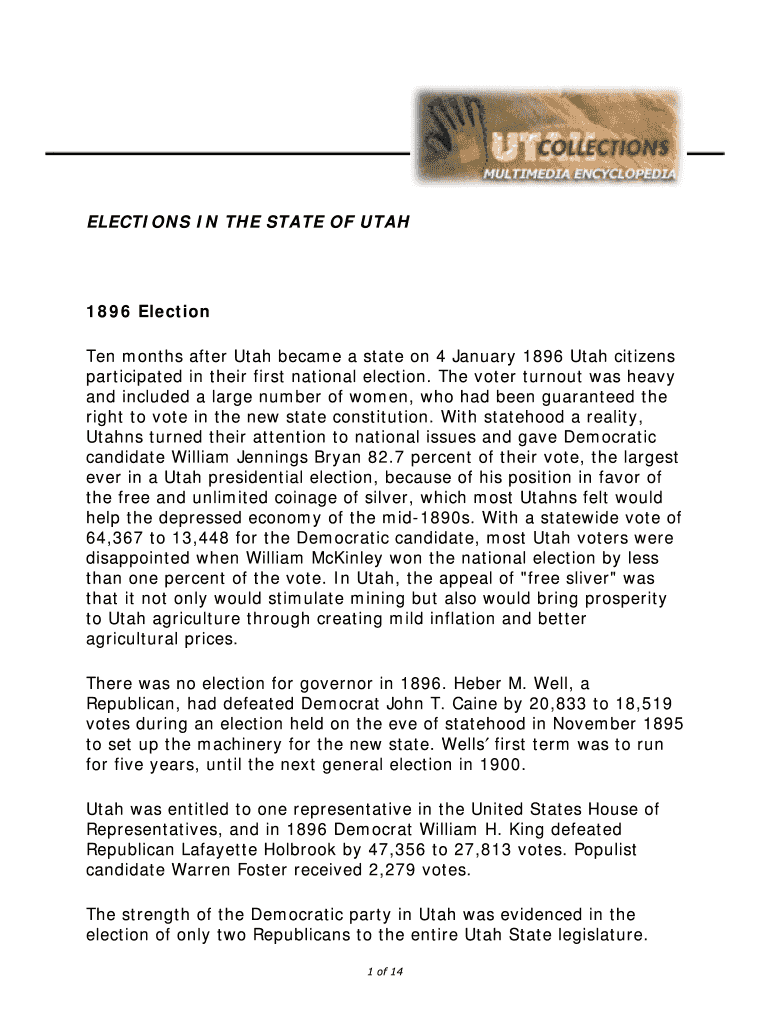
The "Utah History Encyclopedia - eq uen" serves as a comprehensive resource designed to provide detailed insights into the history of Utah. While the exact form or version "eq uen" is not clearly defined within the existing documentation, it can be inferred that it may represent a specific section, edition, or categorization within the broader content of the Utah History Encyclopedia. This encyclopedia is likely a valuable tool for educators, historians, students, and individuals with an interest in Utah's state history.
How to Use the Utah History Encyclopedia - eq uen
Effectively utilizing the Utah History Encyclopedia involves several key steps:
-
Access and Navigation:
- Utilize the table of contents or index to locate specific sections related to Utah's historical periods, events, or figures.
- If available, use digital search features for a more efficient query resolution.
-
Interpretation and Research:
- Analyze the collected data segments for comprehensive understanding.
- Cross-reference with other historical texts to enrich perspective and verify accuracy.
-
Application:
- Integrate insights into academic research papers, public lectures, or private knowledge enhancement sessions concerning Utah's history.
Steps to Complete Research with the Utah History Encyclopedia - eq uen
For a thorough research process using the encyclopedia:
-
Identify the Research Topic:
- Define the specific historical period, event, or individual related to Utah you wish to study.
-
Gather and Organize Information:
- Access pertinent sections of the encyclopedia, and compile notes on significant findings and interpretations.
-
Analyze Collected Data:
- Evaluate and differentiate between primary and secondary insights, focusing on relevance and historical significance.
-
Synthesize and Cite:
- Integrate the information into reports or presentations, ensuring proper citations are used to credit the encyclopedia.
Key Elements of the Utah History Encyclopedia - eq uen
The encyclopedia includes, but is not limited to, the following core elements:
-
Historical Timelines:
- Provides a chronological overview of major events affecting Utah's development over centuries.
-
Biographical Sketches:
- Includes profiles on notable figures in Utah's history, detailing their contributions and impacts.
-
Cultural and Social Dynamics:
- Discusses significant cultural shifts and their implications across different eras in Utah.
Who Typically Uses the Utah History Encyclopedia - eq uen
This resource is prominently utilized by:
-
Academics and Researchers:
- Scholars exploring detailed aspects and narratives within Utah's historical framework.
-
Educators:
- Teachers devising lesson plans or engaging students with in-depth historical contexts.
-
Historians and Enthusiasts:
- Individuals interested in exploring and documenting the nuanced history of Utah.


Important Terms Related to the Utah History Encyclopedia - eq uen
Understanding significant terminology can enhance comprehension:
-
"Pioneer Homes":
- Refers to the dwellings built by early settlers of Utah and their architectural significance.
-
"Statehood Transition":
- The process through which Utah became an official state within the United States in 1896.
-
"Mormon Battalion":
- An essential unit that participated in the Mexican-American War, contributing directly to Utah's territorial recognition.
Legal Use of the Utah History Encyclopedia - eq uen
The use of this encyclopedia generally follows these legal guidelines:
-
Citations and Fair Use:
- When quoting or deriving information from the encyclopedia, users must attribute appropriately according to scholarly standards and fair use policies.
-
Reproduction and Distribution:
- Unauthorized reproduction or widespread distribution of the encyclopedia's content is typically restricted, requiring appropriate permissions.
Examples of Using the Utah History Encyclopedia - eq uen
Consider these scenarios where the encyclopedia provides valuable insights:
-
Educational Curriculum Development:
- Assisting educators in structuring a comprehensive course that covers pivotal events and periods relevant to Utah.
-
Public Lecture Preparation:
- Serving as a foundational resource for speakers at historical societies or educational events highlighting Utah's heritage.
-
Family Genealogy Projects:
- Supporting individuals in tracing ancestral histories through documented events and notable family contributions throughout Utah's development.
Digital vs. Paper Version of the Utah History Encyclopedia - eq uen
The medium of the encyclopedia can vary, offering different user experiences:
-
Digital Version:
- Provides easy access with search features and hyperlinked references, ideal for quick research.
-
Paper Version:
- Offers tactile engagement and a break from digital screens, often preferred by traditional researchers.
These sections collectively guide users through effectively using and understanding the utility and content of the "Utah History Encyclopedia - eq uen" to enhance their exploration of Utah's rich historical landscape.