






Definition and Purpose of the Form RC-1
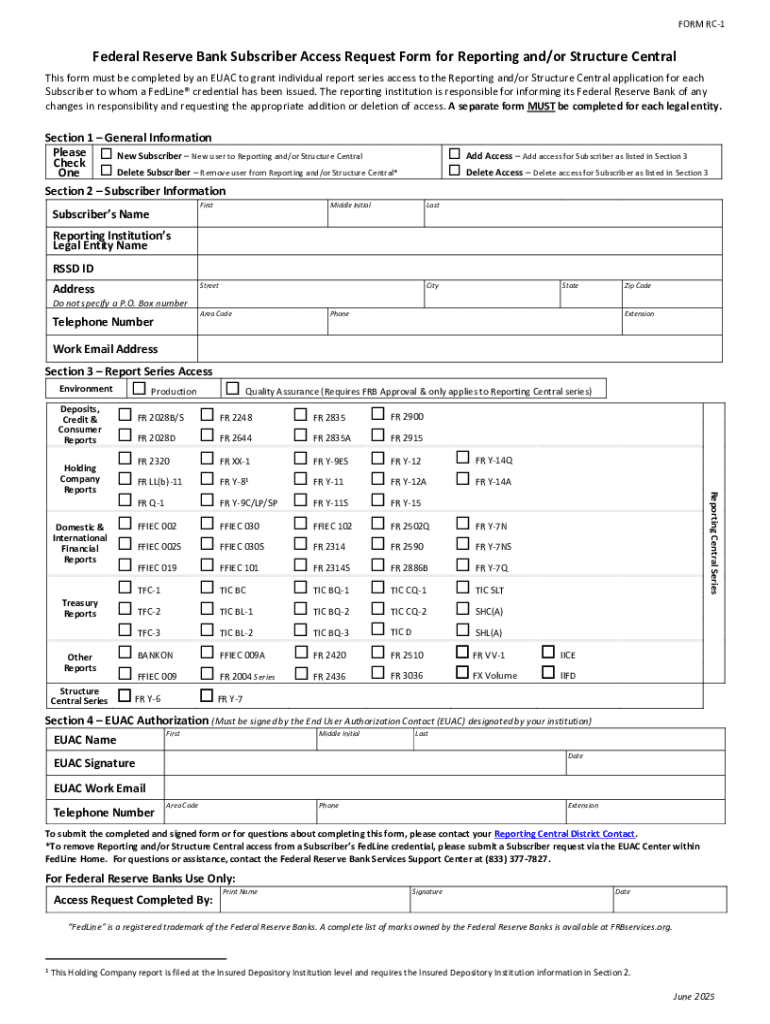
The Form RC-1, also known as the Federal Reserve Bank Subscriber Access Request Form, is designed to grant or modify access for individual users to specific applications such as Reporting and/or Structure Central. This form is essential for managing access permissions within financial institutions, ensuring that authorized individuals have the necessary credentials to interact with sensitive financial reporting systems. The form requires detailed information, including subscriber details and report series access, making it a cornerstone for efficient user management in regulatory environments.
Steps to Complete the Form RC-1
Completing the RC-1 form requires attention to detail and adherence to specific guidelines. Follow these steps to ensure successful submission:
- Provide General Information: Input basic data such as the name of the individual and the entity they represent.
- Subscriber Details Section: Include comprehensive details about the subscriber, such as contact information and user identification number.
- Specify Report Series Access: Indicate which financial reporting series the individual needs access to, and ensure accuracy to avoid access issues.
- End User Authorization Contact (EUAC) Approval: Obtain authorization from an EUAC, who verifies and approves the access request.
- Submission: Submit the form to the appropriate Federal Reserve Bank for processing, ensuring all required fields are complete.
Key Elements of the Form RC-1
The Form RC-1 contains several critical sections that must be completed accurately:
- General Information: Basic details about the user and their organization.
- Subscriber Details: Comprehensive information about the individual seeking access.
- Report Series Access: Specific access rights to the financial reporting series.
- EUAC Authorization: Formal approval from the designated authorization contact within the organization.
Attention to these elements is crucial for accurate processing and access provisioning.
Important Terms Related to the Form RC-1
Understanding specific terminology related to Form RC-1 is vital for its correct completion:
- EUAC (End User Authorization Contact): The designated person responsible for authorizing access requests.
- Subscriber: The individual applying for or having access to the financial application systems.
- Report Series Access: Different categories of financial data that users can access.
Familiarity with these terms supports accurate and efficient completion of the form.
Who Typically Uses the Form RC-1
Form RC-1 is typically used by financial institutions and their employees, particularly those who require access to the Federal Reserve's financial reporting applications. This includes analysts, auditors, compliance officers, and other professionals involved in financial reporting and management. The form ensures that only authorized personnel gain access to sensitive resources, maintaining security and compliance within financial environments.


Who Issues the Form RC-1
The Form RC-1 is issued by the Federal Reserve Bank. It serves as a standardized method to control and secure user access to restricted financial applications. By centralizing control through Federal Reserve Banks, institutions can ensure a unified approach to managing user credentials and access rights, aligning with national regulatory standards.
Form Submission Methods: Online, Mail, or In-Person
There are several ways to submit Form RC-1, offering flexibility to meet different institutional needs:
- Online Submission: Often the fastest method, allowing digital completion and direct submission through an online portal.
- Mail: Submission via postal services, ideal for institutions preferring traditional methods or with limited digital access.
- In-Person: Some institutions may allow hand-delivery for added security and verification.
Choosing the optimal submission method depends on the institution's resources and preferences.
Penalties for Non-Compliance with Form RC-1
Failure to comply with the requirements of Form RC-1 can lead to serious consequences, including potential sanctions from regulatory bodies. Non-compliance might result in restricted access to vital financial systems, fines, or increased scrutiny from regulatory entities. It is crucial for institutions to complete and submit the form accurately and timely to maintain compliance and minimize operational disruptions.
Business Entity Types Benefiting from Form RC-1
Various business entities stand to benefit significantly from using Form RC-1, particularly those involved in finance:
- Banks and Credit Unions: Need access to financial reporting systems for regulatory compliance.
- Investment Firms: Require detailed financial data access for managing portfolios.
- Insurance Companies: Utilize financial reporting access to inform financial strategies and risk assessments.
Entities requiring precise and regulated access to federal financial systems will find the RC-1 form integral to their operations.