







Definition and Meaning
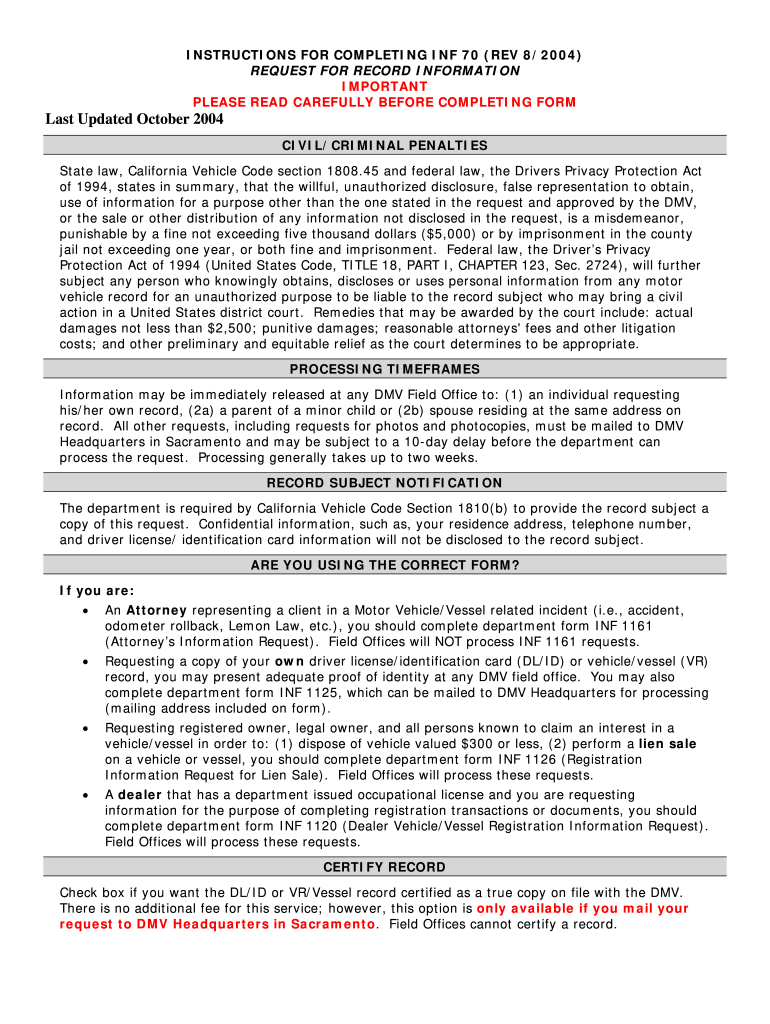
The INF 70 form, commonly known as a Request for Record Information, is a document issued by the California Department of Motor Vehicles (DMV) that allows individuals and entities to request specific vehicle record information. This form is integral for accessing publicly available data related to vehicles registered in California. These records might include title information, vehicle identification numbers (VIN), and registration details, depending on the intended purpose and legal allowances. Understanding the scope and limitations of the INF 70 form is crucial for ensuring compliance with state guidelines and avoiding unauthorized disclosure.
How to Use the INF 70
To utilize the INF 70 form effectively, you must first determine the type of vehicle information needed. This could range from ownership histories to lien holder details. Following this, fill out the form ensuring all sections are complete. It’s important to specify the reason for the information request, as certain data can only be accessed for specific purposes such as legal proceedings or insurance claims. Accuracy is paramount; any discrepancies could lead to processing delays or rejections. Review each section carefully to ensure that personal and vehicle details are correctly entered.
Steps to Complete the INF 70
- Obtain the Form: Download the INF 70 form from the California DMV website or visit a local DMV office.
- Identify Request Type: Clearly specify the type of record information needed and the purpose of the request to avoid unnecessary delays.
- Fill Out Applicant Information: Provide personal details such as name, address, and contact information.
- Specify Vehicle Details: Include the vehicle's VIN, license plate number, and any relevant information that helps identify the record.
- Reason for Request: Clearly state the legal or permissible purpose for requesting the record, as per California law.
- Sign and Date the Form: Ensure that the form is signed and dated before submission.
- Submit the Form: Send the completed form through the specified submission guidelines—via mail or in-person at a DMV office.
Required Documents
When submitting the INF 70 form, accompanying documents may be required to validate the request. These could include proof of identity, such as a driver's license or state ID, and proof of legal standing if acting on behalf of an organization. Additionally, if the request pertains to a legal matter, supporting paperwork such as subpoenas or court orders must be provided. These documents serve to confirm that the request is legitimate and aligns with California laws concerning privacy and record access.
Penalties for Non-Compliance
Non-compliance with the guidelines for requesting vehicle records via the INF 70 can result in several penalties. Unauthorized access or misuse of the information can lead to legal actions under state and federal laws. Moreover, penalties may include fines or other legal consequences, especially if the information is obtained for non-permissible purposes or is disclosed to unauthenticated parties. Ensuring all actions are within the legal framework is essential while processing the INF 70 form.
Legal Use of the INF 70
The legal use of the INF 70 form is restricted to purposes approved by state and federal laws. Authorized uses include processing insurance claims, enforcing legal judgments, verifying information for employment-related background checks, or conducting official research. Violating these legal boundaries by using the information for personal gain or other unauthorized purposes can result in significant legal repercussions.
Important Terms Related to the INF 70
- DMV: The Department of Motor Vehicles, responsible for keeping and issuing vehicle records.
- VIN (Vehicle Identification Number): A unique code used to identify individual motor vehicles.
- Authorized Requestor: An individual or entity permitted by law to access vehicle records.
- Permissible Use: Defined legal reasons for requesting and accessing vehicle records.
- Confidential Record Information: Sensitive data that is protected by privacy laws and only disclosed under strict criteria.
State-Specific Rules for the INF 70
California has specific statutes governing the use of the INF 70 form. These statutes dictate who can access vehicle records, what type of information can be disclosed, and the permissible purposes for which it can be used. Understanding these state-specific rules is crucial for ensuring that the request complies with the legal framework that protects vehicle owners’ privacy. Non-compliance with these rules can lead to rejection of requests and potential legal penalties.
Who Typically Uses the INF 70
The INF 70 form is typically utilized by a range of requestors, including:
- Legal Professionals: Seeking information for use in litigation or legal proceedings.
- Insurance Companies: For underwriting or claims processing.
- Government Agencies: Conducting investigations or regulatory compliance checks.
- Employers: Performing background checks on employees or potential hires.
- Individual Vehicle Owners: Requesting information on their own vehicles for personal records.






