01. Edit your form online
Type text, add images, blackout confidential details, add comments, highlights and more.

Type text, add images, blackout confidential details, add comments, highlights and more.

Draw your signature, type it, upload its image, or use your mobile device as a signature pad.

Send it via email, link, or fax. You can also download it, export it or print it out.
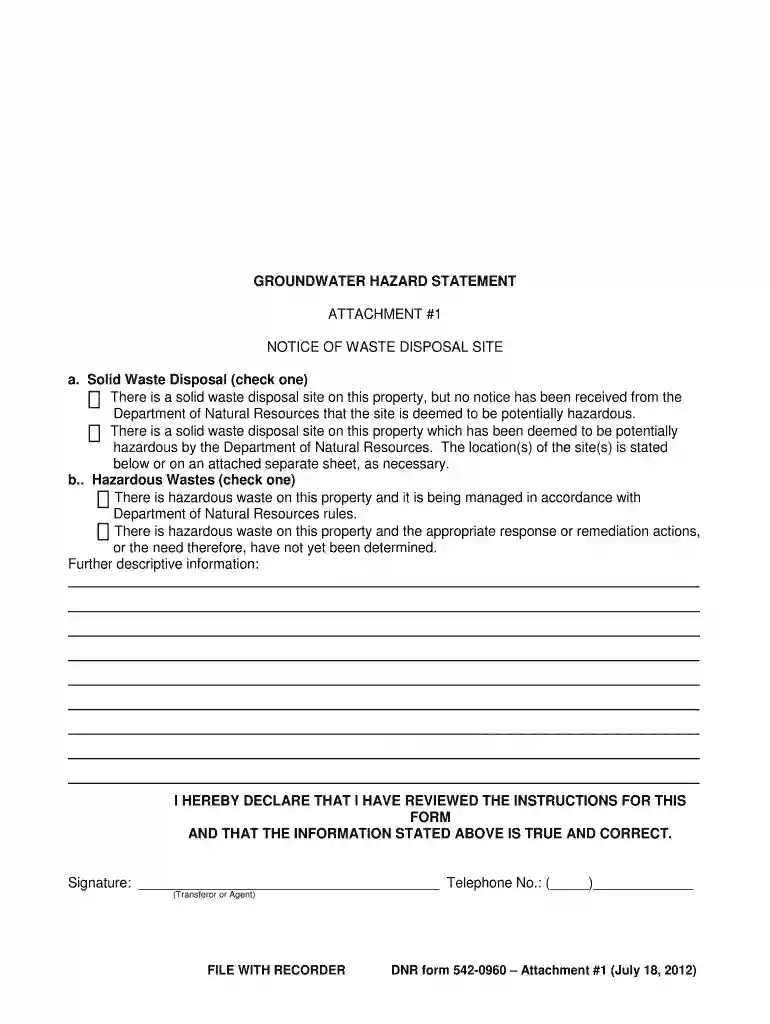
The Groundwater Hazard Statement is a critical document notifying the presence of solid waste disposal sites or hazardous wastes on a property. It is employed by property owners or their agents when dealing with property transfers and ensures informed decisions about waste management. The statement works as an acknowledgment and certification of the property’s environmental condition, providing details on waste materials, site assessments, and potential remediation efforts required by the Department of Natural Resources.
Utilizing the Groundwater Hazard Statement involves a structured process where property owners must disclose any known hazardous waste situations on their lands. The completed form must be shared with buyers during real estate transactions, offering transparency on any risks related to solid waste disposal or contamination. The statement acts as part of the due diligence process, helping facilitate safe land transfers by ensuring all parties are aware of potential environmental hazards, which may require mitigation or remediation.
Individuals can obtain the Groundwater Hazard Statement through state-specific departments dealing with environmental affairs or natural resources. Typically, forms are available online as downloadable PDFs or paper copies upon request from the relevant state agency. In some cases, local government offices handling property transactions may also provide these forms. Once acquired, correct and thorough completion of this form requires documenting known conditions relevant to solid waste and potential hazards.
The primary incentive for using a Groundwater Hazard Statement is to ensure environmental compliance and transparency during property transactions. It protects both the buyer and seller by formally disclosing potential environmental hazards that may affect property value or usage. This document helps mitigate future liability issues and ensures that environmental regulations are adhered to, thereby facilitating informed decision-making for potential property managers or owners.
Typically, the Groundwater Hazard Statement is used by property owners, real estate agents, developers, and legal professionals involved in property transactions. Government entities and environmental agencies might also utilize it to track and manage information regarding properties with known environmental hazards. Buyers and potential investors use these statements to assess environmental risks before purchasing a property.


Using the Groundwater Hazard Statement legally involves abiding by state laws and regulations that govern property transactions and environmental disclosures. Property owners and agents must ensure that all information provided is truthful and comprehensive, reflecting any potential environmental hazards. Non-compliance or falsification can result in legal penalties or liability for damages, emphasizing the importance of accuracy and honesty.
Rules and requirements for the Groundwater Hazard Statement can vary significantly by state. Specific guidelines determine how waste sites must be declared and what constitutes adequate remediation according to regional environmental standards. Understanding these regional differences is crucial for compliance, as some states may require additional documentation or assessments based on their unique environmental laws and property transaction requirements.
Deadlines and critical dates associated with the Groundwater Hazard Statement coincide with the closing stages of property sales or transfers. It's imperative to ensure that this document is completed, signed, and submitted before finalizing any transaction. Specific states may designate precise periods within which documents must be filed to be compliant with local laws.
The Groundwater Hazard Statement can typically be submitted in multiple ways:
We've got more versions of the GROUNDWATER HAZARD STATEMENT a Solid Waste Disposal (check form. Select the right GROUNDWATER HAZARD STATEMENT a Solid Waste Disposal (check version from the list and start editing it straight away!
| Versions | Form popularity | Fillable & printable |
|---|---|---|
| 2012 | 4.8 Satisfied (100 Votes) |
At DocHub, your data security is our priority. We follow HIPAA, SOC2, GDPR, and other standards, so you can work on your documents with confidence.