01. Edit your form online
Type text, add images, blackout confidential details, add comments, highlights and more.

Type text, add images, blackout confidential details, add comments, highlights and more.

Draw your signature, type it, upload its image, or use your mobile device as a signature pad.

Send it via email, link, or fax. You can also download it, export it or print it out.
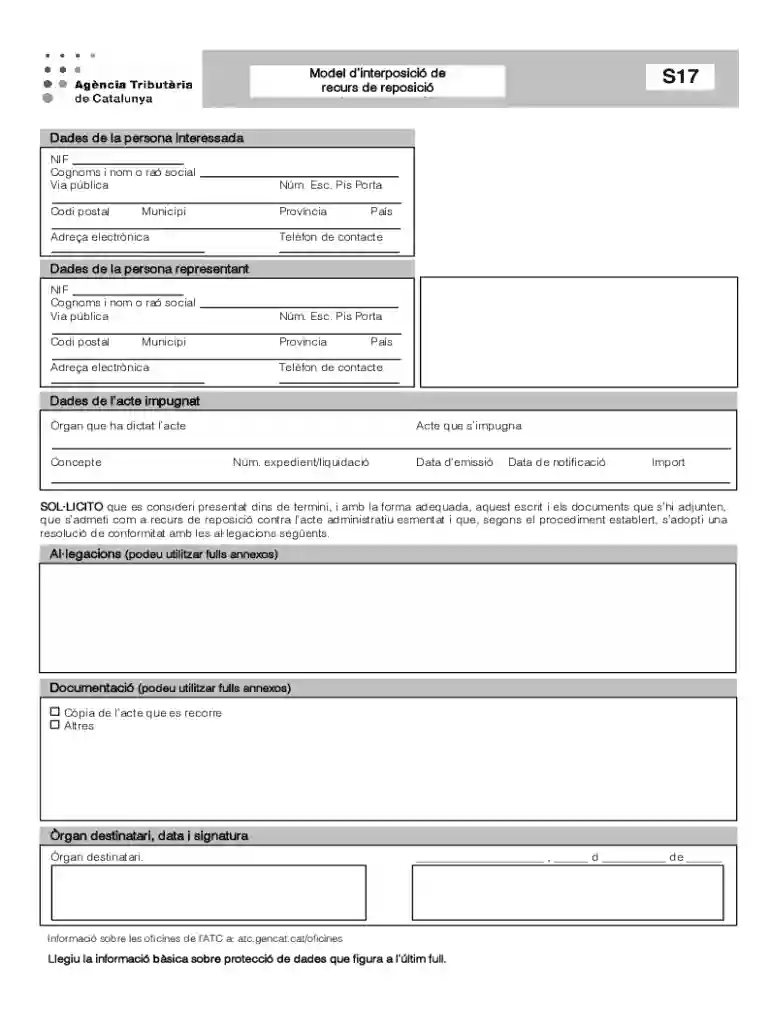
The "Model D interposici De Recurs De Reposici" is an official form used in Catalonia for filing an administrative appeal known as a 'recurs de reposició'. This appeal is aimed at reconsidering decisions made by public administrations. Typically utilized when a party is unsatisfied with a resolution, the appeal's objective is to review and potentially overturn the decision based on the information presented.
To effectively utilize the Model D, one must understand the specific sections it comprises. The form requires detailed personal information about the appellant and their representative, if applicable. It also demands complete identification of the act being contested, including clear and logical arguments for reconsideration. Attachments of supporting documentation enhance the appeal's credibility and completeness.
Understanding legal and administrative terminology used in the form is crucial for accurate completion:
The Model D is legally utilized within Catalonian administrative processes. It serves as a formal method for citizens to challenge government resolutions, ensuring administrative accountability and fairness. Filers must comply with the deadlines and procedural rules established by local regulations to maintain the appeal's validity.
Timeliness is critical when dealing with administrative appeals. In Catalonia, the period to file a 'recurs de reposició' is generally within one month from the date of the administrative resolution notification. Missing this deadline can lead to automatic dismissal of the appeal.
To support your appeal effectively, attach:
Submitting the Model D can be done through various channels:
Selecting the appropriate submission method depends on personal preference and immediacy of the required resolution.
At DocHub, your data security is our priority. We follow HIPAA, SOC2, GDPR, and other standards, so you can work on your documents with confidence.