






Definition and Purpose of a Traffic Clearance Certificate
A Traffic Clearance Certificate serves as an official document provided by law enforcement authorities that verifies an individual's clean traffic record within a specified jurisdiction. In the context of the Royal Cayman Islands Police Service, this form is essential for residents or individuals who have previously resided in or visited the Cayman Islands and may need to demonstrate that they have no traffic-related offenses or convictions. This certificate can play a significant role in legal verifications, employment screening, and immigration processes where a clean driving record is crucial.
Key Features of the Certificate
- Verification of Driving History: Confirms the absence of traffic violations, which may include speeding tickets, DUI offenses, or other notable infractions.
- Official Authentication: The document is signed and sealed by competent authorities, enhancing its credibility for official use.
- Application Scope: Primarily used in international processes, such as visa applications or employment opportunities abroad, where driving history transparency is mandatory.
Steps to Complete the Traffic Clearance Certificate
Completing the Traffic Clearance Certificate accurately ensures its credibility and validity. Applicants must be meticulous and provide thorough information to avoid delays or rejections.
Detailed Step-by-Step Procedure
-
Gather Personal Identification Documents:
- Valid passport or identification card
- Proof of previous residency or visits to the Cayman Islands
-
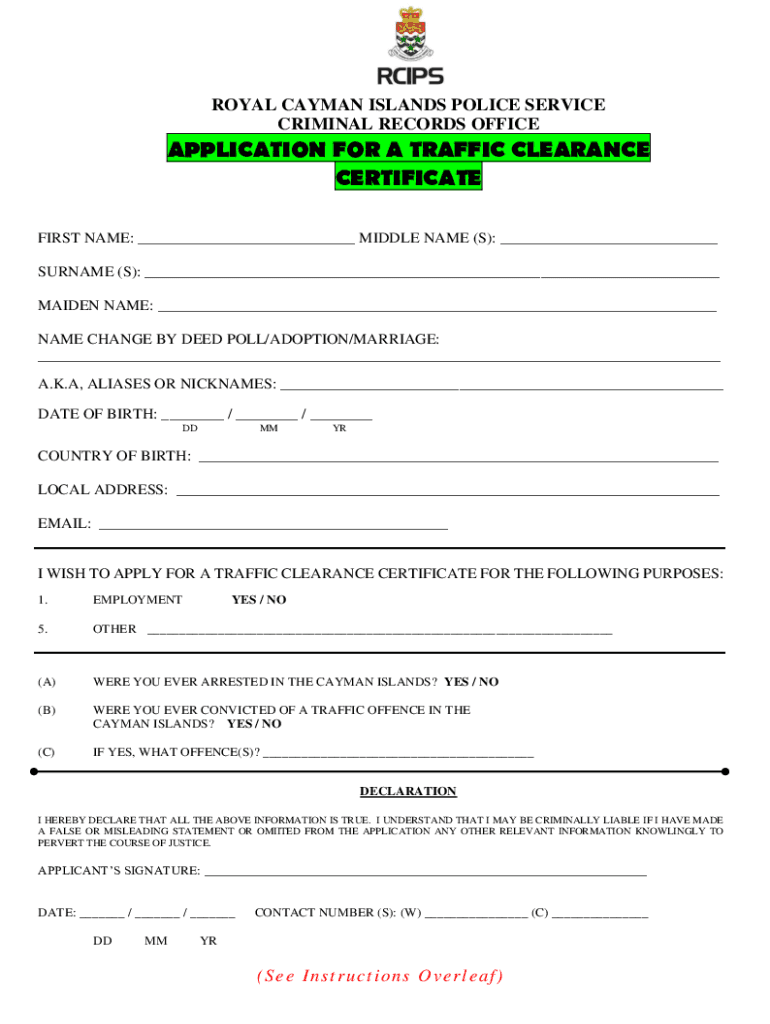
Complete the Application Form:
- Provide full name, date of birth, and current address
- Include specific details about any prior convictions or arrests in the Cayman Islands, even if minor
-
Declaration Section:
- Affirm the truthfulness of all information provided
- Signature acknowledgment to finalize the form
-
Submit the Application:
- Preferred online submission through designated portals
- Attach necessary supporting documents, like identification copies
-
Fee Payment:
- Process payment as required, adhering to acceptable payment methods
- Keep a receipt for your records
-
Track the Application:
- Utilize any tracking mechanisms offered via the submission portal to monitor processing status
Tips for Efficient Completion
- Double-check all entries for accuracy and completeness to prevent processing delays.
- Ensure all attachments are clear copies and legible.
Obtaining the Traffic Clearance Certificate
Securing a Traffic Clearance Certificate involves engaging with law enforcement authorities, either directly in the Cayman Islands or through official channels if applicants are abroad.
Application Channels and Timeframes
-
Online Submissions:
- Preferred method due to efficiency and quick processing times
- Receive electronic acknowledgements and updates
-
In-Person Submissions:
- Direct submission in the Cayman Islands
- May allow for immediate feedback on application completeness
-
Submission via Mail:
- Offered for international applicants unable to use online platforms
- Longer processing times; include self-addressed and stamped envelope for return
Processing Time
- Expected timelines may vary based on submission method and current demand
- Typical processing duration ranges from one to three weeks
Importance of a Traffic Clearance Certificate
The Traffic Clearance Certificate holds significant importance for various legal, professional, and personal aspects.
Why It's Essential
- Employment Prospects: Employers often require verification of a clean driving record, especially for roles involving company vehicles.
- Legal Compliance: Serves as a formal proof required in legal settings to verify character integrity.
- Immigration Requirements: Supports visa and residency applications, demonstrating compliance with traffic laws in previous jurisdictions.
Situational Scenarios
- Applying for a job overseas that involves driving responsibilities
- Seeking residency or citizenship in a new country where character assessment includes driving history
- Participating in international driving competitions or events
Understanding Important Terms and Conditions
Several crucial terms relate to the Traffic Clearance Certificate, ensuring applicants have a clear understanding of the process and requirements.
Key Terms Explained
- Certificate Validity: Duration for which the certificate is considered current; often limited to a few months.
- Conviction Record: Any recorded decision of guilt for a traffic offense, which could affect certificate issuance.
- Traffic Violations: Acts of non-compliance with road safety regulations subject to fines or penalties.
Conditions for Issuance
- Certificate is issued based only on official records maintained by the issuing law enforcement body.
- Any pending or unresolved traffic matters must be concluded before application processing.
Use Cases for the Traffic Clearance Certificate
The Traffic Clearance Certificate is integral in a variety of situations that require historical verification of driving conduct.
Common Use Cases
- Professional Licensing: Certain professions require proof of a clear traffic history for licensure.
- Education Opportunities Abroad: Students applying for certain international programs may need this document as part of their application.
- International Relocation: As part of broader background checks, especially in countries with stringent safety records for immigrants or expatriates.
Practical Examples
- An applicant requiring the certificate due to a job opportunity in Canada involving transportation.
- A student needing the certificate to apply for a scholarship at a university in Australia, where road safety is emphasized.
Variants and Alternatives to the Traffic Clearance Certificate
Though the Traffic Clearance Certificate is specific to certain jurisdictions, there are related forms and certificates with similar purposes.
Exploring Other Options
- Police Clearance Certificate: Offers broader criminal record checks including traffic offenses; often interchangeable in broader contexts.
- Driver's Abstract: Obtained from the Department of Motor Vehicles, detailing driving history within the United States.
When to Consider Alternatives
- If broader criminal background checks are required beyond traffic-related concerns
- For jurisdictions that offer localized driving history reports with comprehensive details tailored to specific applications