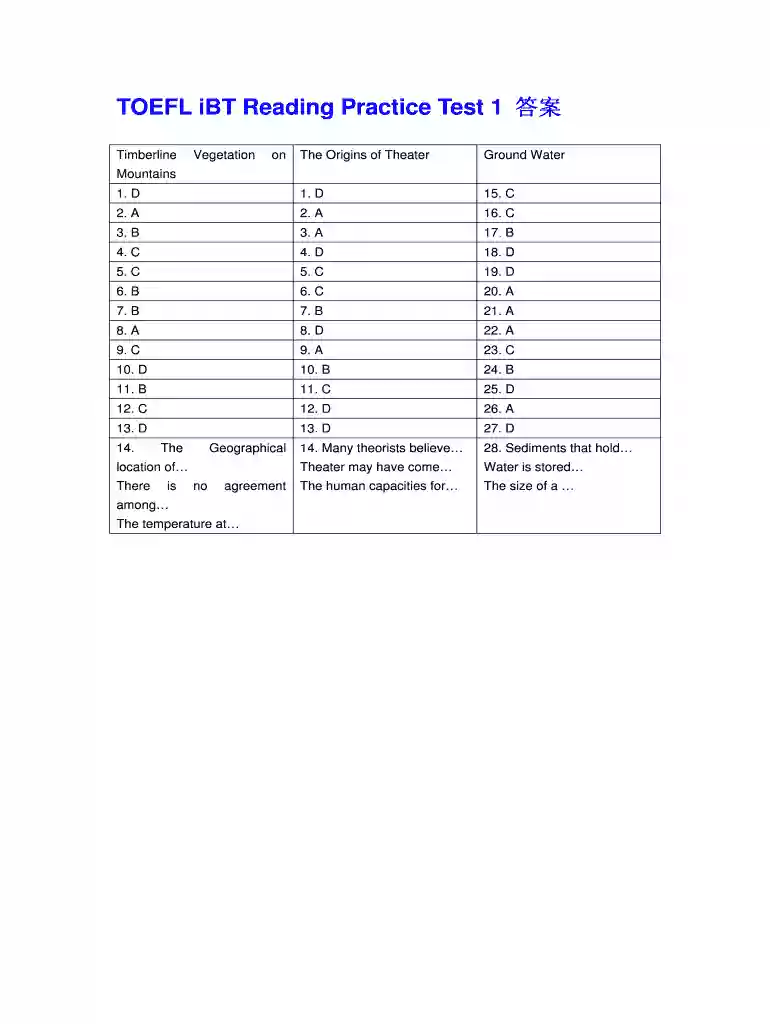
TOEFL iBT Reading Practice Test 1 2026

Get Form
TOEFL iBT Reading Practice Test 1 Preview on Page 1

Here's how it works

01. Edit your form online
Type text, add images, blackout confidential details, add comments, highlights and more.

02. Sign it in a few clicks
Draw your signature, type it, upload its image, or use your mobile device as a signature pad.

03. Share your form with others
Send it via email, link, or fax. You can also download it, export it or print it out.

Understanding the TOEFL iBT Reading Practice Test 1

The TOEFL iBT Reading Practice Test 1 is a crucial tool for individuals preparing for the Test of English as a Foreign Language (TOEFL) Internet-Based Test (iBT). This section measures a candidate's ability to understand and analyze university-level academic texts. It includes various question types requiring skills such as identifying main ideas, understanding details, and making inferences. This test assesses how well test-takers can read and comprehend passages that are similar to those found in university courses.

How to Effectively Use the TOEFL iBT Reading Practice Test 1

To maximize the benefits of the TOEFL iBT Reading Practice Test 1, individuals should employ strategic study techniques. Begin by familiarizing yourself with the structure and format of the test, which typically includes passages on diverse topics, ranging from sciences to humanities. Read each passage carefully, and practice answering questions to get accustomed to the test's timing and question styles.

Strategic Reading Techniques

  • Skimming and Scanning: Use these techniques to quickly gather the main ideas and locate specific information.
  • Critical Analysis: Engage with the text by summarizing paragraphs and predicting possible questions.

Practice Questions

  • Multiple-Choice Questions: Focus on questions related to the main idea, supporting details, or vocabulary in context.
  • Sentence Insertion and Summary: Practice identifying where new sentences fit or choosing the best summary of a passage.

Steps to Complete the TOEFL iBT Reading Practice Test 1

Completing the TOEFL iBT Reading Practice Test 1 involves several key steps. Begin by creating a test-like environment to simulate real exam conditions. Set a timer based on the actual time allocation given during the TOEFL iBT.

  1. Read Instructions Carefully: Understand the directions for each type of question before starting.
  2. Manage Your Time: Allocate your time wisely to ensure that you can read passages and answer all questions.
  3. Review Your Answers: If time permits, review your answers to ensure accuracy.

Who Typically Uses the TOEFL iBT Reading Practice Test 1

The TOEFL iBT Reading Practice Test 1 is primarily used by non-native English speakers who aim to study at English-speaking universities. It is also utilized by individuals looking to evaluate their English reading proficiency for professional opportunities.


decoration image ratings of Dochub

Typical Users:

  • Prospective Students: Individuals applying to academic institutions.
  • Professionals: Those needing certification for employment in English-speaking countries.
  • ESL Teachers and Tutors: To guide students in preparing for the TOEFL iBT.

Key Elements of the TOEFL iBT Reading Practice Test 1

Understanding the key components of the TOEFL iBT Reading Practice Test 1 can help in the preparation process. The test comprises academic passages followed by a series of questions.

Main Components:

  • Academic Passages: Generally consist of 700 words extracted from college-level textbooks.
  • Question Types: Include multiple-choice, sentence completion, and drag-and-drop tasks.

Digital vs. Paper Version of the TOEFL iBT Reading Practice Test 1

The TOEFL iBT is predominantly digital, reflecting real-world testing conditions. However, paper versions may be used for certain accommodations.

Key Differences:

  • Digital Advantages: Familiarizes users with the digital interface of the actual TOEFL iBT exam.
  • Paper Version: Offers a tactile experience for those more comfortable with paper-based testing.

Eligibility Criteria for the TOEFL iBT Reading Practice Test 1

Eligibility to use the TOEFL iBT Reading Practice Test 1 aligns with the general requirements to take the TOEFL iBT exam itself.

decoration image

General Eligibility:

  • Educational Background: Typically aimed at individuals with a high school diploma or equivalent.
  • Age: There is no specific age requirement, although most high school students, college applicants, and adults seeking professional certification take this test.

Variations and Alternatives to the TOEFL iBT Reading Practice Test 1

Several versions and alternative practice tests are available to cater to varied learning needs and preferences. These practice materials include different practice tests that focus on enhancing reading skills.

Alternates:

  • TOEFL Practice Online (TPO): Offers access to more practice tests with varying difficulty.
  • Self-Study Guides: Include comprehensive reading strategies and practice exercises.

Exploring a combination of tests and guides helps broaden understanding and can improve performance by exposing users to a variety of question types and academic topics.

be ready to get more

Complete this form in 5 minutes or less

Get form

Got questions?

We have answers to the most popular questions from our customers. If you can't find an answer to your question, please contact us.
Contact us
Here is a short summary of the four official ETS proficiency levels for TOEFL Reading: Advanced (24-30 Scaled Score):Test-takers with Advanced Reading proficieny generally have an introductory university level understanding of academic passages.
Total score comparison table CEFR levelTOEFL Essentials overall band score (1-12)TOEFL iBT total score (0-120) C1 1011.5 95113 B2 89.5 7294 B1 57.5 4271 A2 34.5 n/a3 more rows
Lets jump right in! Tip #1: Memorize the question types. Tip #2: Find keywords and focus on them. Tip #3: Practice reading with a timer. Tip #4: Beware of modifiers in answer choices. Tip #5: Store knowledge of academic vocabulary. Tip #7: Be an active reader. Tip #8: Study the same test more than once.
Yes, a score of 101 out of 120 on the TOEFL (Test of English as a Foreign Language) is considered a very good score. Generally, a score of 100 or above is seen as proficient and is often sufficient for admission to many universities, especially in English-speaking countries.
Scoring 100 on the TOEFL is achievable but requires a solid understanding of academic English and effective test-taking strategies. While it may not be easy for everyone, with dedicated preparation and practice, many test-takers can docHub this goal.

Security and compliance

At DocHub, your data security is our priority. We follow HIPAA, SOC2, GDPR, and other standards, so you can work on your documents with confidence.

Learn more
ccpa2
pci-dss
gdpr-compliance
hipaa
soc-compliance

People also ask

For the Internet-based Test (iBT), TOEFL scores range from 0 to 120 and are divided as follows: Top Universities: These institutions usually require higher scores, generally from 100 to 120. Average Universities: A good score would be in the range of 80 to 100 for students aiming for these universities.
The TOEFL exam is considered one of the most difficult exams, especially for those who are not comfortable with academic English. Conducted by ETS, it is a crucial requirement for international students seeking admission to universities in English-speaking countries like the USA, UK, Canada, and Australia.

Related links