Definition & Meaning
The "Working Papers Form" is a crucial document required for minors seeking employment in the United States. It establishes that a young person is eligible and authorized to work, following specific regulations set to protect their well-being. This form is essential for ensuring compliance with labor laws related to minors and confirms that the employment does not interfere with their education or well-being.
Key Functions
- Eligibility Confirmation: Validates that the minor meets age and legal criteria for employment.
- Parental/Guardian Consent: Ensures that the guardian acknowledges and consents to the minor's employment.
- Legal Compliance: Adheres to state and federal labor regulations, safeguarding minors from exploitation.
How to Obtain the Working Papers Form
Obtaining a Working Papers Form involves multiple steps, which vary slightly depending on the state. However, typical procedures include:
- Initial Inquiry: Contact the school guidance office or local Department of Labor for the specific form and instructions.
- Documentation: Gather necessary documents such as proof of age (e.g., birth certificate), current school enrollment, and parental consent.
- Application Submission: Submit the completed form and required documents to the designated school or state office.
State Variations
- New York: Minors can obtain working papers through their school. During summer, the school district office usually handles requests.
- California: The state's DLSE often provides guidance, with forms available online or via school districts.
Steps to Complete the Working Papers Form
Completing the Working Papers Form thoroughly is critical for approval. Here's a step-by-step guide:
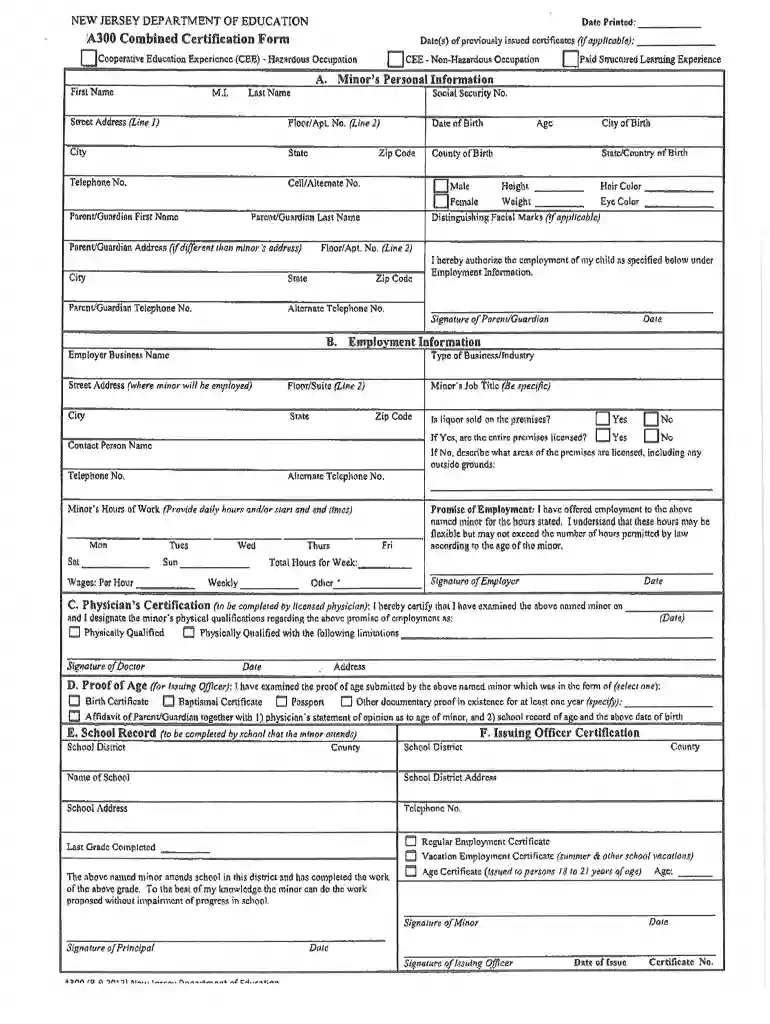
- Personal Information: Fill in sections with the minor's full name, address, and date of birth.
- Employment Details: Identify prospective employer information, including business name and type of job.
- School Official Certification: Obtain required sign-offs from school administrators confirming the minor’s academic standing.
- Physician’s Certification: Some states require a health examination, where a physician must certify the minor’s physical capability to work.
- Parental Consent: Have a parent or guardian sign the consent section, acknowledging awareness of the employment terms.
Key Elements of the Working Papers Form
Understanding the critical elements of the form helps ensure all necessary information is accurately provided:
- Personal and Contact Details: Accurate information about the applicant is foundational.
- Proof of Age: Usually validated through a birth certificate or passport.
- School and Education Records: Confirms that the employment won't impact educational commitments.
- Job Details: Includes the nature of the job, hours, and working conditions.
Legal Use of the Working Papers Form
The Working Papers Form has a vital legal function:
- Age Verification: Confirms legal age requirements based on state and federal laws.
- Employment Limitations: Outlines restrictions on working hours and conditions specific to minors.
- Protection Measures: Protects minors from hazardous employment situations and ensures rights are upheld.
State-Specific Rules for the Working Papers Form
Each state might have specific rules and variations:
- Working Hours: Vary per state, affecting how long minors can work during school days versus vacations.
- Prohibited Jobs: Some states specify industries or job types considered hazardous or inappropriate for minors.
Examples
- Texas: Allows limited working hours during school weeks, expanding during summer.
- Illinois: Prohibits minors from working in construction and heavy manufacturing sectors.
Who Issues the Form
Typically, the form is issued by:
- Schools: Most commonly where minors are enrolled and supervised by school authorities.
- Department of Labor: For some states, this department directly manages issuance.
Required Documents
The documentation process is essential for verifying eligibility:
- Proof of Age: Such as a birth certificate.
- Parental Consent: Signed agreement from a guardian.
- School Records: Recent report card or verification of current enrollment.
Digital vs. Paper Version
Options for the form are increasing with technology advances:
- Digital Forms: Many states offer online submission, which can be quicker and more efficient.
- Paper Forms: Still widely used for submission in-person or via mail, especially where internet access might be limited.