




01. Edit your form online
Type text, add images, blackout confidential details, add comments, highlights and more.

Type text, add images, blackout confidential details, add comments, highlights and more.

Draw your signature, type it, upload its image, or use your mobile device as a signature pad.

Send it via email, link, or fax. You can also download it, export it or print it out.
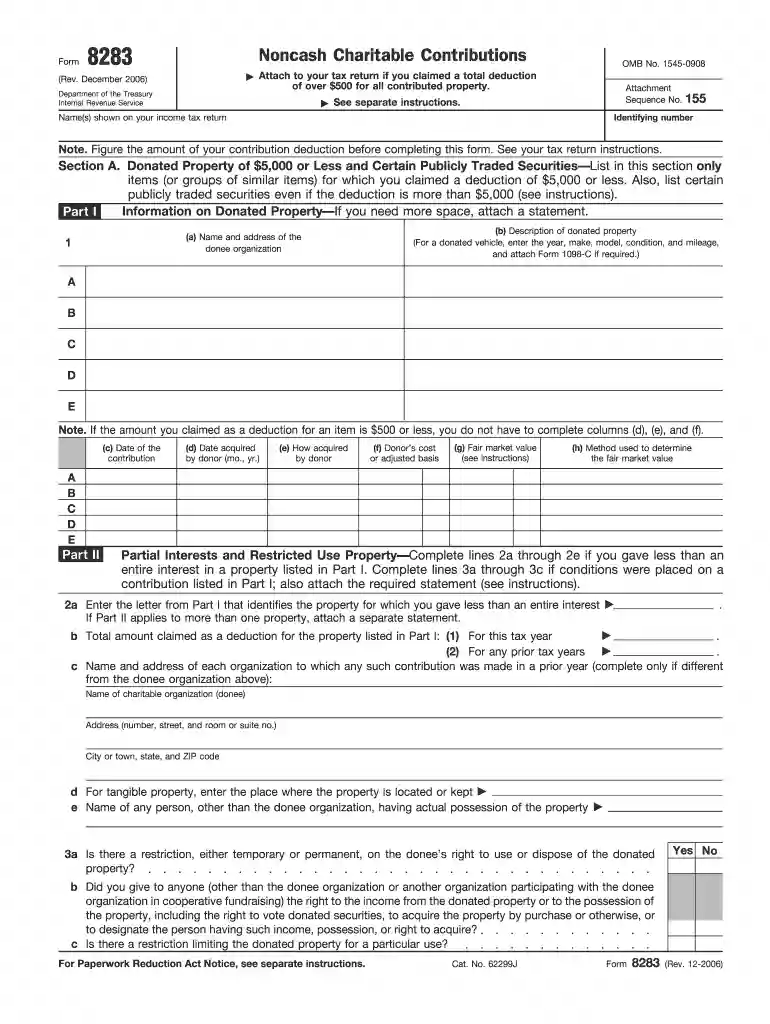
Form 8283, known officially as "Noncash Charitable Contributions," is used by taxpayers in the United States to report information about noncash charitable contributions when they exceed $500. This form is particularly crucial for individuals or organizations looking to claim deductions for their charitable donations of property. It is divided into sections that document details of donated property valued at $5,000 or less and more than $5,000, ensuring compliance with IRS tax deduction criteria. Adequate documentation includes information about the donor, the donee organization, property description, fair market value, and any usage restrictions.
Filling out the 8283 form requires attention to detail:
Complete Section A: Enter details for donations over $500 but not exceeding $5,000. This includes the description of the items, the value, and information about the receiving organization.
Fill Section B: For donations exceeding $5,000, you'll need detailed appraisals, typically by a qualified professional.
Obtain Signatures: Both the donor and possibly an appraiser must sign declarations affirming the fair market value of the property donated.
Form 8283 can be accessed via the IRS website, downloaded as a PDF, or acquired from tax preparation software like TurboTax or QuickBooks. Here’s how to download it:
Follow these steps:
Form 8283 is pivotal for maximizing tax deductions related to noncash charitable contributions. Proper filing:
Non-compliance with IRS rules can lead to disallowed deductions, fines, and potential audits. Examples of non-compliance include:
Form 8283 can be submitted either electronically with your e-filed tax return or mailed alongside a paper tax return. Electronic submission is often advisable due to speed and efficiency. Here’s how:
Eligibility for filing includes any U.S. taxpayer who has donated noncash property over $500 within a tax year. Essential criteria encompass:
Provide detailed explanations for clarity and comply with IRS standards to optimize charitable contribution deductions.


We've got more versions of the 8283 rev 2006 form form. Select the right 8283 rev 2006 form version from the list and start editing it straight away!
| Versions | Form popularity | Fillable & printable |
|---|---|---|
| 2023 | 4.9 Satisfied (51 Votes) | |
| 2022 | 4.9 Satisfied (38 Votes) | |
| 2021 | 4.8 Satisfied (46 Votes) | |
| 2020 | 4.1 Satisfied (63 Votes) | |
| 2019 | 4.3 Satisfied (104 Votes) | |
| 2014 | 4.4 Satisfied (270 Votes) | |
| 2013 | 4.3 Satisfied (70 Votes) | |
| 2012 | 4.2 Satisfied (69 Votes) | |
| 2006 | 4.2 Satisfied (39 Votes) | |
| 1995 | 4 Satisfied (32 Votes) |
At DocHub, your data security is our priority. We follow HIPAA, SOC2, GDPR, and other standards, so you can work on your documents with confidence.
Figure the amount of your contribution deduction before completing this form. See your tax return instructions. Section A. Donated Property of $5,000 or LessRead more
Apr 1, 2019 Revenue included on Form 990, Part VIII, line 1 Number of Forms 8283 received by the organization during the tax year for contributions.Read more
You cannot claim a deduction for clothing or household items you donate after August 17, 2006, unless the clothing or household items are in good used conditionRead more


