




01. Edit your irs form 8283 for 2023 online
Type text, add images, blackout confidential details, add comments, highlights and more.

Type text, add images, blackout confidential details, add comments, highlights and more.

Draw your signature, type it, upload its image, or use your mobile device as a signature pad.

Send form 8283 instructions 2023 via email, link, or fax. You can also download it, export it or print it out.
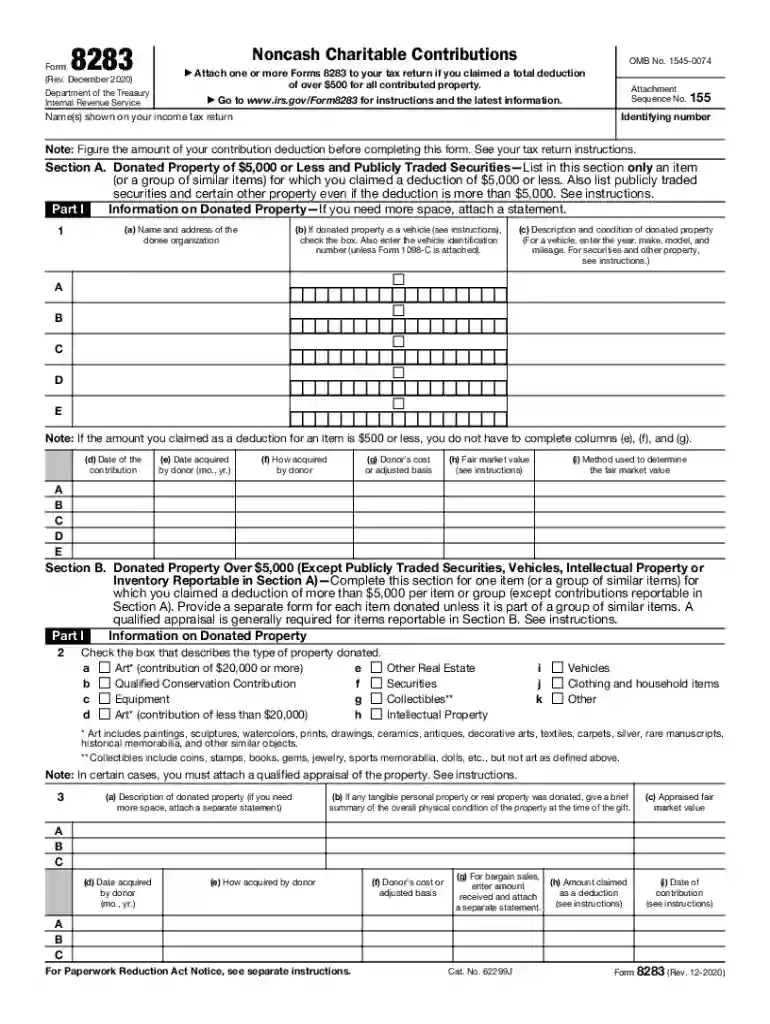
Form 8283 is a tax document utilized by the Internal Revenue Service (IRS) for reporting noncash charitable contributions that exceed $500. The form requires taxpayers to provide detailed information about donated items, including their condition, fair market value, and the recipient organization. It's crucial for ensuring transparency and accuracy in claiming tax deductions for donated property, hence it also necessitates appraisals for high-value items. More intricate contributions, like art pieces or unique collectibles, may require additional documentation to verify their value.
Using Form 8283 necessitates a precise understanding of how to report noncash contributions accurately. When organizing the form, you need to include a comprehensive list of donated items, specifying each item or group with its market value and condition. If the donation is classified as qualified intellectual property or if the deduction exceeds $5,000, a qualified appraisal must be attached. It's important to categorize each donation properly to streamline the process and ensure compliance with IRS standards. Special attention should be given to filling out Section A and B where specific details about donations and appraisals are required.
Gather Documentation: Start by collecting all necessary receipts and appraisals related to the donation.
Section A - Gifts of $500 or Less: For each donated item valued over $500 but less than $5,000, provide details in this section.
Qualified Appraisals: For contributions exceeding $5,000, complete Section B and include a qualified appraisal. The appraiser must sign this section.
Signature Requirements: Ensure that both you and the appraiser, if applicable, sign the necessary sections of the form.
Attach to Tax Return: Once completed, attach Form 8283 to your tax return form 1040.
Individuals and organizations claiming tax deductions for noncash charitable deductions need form 8283. The primary eligibility requirement is that the total value of noncash donations must exceed $500. Donations can include tangible items like clothing or household goods, as well as intangible assets like intellectual property. For high-value donations, taxpayers must meet additional requirements, including providing a professional appraisal and additional documentation as required by the IRS.


The IRS provides specific guidelines to ensure that donations claimed on Form 8283 are legitimate and values are accurately represented. It requires donations to be in good or better condition. The IRS may reject deductions for items of minimal value or that are not in working order. Furthermore, individuals are obligated to maintain records that substantiate the contributions, meaning dated receipts and detailed descriptions are necessary. Following these guidelines is critical to prevent any penalties or rejections.
Form 8283 serves a legal function in documenting tax-deductible, noncash contributions. The filing of this form is mandated under U.S. tax law to secure deductions for such contributions on federal tax returns. Failure to accurately complete or submit the form alongside necessary appraisals can lead to disallowance of deductions or penalties for underreporting. Ensuring that each donation complies with the IRS definitions and requirements is essential to legally benefit from such contributions.
Non-compliance with the regulations governing Form 8283 can result in several penalties. If the form is incorrectly completed or missing crucial documentation, such as appraisals for high-value items, taxpayers may face disallowed deductions. Additionally, penalties for understating tax liability due to incorrectly or overvalued contributions may be imposed. Maintaining adherence to IRS guidelines is vital to avoiding these repercussions.
Form 8283 can be completed using either a digital or paper version. The digital form offers several benefits, including easy access to editing, quicker submission, and seamless integration with tax preparation software like TurboTax or QuickBooks. On the other hand, some users prefer the tangible aspect of paper versions for ease of review and record-keeping. Both formats are valid, but digital submissions often offer enhanced accuracy checking and convenience for rapid filing.
We've got more versions of the irs form 8283 for 2023 form. Select the right irs form 8283 for 2023 version from the list and start editing it straight away!
| Versions | Form popularity | Fillable & printable |
|---|---|---|
| 2023 | 4.9 Satisfied (51 Votes) | |
| 2022 | 4.9 Satisfied (38 Votes) | |
| 2021 | 4.8 Satisfied (46 Votes) | |
| 2020 | 4.1 Satisfied (63 Votes) | |
| 2019 | 4.3 Satisfied (104 Votes) | |
| 2014 | 4.4 Satisfied (270 Votes) | |
| 2013 | 4.3 Satisfied (70 Votes) | |
| 2012 | 4.2 Satisfied (69 Votes) | |
| 2006 | 4.2 Satisfied (39 Votes) | |
| 1995 | 4 Satisfied (32 Votes) |
At DocHub, your data security is our priority. We follow HIPAA, SOC2, GDPR, and other standards, so you can work on your documents with confidence.
Section AList in this section only items (or groups of similar items) for which you claimed a deduction of $5,000 or less. Also, list certain publiclyRead more
Jan 23, 2026 File Form 8283 to report information about noncash charitable contributions when the amount of their deduction for all noncash gifts is more than $500.Read more
Jan 31, 2012 a copy of Form 8283 to attach to the pro rata share of the propertys. Expense shareholders return. Attach a adjusted basis. Give eachRead more


