
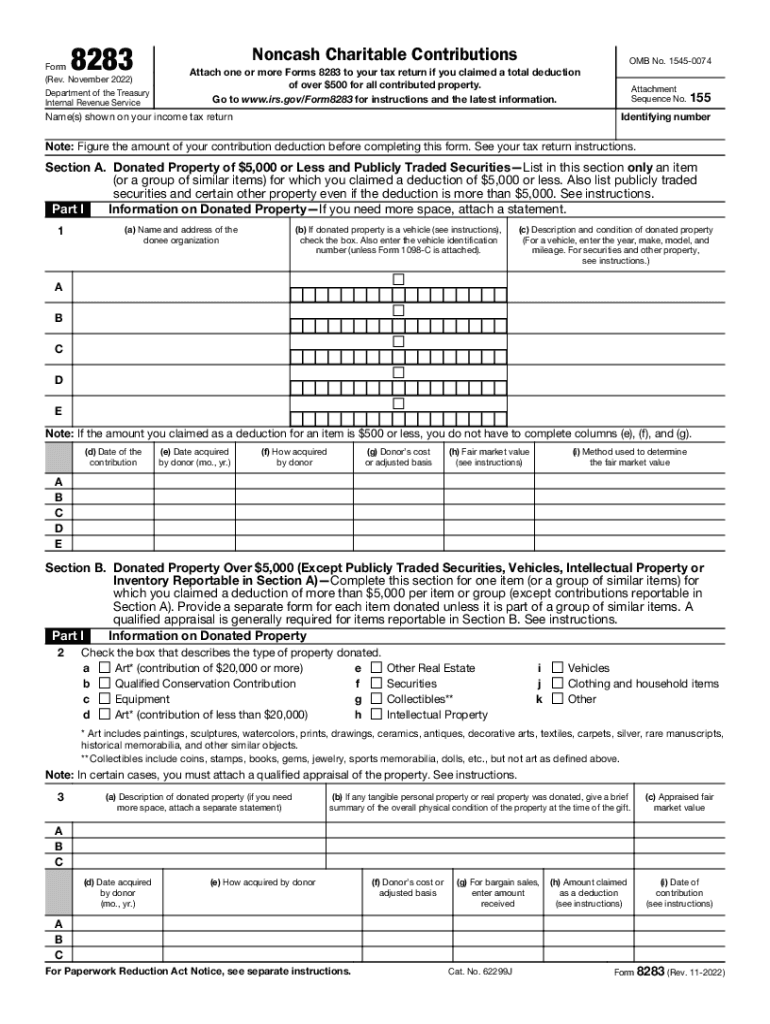







Definition & Purpose of Form 8283
Form 8283, Noncash Charitable Contributions, is issued by the IRS and used by taxpayers in the United States to report noncash charitable contributions. Taxpayers must attach one or more Forms 8283 to their tax returns if their total deduction for all noncash gifts is more than $500. It consists of sections for detailing donated property, ensuring transparency and proper valuation.
Components of Form 8283
- Section A: Used for reporting individual noncash contributions valued at $5,000 or less.
- Section B: Required for items appraised and valued over $5,000.
- Donor and Donee Information: Includes the name and address of both parties.
- Property Description: Detailed listing of each item, including fair market value.
- Appraisals: Necessary for items over $5,000 and sometimes required for lesser-valued items.
Steps to Complete Form 8283
- Gather Necessary Information: Collect details of each noncash donation, including receipts and appraisals.
- Complete Section A or B: Depending on the value of your contributions, fill out the appropriate section.
- Attach Documentation: Include appraisals or receipts as required.
- Sign the Form: Both taxpayer and appraiser (if applicable) need to sign.
- Attach to Tax Return: Ensure Form 8283 is included with your tax filing.
Common Mistakes to Avoid
- Incorrect Valuation: Using improper methods to calculate fair market value can lead to penalties.
- Missing Signatures: Failing to obtain necessary signatures voids the form’s validity.
- Inadequate Documentation: Not providing appraisals or receipts for applicable items.
Who Typically Uses Form 8283
- Individuals: Taxpayers who make significant noncash donations to qualified organizations.
- Businesses: Companies that donate inventory or equipment above the $500 threshold.
- Nonprofits & Charitable Organizations: Entities receiving donations must verify and sometimes keep records.
IRS Guidelines for Form 8283
The IRS sets strict guidelines to ensure accuracy and compliance:
- Valuation Rules: Contributions must be reported at their current fair market value.
- Appraisal Requirements: For contributions exceeding $5,000, an appraisal summary must be submitted.
- Reporting Threshold: Mandatory attachment for deductions over $500.
Importance of Accuracy
The IRS closely scrutinizes Form 8283 for accuracy, especially:
- High-Value Contributions: Items over $5,000 require more stringent documentation.
- Multiple Contributions: Aggregated smaller donations that exceed the reporting floor.
Filing Deadlines & Important Dates
Form 8283 should be filed alongside your federal tax return by the standard IRS filing deadline, usually April 15th:
- Extensions: If you receive an extension for filing your taxes, remember that Form 8283 must also be filed by this new deadline.
- Record Keeping: Keep all documentation related to your noncash contributions for at least three years.
Software Compatibility
Form 8283 is compatible with various tax preparation software, enhancing user convenience:
- TurboTax: Offers guided assistance for completing and filing Form 8283.
- H&R Block: Features integrated support for necessary tax forms.
- QuickBooks: Provides business insights into charitable giving.
Penalties for Non-Compliance
Failing to accurately complete and file Form 8283 can lead to:
- Disallowed Deductions: Donations may not qualify for tax benefits without proper filing.
- Fines and Audits: Inconsistent or fraudulent reporting can result in IRS audits or penalties.
Preventing Compliance Issues
To avoid non-compliance:
- Maintain Thorough Records: Keep every form, receipt, and appraisal in an organized manner.
- Use Professional Appraisal Services: When necessary, hire certified appraisers to evaluate high-value items accurately.
Digital vs. Paper Version of Form 8283
Taxpayers have the option to submit Form 8283 digitally or via paper:
- Digital Submission: Benefits include faster processing and confirmation from the IRS.
- Paper Submission: Traditional option remains valid but might be slower.
Advantages of Digital Filing
- Convenience: Easy filing through tax software.
- Efficiency: Immediate acknowledgment of receipt lowers chances of misplacement.
Business Entity Types That Benefit Most
Different business structures can strategically use Form 8283:
- Corporations: Often donate large quantities of products.
- Partnerships & LLCs: Use the form for distributed asset donations.
Maximizing Deductions
Business entities can maximize deductions by:
- Donating Inventory: Contributing excess or obsolete stock.
- Considering Tax Planning: Aligning donations with periods of higher taxable income.
By understanding and properly utilizing Form 8283, taxpayers and businesses can optimize their charitable contributions and ensure full compliance with IRS regulations. Thorough preparation and accurate reporting will aid in maximizing deductions and minimizing any potential for audit or penalty.




