
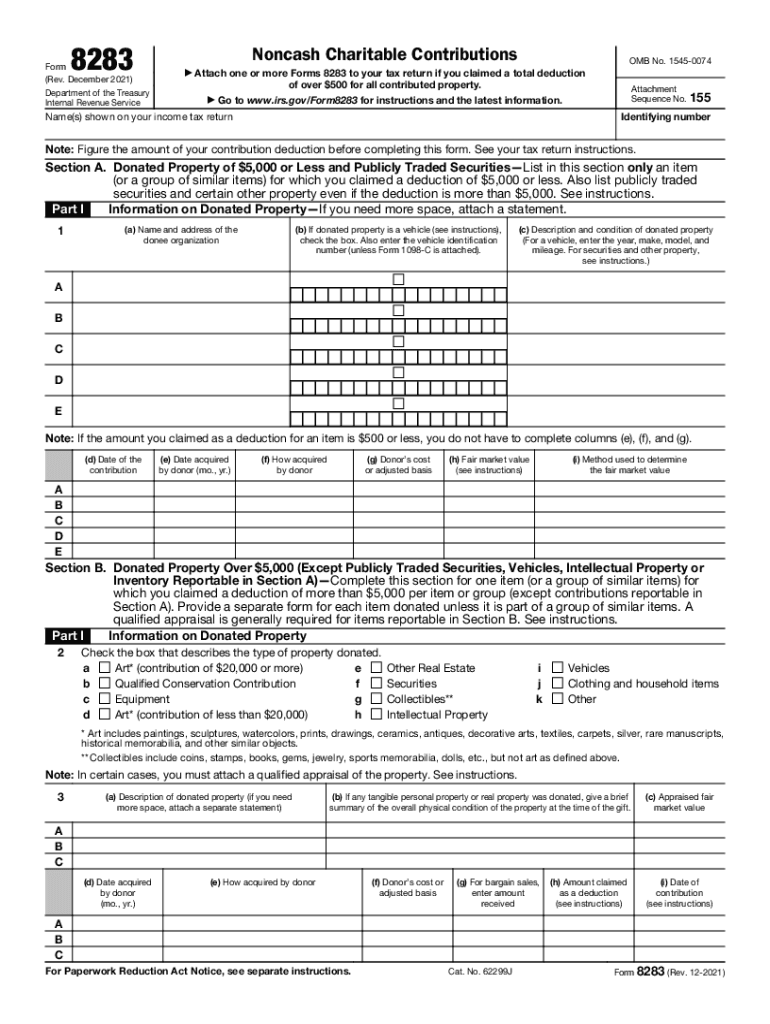







Definition and Meaning of Form 8283
Form 8283, officially termed as Noncash Charitable Contributions, is a critical document for taxpayers in the United States, used to report noncash charitable contributions that exceed $500. This form plays a vital role for individuals and entities aiming to claim tax deductions for their generosity. Donations that can be reported include tangible items such as vehicles, artworks, and securities, among others. Form 8283 ensures transparency and documentation, enabling the IRS to verify the legitimacy and fair market values of the contributions.
- Purpose: Facilitates the claiming of deductions for noncash donations.
- Scope: Applicable to noncash donations exceeding $500 in value.
- Sections: Divided into parts based on the type and value of the donation.
Steps to Complete Form 8283
Filling out Form 8283 requires attention to detail and an understanding of the information needed. Below are the general steps to accurately complete this form:
- Identify Donation Value: Start by determining if your noncash contributions exceed $500. Gather all donation receipts and appraisals if necessary.
- Part I - Description: Provide a comprehensive description of each donated item, including its condition and fair market value.
- Donee Organization Information: Include the name and address of the organization receiving your donation, ensuring alignment with IRS-approved institutions.
- Part II - Appraisal Summary: Fill out this section if any donated items exceed $5,000. An independent qualified appraiser must complete this portion.
- Signature and Date: Verify all information for accuracy and complete the form with your signature and the date to reduce processing delays.
Key Elements of Form 8283
Understanding the form's structure is essential for successfully claiming your deductions. Below are the fundamental elements:
- Personal Details: Includes taxpayer identification such as name and Social Security number.
- Itemized Donations: An itemized list detailing each donated item and its fair market value.
- Donee Acknowledgment: Necessary for donations over $5,000, confirming the transaction and the item's description.
- Appraisal Data: Critical for higher-value donations, providing the appraiser's credentials and conclusions regarding item value.
IRS Guidelines for Form 8283
To conform with IRS regulations, donors must adhere to specific guidelines:
- Valuation: The IRS requires credible evidence to support the fair market value claimed. Appraisals are crucial for items worth more than $5,000.
- Documentation: Retain detailed donor records, including photographs, receipts, and appraisals.
- Submission: Attach Form 8283 to your tax return for the year the donations were made.
Examples of Using Form 8283
Examples illustrate the practical application of Form 8283:
- Artwork Donation: An artist gifts a painting valued at over $5,000 to a museum and must complete Parts I and II, supported by a professional appraisal.
- Vehicle Contribution: A taxpayer donates a used car valuing $2,900 to a recognized charity, requiring Part I completion but no professional appraisal.
Who Typically Uses Form 8283
Form 8283 is essential for various groups:
- Individual Taxpayers: Beneficial for those seeking tax deductions for substantial noncash donations.
- Business Entities: Corporations or partnerships donating goods or equipment to enhance community engagement and achieve tax benefits.
- Nonprofit Organizations: As receipt providers, these entities assist donors with the necessary documentation.
Penalties for Non-Compliance
Failing to complete Form 8283 accurately can have significant implications:
- Denial of Deductions: Incorrect or incomplete forms can lead to rejected deduction claims.
- Audits: Inconsistent or undocumented filings may trigger IRS audits, increasing scrutiny and potential penalties.
- Fines: Potential financial penalties for deliberately misreporting donation values to benefit illicitly from deductions.
Form Submission Methods
Form 8283 can be submitted through various channels:
- Online Filing: Preferred for convenience and speed, often integrated within tax-filing software like TurboTax and QuickBooks.
- Mail: Traditional paper submissions require additional mail handling time but remain an option for those filing via physical copies.
- In-Person: Rare but possible at IRS offices, suitable for taxpayers seeking immediate confirmation of submission.
Quantum of Examples and Scenarios
To further ensure accuracy, several hypothetical scenarios can be considered:
- Self-Employed Professionals: Utilize their own materials or products as donations, necessitating careful appraisal and documentation.
- Retirees: Common with retirees donating lifetime collections, requiring comprehensive item descriptions and possibly complex appraisals.
- Students: Often involve lower-value contributions, simplifying form requirements, yet exemplifying broader tax education and application.
By understanding these blocks, taxpayers can efficiently navigate Form 8283, maximizing their potential deductions while complying with IRS standards.




