




01. Edit your form 8283 online
Type text, add images, blackout confidential details, add comments, highlights and more.

Type text, add images, blackout confidential details, add comments, highlights and more.

Draw your signature, type it, upload its image, or use your mobile device as a signature pad.

Send irs form 8283 via email, link, or fax. You can also download it, export it or print it out.
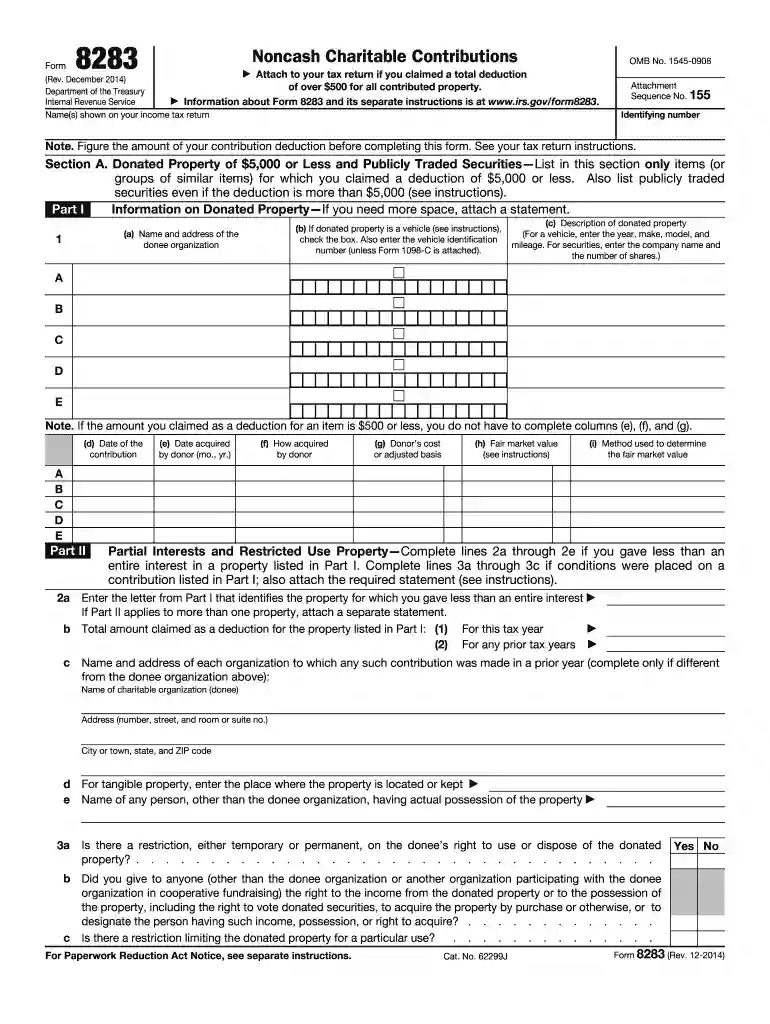
Form 8283, officially titled "Noncash Charitable Contributions," is a tax document used by individuals who are reporting noncash contributions to qualified charitable organizations. When the total deducts exceed $500 in a given tax year, Form 8283 becomes essential. This document serves to provide detailed information about noncash donations, ensuring transparency and compliance with IRS guidelines. Generally, Form 8283 includes sections for donations under $5,000 and those over $5,000, requiring additional details such as the donor's information, the donee organization's specifics, a description of the donated property, its fair market value, and any restrictions associated with the donation.
Form 8283 can be obtained directly from the IRS website, which provides a downloadable PDF version for taxpayers. Alternatively, tax preparation software like TurboTax and QuickBooks often include Form 8283 as part of their tax filing solutions. These platforms typically guide users through the process of entering required information and ensure the form's accuracy by cross-referencing data with other tax documents. Tax practitioners and accountants can also provide this form as part of their services to clients.
Gather Required Information: Before completing Form 8283, collect all necessary documentation regarding your noncash donations, including receipts, appraisals for items over $5,000, and acknowledgment letters from the charities.
Complete Section A: For donated properties valued at $5,000 or less, fill out Section A. This includes a description of each item, the date of contribution, the fair market value, and the method used to determine this value.
Fill Out Section B: If the donation involves property valued over $5,000, Section B is required. It demands detailed descriptions of the property, qualifications of the appraiser, and must be signed by both the appraiser and the donee organization.
Double-Check and Attach: Review the completed form carefully, ensuring all information is accurate. Attach Form 8283 to your tax return, along with any necessary appraisals, if applicable.
Submit Your Tax Return: File your entire tax return, including Form 8283, by the due date to avoid any penalties or delays in processing. This can be done online through tax software or by mailing the documentation to the IRS.
Form 8283 is commonly used by individuals and entities who make significant noncash donations to charities. Typical users include:
The IRS establishes clear guidelines for Form 8283 to ensure accurate and authenticated reporting of noncash charitable contributions. These include:
Failure to properly file Form 8283 or provide accurate information can result in disallowance of the claimed deduction. Additional penalties may include fines for excessive valuation or negligence in adhering to IRS rules. For accurate compliance, it is crucial to thoroughly review IRS Publication 561, which discusses acceptable appraisal procedures and reporting criteria for noncash charitable contributions.
We've got more versions of the form 8283 form. Select the right form 8283 version from the list and start editing it straight away!
| Versions | Form popularity | Fillable & printable |
|---|---|---|
| 2023 | 4.9 Satisfied (51 Votes) | |
| 2022 | 4.9 Satisfied (38 Votes) | |
| 2021 | 4.8 Satisfied (46 Votes) | |
| 2020 | 4.1 Satisfied (63 Votes) | |
| 2019 | 4.3 Satisfied (104 Votes) | |
| 2014 | 4.4 Satisfied (270 Votes) | |
| 2013 | 4.3 Satisfied (70 Votes) | |
| 2012 | 4.2 Satisfied (69 Votes) | |
| 2006 | 4.2 Satisfied (39 Votes) | |
| 1995 | 4 Satisfied (32 Votes) |
At DocHub, your data security is our priority. We follow HIPAA, SOC2, GDPR, and other standards, so you can work on your documents with confidence.



Section AList in this section only items (or groups of similar items) for which you claimed a deduction of $5,000 or less. Also, list certain publiclyRead more
Jan 31, 2012 a copy of Form 8283 to attach to the pro rata share of the propertys. Expense shareholders return. Attach a adjusted basis. Give eachRead more
Jan 23, 2026 File Form 8283 to report information about noncash charitable contributions when the amount of their deduction for all noncash gifts is more than $500.Read more


