




01. Edit your form online
Type text, add images, blackout confidential details, add comments, highlights and more.

Type text, add images, blackout confidential details, add comments, highlights and more.

Draw your signature, type it, upload its image, or use your mobile device as a signature pad.

Send it via email, link, or fax. You can also download it, export it or print it out.
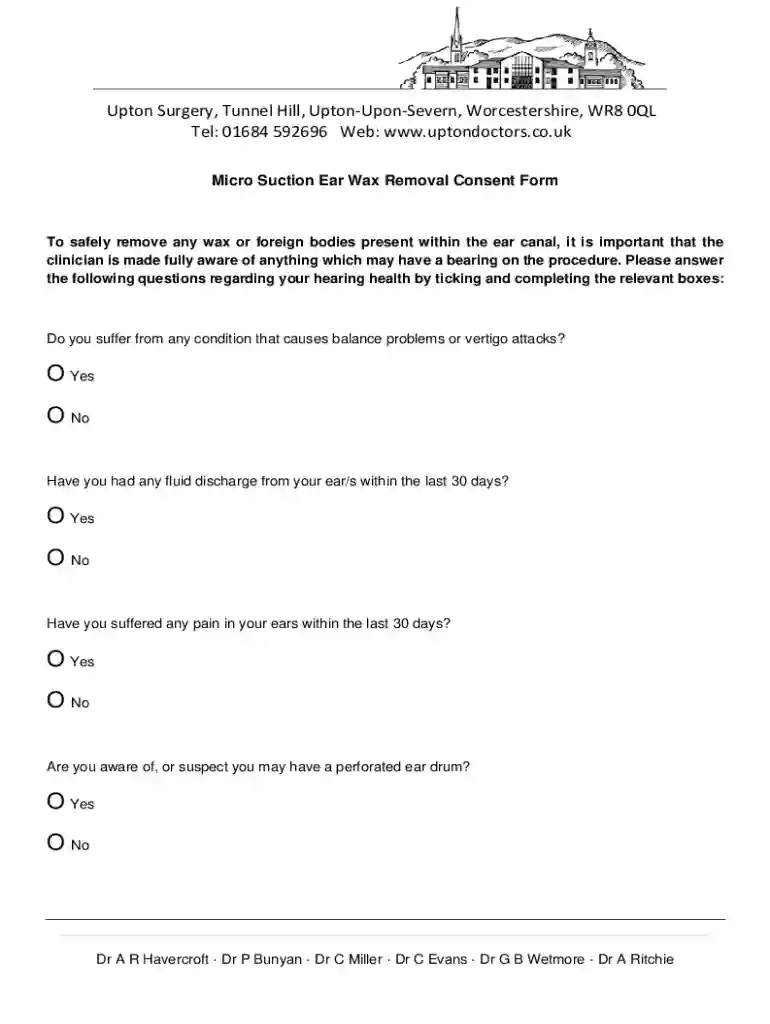
The Micro Suction Ear Wax Removal Consent Form is a document designed to obtain a patient’s informed consent before undergoing ear wax removal using micro suction. It ensures that the patient understands the procedure, potential risks, and benefits. This form often includes details about the patient's medical history and any relevant hearing issues. By signing this form, the patient acknowledges that they have received sufficient information to make an informed decision about proceeding with the treatment.
To use the Micro Suction Ear Wax Removal Consent Form effectively, healthcare providers should follow a structured approach:
Preamble: Begin by explaining the purpose of the form to the patient, emphasizing the importance of informed consent for safe medical practice.
Sections Overview: Guide the patient through each section of the form, including their medical history, current health status, and the specific nature of the micro suction procedure.
Risk and Benefits Explanation: Clearly outline potential risks and benefits associated with the procedure to ensure the patient’s understanding.
Patient Information: Confirm that all personal details and medical histories provided are accurate and complete.
Signatures and Consent: The patient should review the completed form. After clarification of any queries, both the patient and the practitioner should sign and date the form to validate consent.
Completing the Micro Suction Ear Wax Removal Consent Form is a step-by-step process that ensures accuracy and thoroughness:
Personal Information: Fill in the patient’s name, date of birth, contact details, and any identifiers needed by the healthcare provider.
Medical History Section: Provide a comprehensive medical history, focusing on ear health, previous procedures, allergies, and medications.
Understanding the Procedure: Review detailed descriptions of the micro suction ear wax removal process, including tools and techniques used.
Acknowledgement of Risks: Ensure the patient understands potential risks, such as discomfort or temporary hearing changes.
Consent and Signature: After the healthcare provider answers any questions, the patient signs the form, indicating their consent to proceed.
Witness or Second Signature: If required, a witness or healthcare provider may also sign to confirm that the consent process followed protocol.
Essential components of the form include:
This form is commonly used by:


Legally, this form:
While the general structure of consent forms is similar, specific rules may vary by state:
Understanding these variations informs healthcare professionals of any extra steps necessary to ensure compliance with local regulations.
Several key terms are critical to understanding this form:
Ensuring familiarity with these terms helps both healthcare professionals and patients navigate the consent process confidently.
At DocHub, your data security is our priority. We follow HIPAA, SOC2, GDPR, and other standards, so you can work on your documents with confidence.
Mar 31, 2021 Manually removing earwax with instruments like forceps requires adequate visualization, training, experience, and a cooperative patient. ThisRead more
by JC Radford 2020 Cited by 6 Given the risks associated with irrigation and microsuction, informed consent for either procedure should always be sought. Providing writtenRead more


