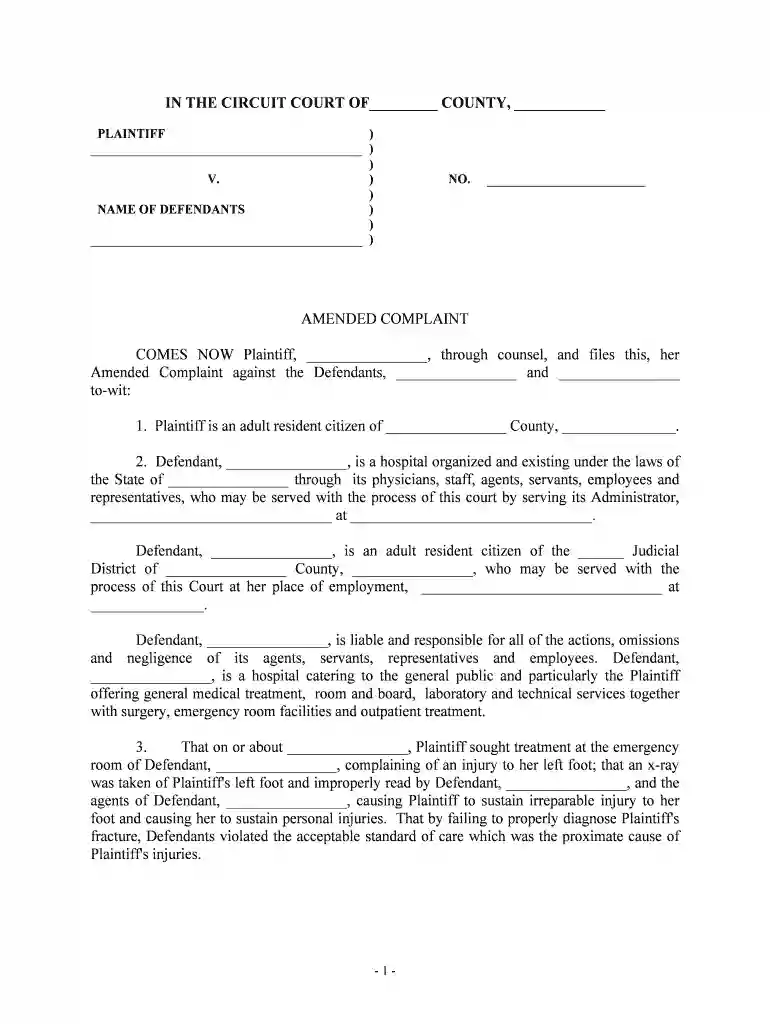
Medical complaint form 2026

Get Form
complaint medical malpractice Preview on Page 1

Here's how it works

01. Edit your complaint medical malpractice online
Type text, add images, blackout confidential details, add comments, highlights and more.

02. Sign it in a few clicks
Draw your signature, type it, upload its image, or use your mobile device as a signature pad.

03. Share your form with others
Send complaint medical form via email, link, or fax. You can also download it, export it or print it out.

Definition & Purpose of the Medical Complaint Form

The medical complaint form is a crucial document typically used to record grievances related to medical care, misdiagnosis, or treatment received in a healthcare setting. This form helps individuals formally address issues such as negligence, improper treatment, or billing discrepancies with hospitals or medical professionals. By utilizing this form, patients can initiate a documented conversation with healthcare providers regarding their concerns.

Examples of Situations Requiring a Medical Complaint Form

  • Misdiagnosis: A patient who was diagnosed incorrectly leading to improper treatment can use this form to document the incident.
  • Billing Issues: Concerns over incorrect billing for medical services can be detailed and clarified using this form.
  • Medical Negligence: Instances where there has been a failure to provide an appropriate standard of care can be formally reported.

Steps to Complete the Medical Complaint Form

Filling out a medical complaint form accurately ensures that your grievances are effectively communicated. Here is a step-by-step guide to complete the form:

  1. Gather Information: Collect all necessary details, including the date of the incident, medical facility, and personnel involved.
  2. Personal Details: Fill in your contact information such as your name, phone number, and address.
  3. Describe the Incident: Provide a detailed account of what happened, including who was involved and when it took place.
  4. Attach Supporting Documents: Include any relevant documents such as medical records, bills, or previous correspondence.
  5. Specify Desired Outcome: Clearly outline what you expect as a resolution to your complaint, whether it is an apology, corrective treatment, or financial restitution.

How to Obtain the Medical Complaint Form

Obtaining a medical complaint form can be done through several channels. Most healthcare facilities maintain forms that can be requested in person, while others provide downloadable versions on their websites. Additionally, the form can sometimes be accessed through state health department websites or patient advocacy organizations.

Options for Accessing the Form

  • Directly from Healthcare Providers: Request the form from the hospital or clinic where the incident occurred.
  • Online Platforms: Many providers allow you to download the form from their official website.
  • Patient Advocacy Groups: Some organizations offer standardized forms for patient grievances that can be submitted to medical boards or institutions.

Legal Use of the Medical Complaint Form

The medical complaint form serves as a formal record that can be used in legal proceedings if necessary. It documents a patient's issues and serves as evidence that the healthcare provider has been made aware of the grievances.

Potential Legal Scenarios

  • Litigation: Should the need for legal action arise, a completed form serves as part of the evidence detailing the provider's alleged fault.
  • Mediation: The form can be used to initiate discussions with healthcare providers about the incident, possibly leading to mediation or settlement.
  • Internal Review: Healthcare institutions may conduct internal investigations based on submitted forms to address and rectify issues.

Key Elements of the Medical Complaint Form

Several critical components must be included in the medical complaint form to ensure that it is both comprehensive and effective:

  • Complainant Information: Full name, contact information, and relationship to the patient (if different).
  • Provider Details: Name of the medical facility and practitioners involved.
  • Incident Details: A chronological account of the issue, including specific actions and communications.
  • Evidence and Documentation: Attachments such as medical records, correspondence, and billing statements to support your claim.

Who Typically Uses the Medical Complaint Form

The form is predominantly utilized by patients or their representatives who have experienced unsatisfactory care or treatment:


  • Patients: Primary users who directly face issues in their medical care.
  • Family Members: Representatives often file on behalf of minors or incapacitated individuals.
  • Legal Representatives: Attorneys involved in malpractice or related cases might use the form as part of their evidence collection.
decoration image ratings of Dochub

State-Specific Rules for the Medical Complaint Form

Depending on the jurisdiction, there may be distinct rules or procedures concerning the submission and processing of medical complaint forms. Each state may have unique timelines, required information, and governing bodies overseeing the review of grievances.

Key Points on State-Specific Differences

  • Submission Deadlines: Some states may have specific time limits within which a complaint must be filed after an incident occurs.
  • Review Boards: States might have specialized boards that handle medical complaints, which can dictate specific submission formats or required accompanying documents.
  • Complaint Outcomes: The possible actions taken post-review, including formal apologies, disciplinary actions against providers, or potential licensing repercussions, can vary by state.

Form Submission Methods

Patients can submit their completed medical complaint form through various channels, catering to the convenience and preferences of the complainant.

Available Submission Channels

  • Online Submission: Many health departments and facilities offer online portals for easy form submission and tracking.
  • Mail: Forms can be printed, filled out, and mailed to the specific department within a healthcare facility or responsible government body.
  • In-Person: Direct submission at the provider’s office or relevant administrative body, often providing immediate feedback on form completeness.
be ready to get more

Complete this form in 5 minutes or less

Get form

Got questions?

We have answers to the most popular questions from our customers. If you can't find an answer to your question, please contact us.
Contact us
Common Conditions The human body is a remarkable structure. But certain health issues, diseases, and conditions, whether back pain, hypertension, high cholesterol, arthritis, diabetes, digestive issues, hearing loss, or cataracts, become more common, particularly as we age.
To file a complaint against a physician or specialist, contact your state medical board.
Include the names and roles of the key people involved. Step 2 Briefly outline why you are making the complaint. Step 3 Outline the events in the order they happened. Include dates, descriptions of the incidents, information about relevant phone calls, meetings letters etc.
Some of the most common complaints include: Long wait times. Product or service problems. Delivery issues. Out-of-stock products. Staff and customer service. Lack of communication. Slow resolution. Public or social media.
7 Most Common Medical Emergencies Bleeding. Cuts and wounds cause bleeding, but severe injury can also cause internal bleeding that you cant see. Breathing difficulties. Someone collapses. Fit and/or epileptic seizure. Severe pain. Heart attack. A stroke.

Security and compliance

At DocHub, your data security is our priority. We follow HIPAA, SOC2, GDPR, and other standards, so you can work on your documents with confidence.
Learn more
ccpa2
pci-dss
gdpr-compliance
hipaa
soc-compliance

People also ask

Chronic pain and depression are amongst the most common health problems reported by patients attending primary care [1].
Complaining to an ombudsman. An ombudsman is a person who has been appointed to look into complaints about companies and organisations. Ombudsman schemes are independent, free and impartial so they dont take sides. You should try and resolve your complaint with the organisation before you complain to an ombudsman.
Here are the six most common patient complaints in healthcare: Long Wait Times. Insufficient Communication. Lack of Personal Attention. Billing Issues. Poor Follow-Ups. Unprofessional or Unfriendly Staff. Optimize Scheduling. Create a Communication Framework.

complaint medical malpractice sample