




01. Edit your form online
Type text, add images, blackout confidential details, add comments, highlights and more.

Type text, add images, blackout confidential details, add comments, highlights and more.

Draw your signature, type it, upload its image, or use your mobile device as a signature pad.

Send it via email, link, or fax. You can also download it, export it or print it out.
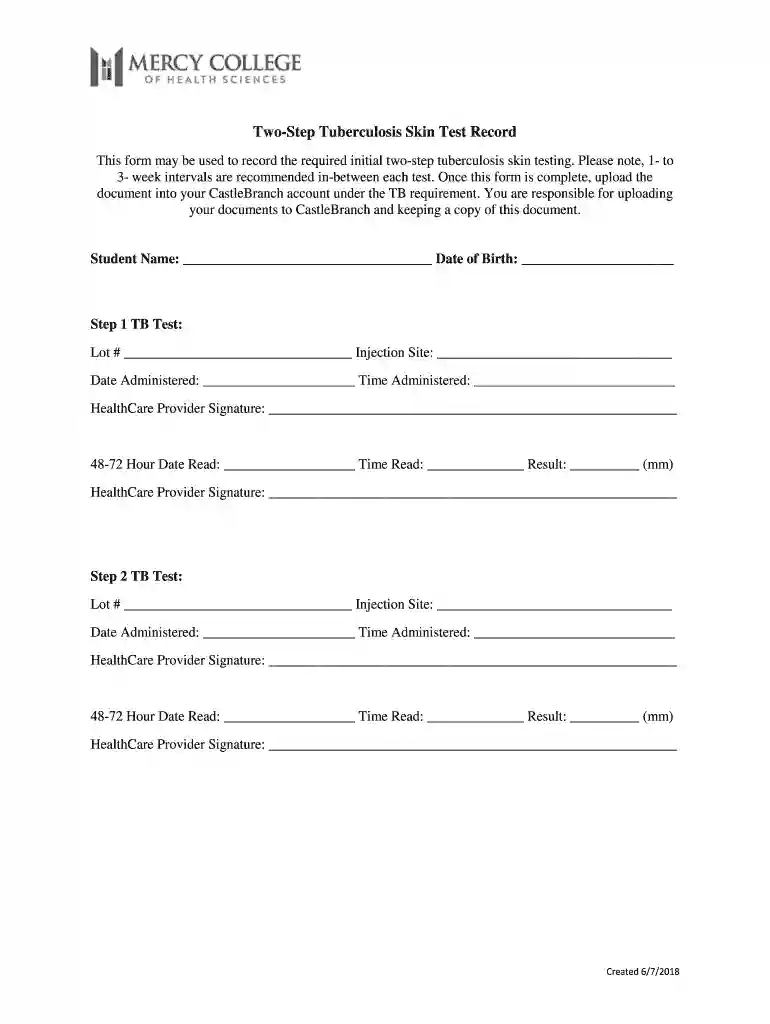
The Two-Step Tuberculosis Skin Test Record is a critical form used in documenting the administration and outcomes of a two-step TB skin test. This form ensures that healthcare providers systematically record vital details pertaining to both stages of the testing process. It contains sections for capturing essential patient information and the specifics of each test step, enabling a comprehensive record of the TB testing procedure. This form facilitates accurate documentation, which is particularly important for clinical assessments and must be uploaded to CastleBranch, a secure medical document management system, upon completion.
The form includes various components essential for thorough documentation:
Patient Information: Contains fields for the patient's name, date of birth, and contact details. This ensures that the test results can be properly attributed.
Test Details: Each test step is meticulously recorded to track the procedure's accuracy. This section logs administration dates, health care provider information, and test sites.
Results Section: An area dedicated to recording the observations and measurements after each test step, signifying whether the test is positive or negative.
Provider Signatures: Space is allocated for signatures from the administering health care providers, confirming the completion and accuracy of each test phase.
Completing this form involves a systematic approach to ensure all necessary information is accurately captured:
Patient Registration: Gather and enter all relevant patient data, ensuring that identification fields are fully completed.
Initial Test Administration: Record the date and location of the initial TB test application, followed by the administering healthcare provider’s details.
First Test Results Documentation: After the designated period, measure and document the induration results, making sure the observations are logged by the healthcare provider.
Second Test Administration: Following the interval between tests, repeat the test and log the second test’s administration details.
Final Results and Conclusions: Document the results of the second test, ensuring both tests have parallel completion in terms of results logged and provider authentication.
Final Review and Signature: Complete the form with final checks, ensuring all fields are filled and signed off by authorized personnel.
To acquire a Two-Step Tuberculosis Skin Test Record, the following methods are commonly utilized:
Healthcare Facilities: Many clinics and hospitals will provide this form during a TB screening appointment, ensuring that documentation begins at the time of the test.
Online Platforms: Forms can be downloaded from health service websites or third-party medical documentation platforms that offer the form in various formats for digital completion.
Public Health Offices: Local health departments may offer these forms to residents undergoing TB testing as part of public health initiatives.
This form is primarily employed by:
Healthcare Providers: Essential for doctors, nurses, and medical assistants who administer and verify TB skin tests.
Public Health Entities: Utilized by public and community health organizations assessing TB exposure risk among populations.
Educational Institutions: Universities and colleges that require students and staff to verify their TB test status may use this form for compliance.
Employers: Certain industries, especially health-related sectors, mandate TB testing as part of pre-employment health checks, utilizing this record for employee medical files.


The form serves a critical legal role in documenting the following:
Compliance: Meets public health requirements and ensures compliance with state and federal health regulations.
Verification of Health Status: Provides evidence of a negative TB status, critical for environments where infection control is paramount.
Medical Records: Becomes a formal part of an individual's medical record, enhancing medical history accuracy and patient care outcomes.
Some states may have specific guidelines or additional requirements for TB skin tests, such as:
Documentation Requirements: Variations may exist in the specific fields or data points required by a state health department.
Testing Frequency: Differences in the mandated frequency of testing for various population groups or high-risk environments.
Authorization Protocols: Certain states might require additional verification steps or an adaptation according to their public health laws.
Employing this form is crucial for multi-faceted reasons:
Precision in Health Assessment: Guarantees detailed documentation, enhancing the reliability of the TB testing diagnosis.
Aids Public Health Initiatives: By ensuring comprehensive data collection, this form supports larger health surveillance and prevention programs.
Protects Legal Interests: Documents the proper execution of health assessments, serving as a defense in legal or compliance disputes.
Facilitates Healthcare Continuity: Ensures that subsequent healthcare providers can access a patient’s TB test history for ongoing care decisions.
By understanding the comprehensive functionalities and importance of the Two-Step Tuberculosis Skin Test Record, users can ensure that TB testing is documented accurately, efficiently, and securely to meet both healthcare and legal needs.
At DocHub, your data security is our priority. We follow HIPAA, SOC2, GDPR, and other standards, so you can work on your documents with confidence.
Two-Step PPD Skin Test (four total provider visits) Visit 1 - Have provider place PPD #1 and wait 48-72 hours Visit 2 - Return to provider to have PPD #1 read;
Because of this, routine testing is crucial in managing the spread of the disease. The primary bTB diagnostic tool used in the UK is the tuberculin skin test, aRead more
Two-step testing is a strategy used to reduce the likelihood that a boosted reaction will be misinterpreted as a recent infection if the person has to be testedRead more


