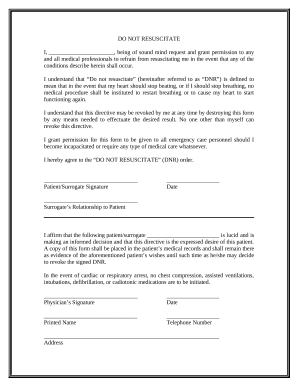
01. Edit your form online
Type text, add images, blackout confidential details, add comments, highlights and more.

Type text, add images, blackout confidential details, add comments, highlights and more.

Draw your signature, type it, upload its image, or use your mobile device as a signature pad.

Send it via email, link, or fax. You can also download it, export it or print it out.
An affidavit to opt out of Medicare is a formal declaration used by healthcare providers who decide not to participate in the Medicare program. This legal document must be filed by any physician or practitioner who wishes to provide services to Medicare beneficiaries under a private contract. By opting out, they acknowledge that they will not bill Medicare for any services provided to these patients during the opt-out period, thus establishing a direct payment contract with their clients instead.
Opting out of Medicare using this affidavit allows physicians greater flexibility in managing their practice and financial agreements with patients. By entering into private contracts, practitioners can set their fees without adhering to the Medicare fee schedule, thus tailoring services to meet both their financial needs and the preferences of their patients. This option is especially beneficial for practitioners in niche specialties or those seeking personalized financial arrangements with their patients.
The affidavit must be filed within ten days of entering into a private contract with the first Medicare beneficiary. Failure to comply with this timeline results in the default participation in Medicare, rendering the private contract null and void. Additionally, practitioners must renew their decision to opt-out every two years, adhering to the same deadline requirements to maintain their status.
This affidavit serves a legal purpose by formalizing the opt-out process, ensuring all parties involved understand the scope, limitations, and duration of the agreement. Compliance with the terms is essential for avoiding legal and financial repercussions. It aligns with U.S. federal laws governing Medicare participation and provides a clear legal framework for practices choosing this path.
For instance, a psychiatrist specializing in holistic treatment might opt to operate outside Medicare to offer personalized care packages, charging directly to patients. Similarly, a concierge medical practice may find the flexibility afforded by private contracts more conducive to their boutique service models.
Eligibility requires that the physician or practitioner is legally recognized within their field to offer services covered by Medicare. Furthermore, they must not be excluded or disqualified by the Department of Health and Human Services (HHS) or any equivalent federal authority from participating in healthcare programs.


Typically, physicians in private practice, psychiatrists, or specialists in personalized or boutique care benefit the most from opting out. This is common among practitioners who desire control over billing and patient care quality, aligning services with patient preferences and personal practice models.

Contact the respective MAC assigned to your state to request the necessary forms. Often, these forms can also be downloaded directly from the MAC's website. Ensure you have the most updated version to avoid processing delays.
At DocHub, your data security is our priority. We follow HIPAA, SOC2, GDPR, and other standards, so you can work on your documents with confidence.