01. Edit your form online
Type text, add images, blackout confidential details, add comments, highlights and more.

Type text, add images, blackout confidential details, add comments, highlights and more.

Draw your signature, type it, upload its image, or use your mobile device as a signature pad.

Send it via email, link, or fax. You can also download it, export it or print it out.
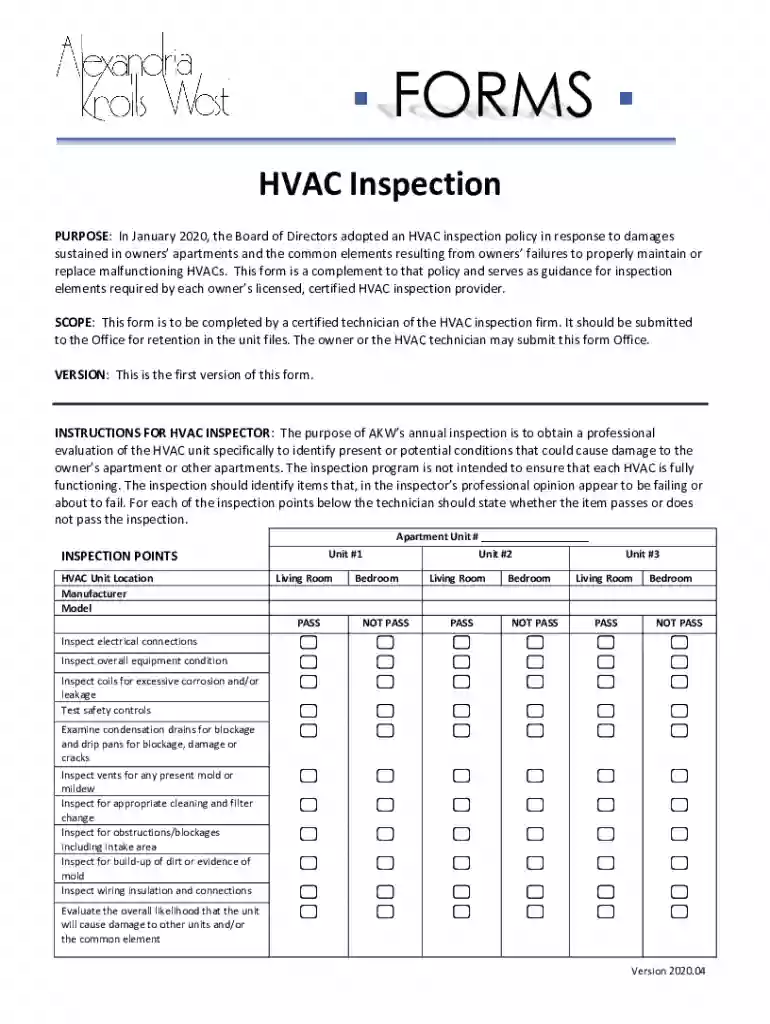
The "2020 04 HVAC Inspection Form-Final" serves as a crucial document for certified HVAC technicians to assess the condition of heating, ventilation, and air conditioning systems. Developed to address the potential for substantial damages due to neglected maintenance, this form standardizes the inspection process for the HVAC units installed in residential and commercial properties. The primary goal is to identify and address potential issues such as electrical misconfigurations, equipment deterioration, and mold infestations, which can lead to significant damage if left unchecked. By facilitating a thorough and uniform inspection process, this form plays a pivotal role in the upkeep and safety of HVAC systems.
To effectively utilize the "2020 04 HVAC Inspection Form-Final," technicians must follow a systematic approach:
Initial Review: Begin by thoroughly reading the entire form to understand the sections and the information required.
Inspection Preparation: Gather all necessary tools and safety equipment to perform a comprehensive HVAC inspection.
Field Examination: Conduct a meticulous inspection, recording findings in the respective sections of the form. Focus areas include:
Documentation: Use the form’s predefined fields to document findings, ensuring clarity and accuracy.
Final Checks: Review the completed form for any missed sections or inaccuracies before submission.
Completing this form involves several key steps to ensure all critical areas of the HVAC system are evaluated:
Gather Background Information: Note the specifics of the equipment, including model numbers and installation dates.
Visual Inspection: Record observations from a visual inspection, checking for any obvious signs of wear or damage.
Test Electrical Systems: Verify the integrity of electrical connections and relay any concerns related to mismatched wires or faulty components.
Assess Equipment Condition: Evaluate the physical state of the HVAC units, making notes on any rust, leaks, or damages.
Check for Mold and Mildew: Examine the equipment for signs of mold, focusing particularly on areas susceptible to moisture.
Enter Findings: Use the form to enter inspection results systematically, ensuring each section is completed accurately.
Submit the Form: Upon completion, the form must be submitted for official record-keeping and future reference.
The primary users of the "2020 04 HVAC Inspection Form-Final" include:


The structure of the form comprises several essential elements:
The form plays a vital role in legal compliance for property maintenance:
Real-world scenarios where the form is utilized include:
Certain states may have additional rules pertaining to HVAC inspections:
To successfully complete the form, having the following documents can be crucial:
The "2020 04 HVAC Inspection Form-Final" can be submitted through various channels:
At DocHub, your data security is our priority. We follow HIPAA, SOC2, GDPR, and other standards, so you can work on your documents with confidence.