01. Edit your pip 1 form download online
Type text, add images, blackout confidential details, add comments, highlights and more.

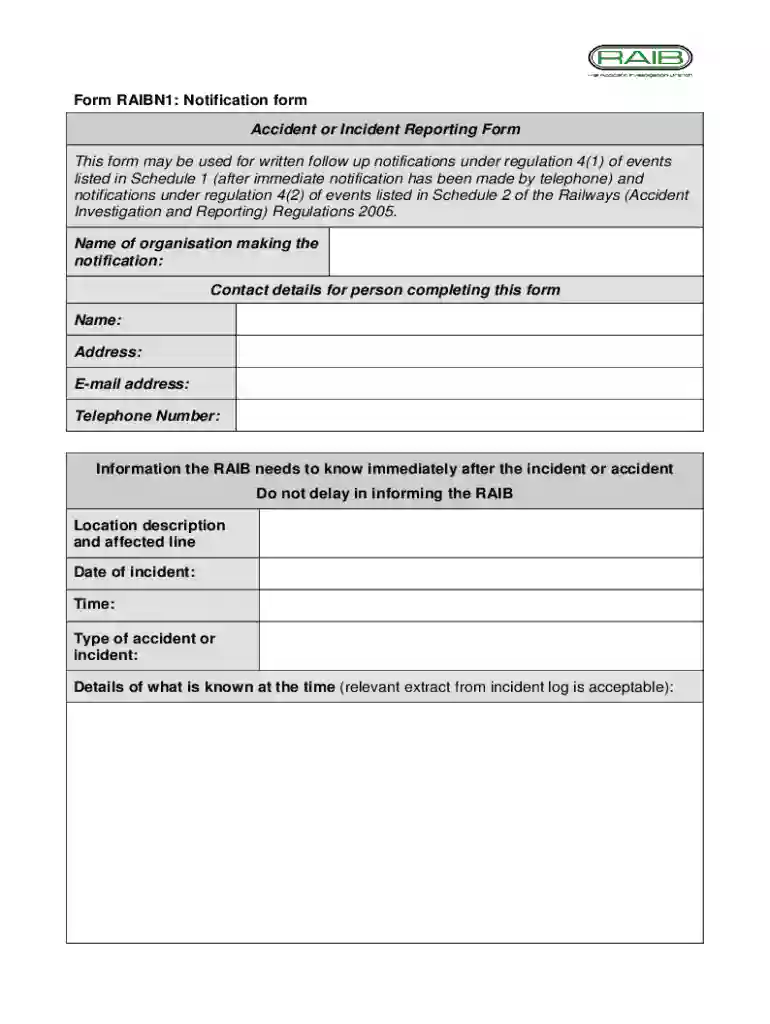
Type text, add images, blackout confidential details, add comments, highlights and more.

Draw your signature, type it, upload its image, or use your mobile device as a signature pad.

Send raibn1 via email, link, or fax. You can also download it, export it or print it out.
The RAIBN1 form is a crucial document used to report accidents or incidents in compliance with the Railways (Accident Investigation and Reporting) Regulations 2005. Its primary function is to furnish immediate and detailed information about railway-related accidents to the Rail Accident Investigation Branch (RAIB). The data captured includes the location, time, type of accident, train information, casualty details, and other pertinent information. The purpose of the form is to facilitate a thorough and timely investigation into railway incidents to improve safety protocols and prevent future occurrences.
This document ensures that the RAIB receives consistent and complete information, which is essential for accurate assessments and regulatory compliance. The form is structured to gather specific details necessary for comprehensive accident analysis, helping to enhance overall railway safety and operational standards.
Completing the RAIBN1 form involves several structured steps designed to ensure all essential information is captured accurately:
Identify the Incident: Begin by documenting the exact location, date, and time of the incident. This information situates the incident accurately in the context of railway operations.
Describe the Accident: Provide a thorough description of the type and nature of the accident. Use detailed language to convey the specific components and circumstances of the event.
List Train Details: Include train identifiers, such as the train number, operator, and any relevant schedule or logistical information. This ensures linkage between the incident and specific rail operations.
Record Casualty Information: Clearly document any injuries or fatalities, including their nature and severity. This aids in the understanding of human impact and subsequent response measures.
Include Witness Statements: When available, incorporate statements from personnel or bystanders, which can provide invaluable insight into the incident dynamics and precursors.
Summarize Initial Responses: Outline the immediate actions taken by railway personnel or emergency services. This records procedural adherence and the efficacy of emergency protocols.
These steps must be completed with attention to detail, ensuring accurate and thorough information is provided to support the RAIB's investigative and regulatory functions.
The RAIBN1 form is composed of several key elements critical to its function:
These elements collectively offer a comprehensive view of an incident, enabling the RAIB to conduct thorough investigations and recommend improvements.
Utilizing the RAIBN1 form aligns with the legal mandates set forth in the Railways (Accident Investigation and Reporting) Regulations 2005. The form ensures regulatory compliance by mandating the prompt reporting of railway accidents to the RAIB, thus supporting lawful operational standards within the railway industry.
Failure to use or properly complete this form can result in penalties or legal scrutiny, highlighting its critical role in maintaining transparent and compliant railway operations. Organizations involved must adhere to legal requirements, ensuring accurate and timely submissions.
The significance of the RAIBN1 form transcends regulatory compliance, emphasizing its role in safety enhancement, data documentation, and operational integrity. By providing structured data, the form assists in identifying accident trends and underlying risk factors, informing preventive strategies and safety improvements.
Moreover, the form contributes to the establishment of accountability and encourages adherence to highest safety standards, crucial in upholding public and stakeholder trust.
While the RAIBN1 form is primarily governed by national standards, it’s important for organizations to be aware of any state-specific regulations that may influence reporting practices. Differences in state operations, infrastructure, or regulatory emphasis could affect data collection practices or the prioritization of specific incident types.
Understanding these variations ensures precise compliance and fosters alignment with both national and regional safety priorities. Stakeholders must consult regional regulations to complement their submissions.
Practical application of the RAIBN1 form is demonstrated through diverse railway scenarios. For instance, an incident involving a derailment would necessitate detailed reporting on track conditions, operational procedures, and equipment integrity noted within the form.
In another instance, an accidental collision at a crossing would demand focus on signalling failure, crossing safety, and immediate responses initiated. These varied scenarios illustrate the form’s adaptability in capturing broad incident spectrums.
The RAIBN1 form is predominantly used by railway companies, incident investigators, and safety managers tasked with ensuring compliance and operational safety. Regulatory authorities, safety auditors, and risk management professionals also utilize the form as part of their oversight functions.
These users rely on the RAIBN1 form to provide reliable data necessary for maintaining railway operational integrity, supporting safety analysis, and enabling regulatory compliance. They perform crucial roles in safeguarding railway environments through meticulous documentation and reporting.


At DocHub, your data security is our priority. We follow HIPAA, SOC2, GDPR, and other standards, so you can work on your documents with confidence.