




01. Edit your form online
Type text, add images, blackout confidential details, add comments, highlights and more.

Type text, add images, blackout confidential details, add comments, highlights and more.

Draw your signature, type it, upload its image, or use your mobile device as a signature pad.

Send it via email, link, or fax. You can also download it, export it or print it out.
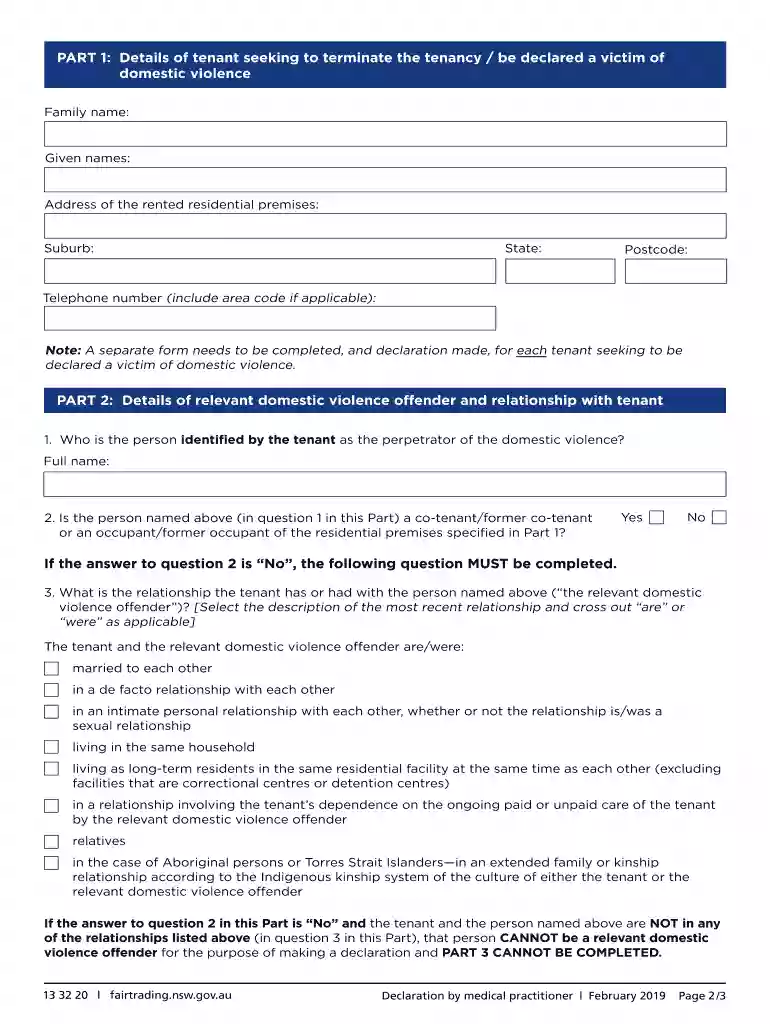
The "Victims of Domestic Violence Empowered to Break Lease" is a legal form designed to assist tenants who are survivors of domestic violence in terminating their rental agreements without financial penalty. The intent of the form is to offer a practical and humane option for those experiencing unsafe living conditions. By allowing victims to legally break a lease, this form aims to prioritize their safety and enable them to relocate to a secure environment.
To effectively use this form, the tenant must first obtain a declaration from a registered medical practitioner or authorized professional confirming that they are a victim of domestic violence. This declaration serves as a legal statement supporting the tenant's claim and is a crucial prerequisite for proceeding with a lease termination. It's essential that tenants inform their landlords as early as possible in the process to begin discussions around lease termination, and the form should be submitted alongside this notification.
Tenants eligible to use this form must be verified victims of domestic violence with supporting documentation from a recognized professional. They must also be current signatories on the lease they wish to terminate. Specific states may have additional requirements, such as time frames for notifying the landlord after an incident.


Utilizing this form protects tenants legally, ensuring they are not held responsible for the remainder of the lease term financially. It also mitigates the risk of landlords pursuing action against a tenant for premature lease termination due to qualified domestic violence claims. Tenants should consult legal counsel if they encounter resistance from landlords or property managers.
While the form serves a similar purpose across the United States, specific regulations and protections can vary from state to state. For example, the notification period and required documentation may differ. Tenants should review state-specific laws and, if necessary, seek legal advice to understand their rights and obligations fully.
Tenants successfully using the form typically include those who've provided documentation of a personal protection order or received professional support on domestic violence. For instance, a tenant in California might present a signed declaration from a licensed counselor in addition to completing the form, aligning with state requirements for clear documentation.
Each state may present unique criteria for accepting the form and completing the lease termination process. In some jurisdictions, additional documentation may be necessary, or a longer waiting period might be enforced before the lease can be officially broken. Understanding these nuances is essential for properly executing the form.
We've got more versions of the Victims of domestic violence empowered to break lease form. Select the right Victims of domestic violence empowered to break lease version from the list and start editing it straight away!
| Versions | Form popularity | Fillable & printable |
|---|---|---|
| 2019 | 4.8 Satisfied (42 Votes) |
At DocHub, your data security is our priority. We follow HIPAA, SOC2, GDPR, and other standards, so you can work on your documents with confidence.




by C Gerchick 2020 Cited by 4 It allows domestic violence victims to terminate a lease early for the purpose of removing themselves from an abusive household. Title VI also.Read more
This section does not limit a landlords right to terminate a lease pursuant to section 33-1368 against the victim for actions unrelated to the act of domesticRead more
Oct 5, 2018 Assistance to individuals and households. Multifamily lease and repair assistance. Additional disaster assistance. National veterinary


