Definition & Meaning
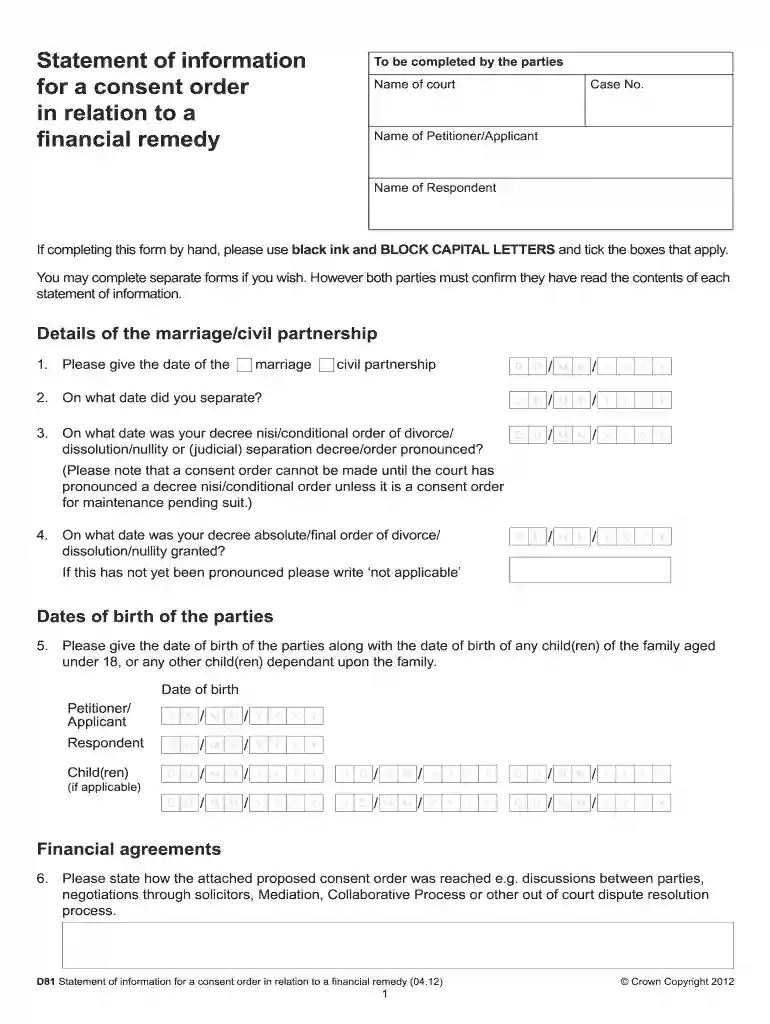
The "D81 Form" is officially known as the Statement of Information for a Consent Order, used primarily in divorce or civil partnership dissolution proceedings. This legal document is essential for both parties as it requires detailed disclosure of personal and financial information to facilitate a fair division of assets and determine financial obligations. It provides the court with a transparent view of financial arrangements, covering aspects such as income, capital, and living arrangements.
Key Components
- Personal Details: Includes names and basic information of both parties.
- Marriage and Separation Dates: Information on the marriage duration and the date of separation.
- Financial Agreements: Any pre-existing arrangements regarding finances.
- Statements of Truth: Affirmations by both parties regarding the accuracy of the provided information.
How to Use the D81 Form
The D81 form is integral in finalizing financial agreements through a Consent Order. It serves as a reference for the court to ensure fair financial settlements.
- Collect Required Information: Gather detailed personal and financial records.
- Fill Out the Form: Ensure all fields are completed accurately, especially regarding financial details.
- Review and Verify: Double-check the information for consistency and accuracy.
- Submit to the Court: After completion, the D81 form must be submitted as part of your Consent Order application.
Key Considerations
- Make sure both parties complete their respective sections.
- Validate all financial figures with supporting documents.
Steps to Complete the D81 Form
Completing the D81 form involves several precise steps, each requiring careful attention to detail:
- Personal Information Section: Fill out names and relationship details.
- Financial Information: Provide comprehensive details on capital, income, debts, and expenditures.
- Verification: Both parties must confirm the truthfulness of the information with signatures.
- Submit along with the Consent Order: Ensure the form is included in your Consent Order application package.
Detailed Breakdown
- Income Details: Include all forms of income such as salary, rental income, and investments.
- Debts and Liabilities: Outline all debts to provide a clear view of financial obligations.
- Child and Spousal Support: Record any existing support agreements.
Why You Should Use the D81 Form
Using the D81 form is crucial for a number of reasons:
- Transparency: Provides a clear financial overview which aids in honest negotiations and settlements.
- Compliance: Fulfilling legal requirements for financial disclosure in divorce or dissolution proceedings.
- Efficiency: Streamlines the process by consolidating relevant information.
Benefits
- Avoid false claims or omissions by ensuring both parties are fully informed of financial standings.
- Protects parties by legally documenting financial disclosures and obligations.
Legal Use of the D81 Form
The legal framework surrounding the D81 form enforces its precise use during financial settlements in divorce or civil partnership dissolutions.
- Court Requirement: Courts require the D81 to evaluate and finalize financial orders.
- Ensures Equity: Helps judges assess equitable distribution of assets.
- Legal Binding: Once completed, it forms a part of the legal record and may be enforced by the court.
Legal Implications
- Both parties are legally bound to provide truthful and complete information.
- Discrepancies or omissions can lead to legal challenges or unfair settlements.
Key Elements of the D81 Form
Understanding the core components of the D81 form ensures it is filled accurately and effectively.
- Capital and Assets: Listing of all assets including properties, savings, and investments.
- Living Arrangements: Addresses current and future housing plans which might affect settlement.
- Statements of Truth: Critical declarations affirm the honesty of each party’s disclosures.
Common Errors
- Failing to provide complete financial details can delay legal processes.
- Omissions in personal details can lead to misunderstandings or misfilings.
State-Specific Rules for the D81 Form
While the D81 form is a standard document, certain states may have specific requirements or additional forms to be filled.
- Additional Documentation: Some states require supplementary documentation according to local laws.
- Filing Procedures: Official submission channels might vary; online submissions could be permitted in some jurisdictions.
Examples of Variations
- In jurisdictions with common law marriage recognition, additional proofs of partnership might be required.
- States with differing property division laws could require adjustments in the D81 form submission process.
Examples of Using the D81 Form
Real-world examples illustrate the importance and practical application of the D81 form in legal proceedings.
- Case Study 1: A couple amicably sharing joint assets utilized the D81 to delineate financial responsibilities and asset division, avoiding court disputes.
- Case Study 2: An individual claiming spousal support leveraged the D81 form to demonstrate financial needs and partner assets, successfully negotiating fair support terms.
Practical Scenarios
- Complex Financial Portfolios: Couples with diverse investments use the D81 to ensure all items are considered.
- Cross-Border Cases: Expats undergoing divorce might utilize the D81 alongside international document requirements for comprehensive coverage.