Iowa Notice Of Right To Cure Form - Fill Online, Printable 2026

Get Form
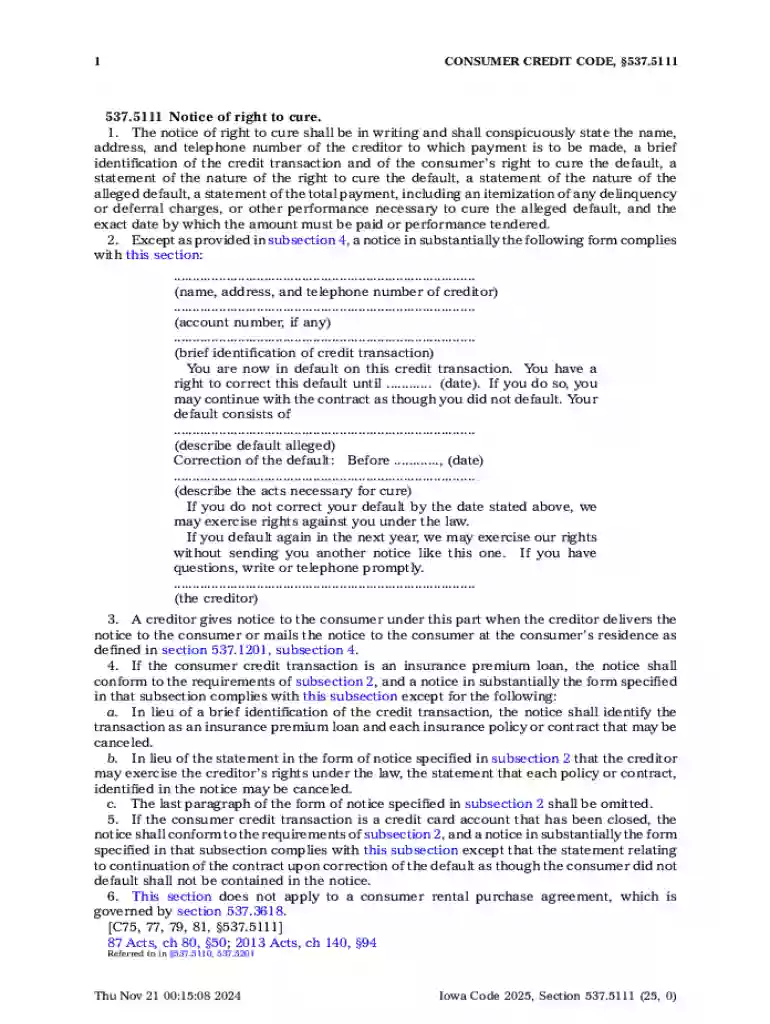
Iowa Notice Of Right To Cure Form - Fill Online, Printable Preview on Page 1

Here's how it works

01. Edit your form online
Type text, add images, blackout confidential details, add comments, highlights and more.

02. Sign it in a few clicks
Draw your signature, type it, upload its image, or use your mobile device as a signature pad.

03. Share your form with others
Send it via email, link, or fax. You can also download it, export it or print it out.

Definition and Meaning

The "Iowa Notice of Right to Cure Form" is a legal document utilized under the Consumer Credit Code. It serves as a formal notification issued to consumers who have defaulted on their credit transactions. The form's primary objective is to inform the debtor of their current default status and provide them with an opportunity to rectify the situation before any further legal actions are taken by the creditor. This document plays a crucial role in consumer protection by ensuring that debtors are given a fair chance to address the default and maintain their credit standing.

Key Characteristics

  • Notice: The form serves as an official notification to the debtor about their default.
  • Cure Opportunity: It provides guidelines for the debtor to rectify the default.
  • Consumer Protection: Ensures compliance with consumer rights under the law.

How to Use the Iowa Notice of Right to Cure Form

To effectively use the Iowa Notice of Right to Cure Form, it is essential to follow a structured approach:

  1. Identify the Default: Clearly define the nature of the default in the credit transaction.
  2. Detail the Requirements: Outline the steps the debtor needs to take to cure the default, including the total payment amount due.
  3. Set a Deadline: Establish a clear deadline by which the payment or corrective action must be completed.
  4. Provide Contact Information: Include the creditor's contact details for any required communication.

Practical Example

  • A creditor utilizes this form when a borrower misses several payments on a loan. The form details the outstanding amount, the necessary corrective steps, and provides a timeline, ensuring the borrower understands what is required to remedy the default.

Key Elements of the Iowa Notice of Right to Cure Form

The form contains several critical components that ensure clarity and compliance with Iowa's regulations:

  • Creditor Information: Name, address, and contact details of the creditor issuing the notice.
  • Transaction Identification: Clear identification of the specific credit transaction in default.
  • Detailed Description of Default: Comprehensive explanation of the default.
  • Cure Instructions: Specific steps or payments the debtor must make.
  • Deadline for Correction: Final date by which the debtor must address the default to avoid further actions.

Legal Use of the Iowa Notice of Right to Cure Form

Under Iowa law, the Notice of Right to Cure also serves a legal function by adhering to consumer credit regulations. The form must:

  • Ensure Fairness: Guarantees debtors receive adequate notice and opportunity to resolve defaults.
  • Prevent Legal Escalation: Aims to prevent immediate legal actions like repossessions or lawsuits.
  • Maintain Compliance: Aligns with legal standards to avoid penalties for unlawful debt collection practices.

State-Specific Rules for the Iowa Notice of Right to Cure Form

Iowa has particular rules concerning the use and applicability of the Notice of Right to Cure Form:

  • Legal Timeframes: Iowa mandates specific timelines for issuing the notice and allowing the debtor to cure the default.
  • Exclusions: Certain transactions, such as consumer rental purchase agreements, may not require a Notice of Right to Cure under Iowa statutes.
  • Variations: Different provisions might apply for insurance premium loans or closed credit card accounts.

Steps to Complete the Iowa Notice of Right to Cure Form

Filling out the form requires precision to ensure legality and effectiveness:

  1. Gather Information: Obtain all necessary transaction details and contact information.
  2. Draft the Notice: Fill in all required fields with accurate data.
  3. Review and Verify: Double-check the information for accuracy and compliance with Iowa law.
  4. Deliver the Notice: Send the completed form in a manner compliant with legal requirements, such as via certified mail.

Detailed Instruction Breakdown

  • Carefully detail the transaction and default.
  • Clearly articulate the steps needed to cure the default.
  • Provide precise deadline and payment requirements to avoid ambiguity.

Form Submission Methods (Online/Mail/In-Person)

Various methods are available for submitting the Notice of Right to Cure, including:

  • Online Platforms: Utilize tools like DocHub for a digital form completion and submission.
  • Mail: Traditional mailing methods, often certified, to ensure proper delivery proof.
  • In-Person: Hand-delivery to ensure immediate receipt, typically used in more urgent cases.

Considerations for Submission

  • Choose the method that provides the most timely and reliable confirmation of receipt.
  • Certified mail or in-person deliveries offer tangible proof of delivery.

Who Typically Uses the Iowa Notice of Right to Cure Form

This form is generally employed by creditors such as:

  • Banks and Financial Institutions: To recover debts on loans or credit lines.
  • Auto Loan Providers: When repossessing a vehicle is a potential next step.
  • Retail Credit Lenders: For addressing payment defaults on installment purchases.
decoration image ratings of Dochub

Important Terms Related to the Iowa Notice of Right to Cure Form

Understanding certain terminologies is crucial for effectively using the form:

  • Default: A failure to meet the legal obligations of the credit agreement.
  • Creditor: The entity to whom the money is owed.
  • Cure: The corrective action required by the debtor to resolve the default status.

Compliance Details for Digital vs. Paper Versions

Utilizing digital or paper versions of the form adheres to different compliance measures:

  • Digital Forms: Ensure electronic processes align with Iowa's acceptance rules and encryption standards.
  • Paper Forms: Must be filled out legibly and meet mailing or hand-delivery requirements.

Penalties for Non-Compliance

Failing to correctly issue or respond to a Notice of Right to Cure can have serious consequences:

  • For Creditors: Legal penalties for not complying with state regulations.
  • For Debtors: Potential for legal action, increased fees, or asset repossession if the default is not cured.

Understanding and applying these guidelines ensures the effective use of the Iowa Notice of Right to Cure Form, maintaining compliance and protecting the rights of both creditors and consumers.

be ready to get more

Complete this form in 5 minutes or less

Get form

Got questions?

We have answers to the most popular questions from our customers. If you can't find an answer to your question, please contact us.
Contact us
A consumer has a right to cure the default unless, in other than an insurance premium loan transaction, the creditor has given the consumer a proper notice of right to cure with respect to a prior default which occurred within three hundred sixty-five days of the present default, or the consumer has voluntarily
Under the Iowa Consumer Credit Code, creditors are required to send you a written notice of your right to cure. Curing means fixing the violation of the loan agreement (usually by catching up with payments).
When payments are not made, creditors or debt collection companies may step up their collection efforts by mailing notices, making phone calls and even taking legal action. We all have an obligation to pay valid debts.
The notice of right to cure shall be in writing and shall conspicuously state the name, address, and telephone number of the creditor to which payment is to be made, a brief identification of the credit transaction and of the consumers right to cure the default, a statement of the nature of the right to cure the
A person who is not engaged in illegal activity has no duty to retreat from any place where the person is lawfully present before using force as specified in this chapter. 704.2 Deadly force. 1.

Security and compliance

At DocHub, your data security is our priority. We follow HIPAA, SOC2, GDPR, and other standards, so you can work on your documents with confidence.

Learn more
ccpa2
pci-dss
gdpr-compliance
hipaa
soc-compliance
be ready to get more

Complete this form in 5 minutes or less

Get form

People also ask

Of the 13 states that enacted laws, only Florida did not provide a right to cure. Currently, four state laws are operative, Connecticut, Virginia, Colorado and California.

Related links