






Definition & Meaning
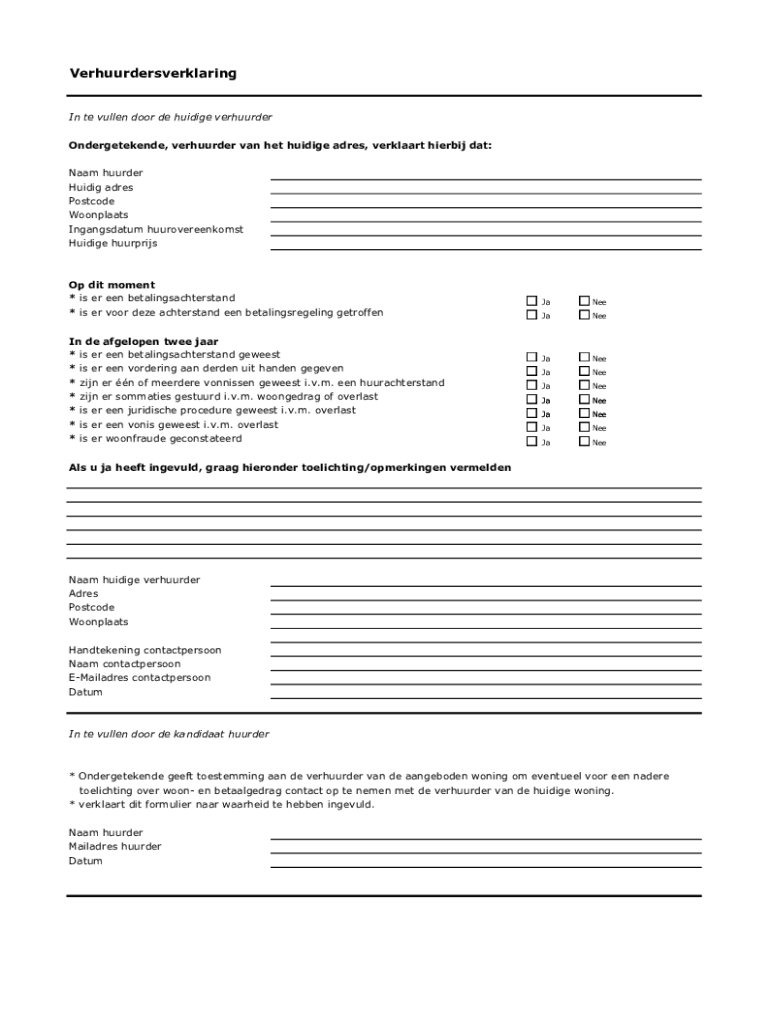
The "Deel II Verhuurdersverklaring" is a landlord declaration form used to verify a tenant's rental history and current standing. Its primary function is to provide prospective landlords or rental agencies with confirmation regarding a tenant's behavior and reliability in meeting rental obligations. This form captures essential details about the tenant, such as payment history, any rent arrears, legal actions due to disturbances, and overall conduct during the rental period.
The information collected on this form fosters a transparent rental application process, enabling landlords to make informed decisions based on documented rental performance. It acts as a formal acknowledgment from the current landlord, effectively serving as a reference that supports the tenant’s application for a new lease or rental agreement.
How to Use the Deel II Verhuurdersverklaring
The form is typically utilized during the rental application process. When a tenant is seeking a new rental agreement, they may be required to provide the Deel II Verhuurdersverklaring as part of their application package. Here’s how to effectively use it:
-
Request Completion: The prospective tenant should politely request their current landlord to fill out the form, explaining the purpose and significance behind the request.
-
Provide Accurate Information: The landlord should ensure that all the details, such as rental payments and any issues during the tenancy, are accurately represented in the form.
-
Submit with Application: Once completed, the tenant should include the form in their rental application package to prospective landlords or property management companies.
-
Authorize Contact: It is advisable for tenants to authorize communication between potential and current landlords if further clarification is needed beyond the provided details.
Steps to Complete the Deel II Verhuurdersverklaring
Completing the form involves several steps to ensure all necessary details are recorded accurately:
-
Tenant Information: Begin by filling out the tenant’s personal information, including their full name, current address, and contact details.
-
Rental History Section: Enter details of the current lease, including start and end dates, monthly rent amount, and payment frequency.
-
Payment Arrears: Document any instances of delayed or missed payments. Note how these issues were resolved, if applicable.
-
Behavior and Conduct: Include any relevant details about the tenant’s behavior, especially any instances that resulted in legal actions or notices due to property disturbances.
-
Landlord Authorization: Complete the section allowing the prospective landlord to contact the current landlord to verify information.
-
Signature and Date: The form should be signed and dated by the current landlord to verify authenticity.
Key Elements of the Deel II Verhuurdersverklaring
The form consists of several critical components designed to provide a comprehensive overview of the tenant's rental history:
- Tenant Identification: Clear identification of the tenant, including name and current address.
- Rental Terms: Specifics about the lease agreement like rent amount, payment schedule, and lease duration.
- Payment Record: A summary of the tenant’s payment history, including any arrears.
- Conduct Assessment: Observations regarding tenant conduct and property upkeep.
- Landlord Verification: A section for the landlord to attest to the accuracy of the information and provide consent for contact.
Who Typically Uses the Deel II Verhuurdersverklaring
This form is primarily used by tenants moving to a new rental property. It serves as a reference for prospective landlords who want to ensure that the tenant has a reliable rental history. In addition to tenants, property managers and real estate agents may also request this form to assess prospective tenants' applications effectively.


Legal Use of the Deel II Verhuurdersverklaring
In the United States, similar forms are used to uphold fair rental practices and to help mitigate risks associated with leasing properties. The Deel II Verhuurdersverklaring, while reflecting a structure common in Dutch-speaking regions, aligns with U.S. practices through its verification and accountability principles.
Legal use includes ensuring all information provided is truthful and accurate, as falsification can result in legal ramifications for the tenant or landlord involved. Consistency with U.S. fair housing laws should be maintained, avoiding discrimination based on federally or state-protected classes.
Examples of Using the Deel II Verhuurdersverklaring
Examples of scenarios where the Deel II Verhuurdersverklaring may be used include:
- Moving to a Larger Apartment: A tenant relocating to a larger unit may need this form to show past reliability in making timely rent payments.
- Switching Cities: Tenants moving to a different city for work or education can utilize this form to establish their rental credibility with new landlords.
- Updating Rental Agreements: When a current rental agreement is up for renewal and conditions are being renegotiated, this form can provide supportive evidence of a tenant’s responsible behavior.
Digital vs. Paper Version
In today’s increasingly digital world, the Deel II Verhuurdersverklaring can be completed electronically or via a traditional paper format:
- Digital Version: Offers ease of access and can be conveniently completed online through platforms like DocHub. This version allows for streamlined submission via email, enhancing efficiency.
- Paper Version: May be preferred by those who are less comfortable with digital solutions or when digital submission is not feasible.
Both formats should provide identical information to ensure consistency in the application process.