




01. Edit your form online
Type text, add images, blackout confidential details, add comments, highlights and more.

Type text, add images, blackout confidential details, add comments, highlights and more.

Draw your signature, type it, upload its image, or use your mobile device as a signature pad.

Send it via email, link, or fax. You can also download it, export it or print it out.
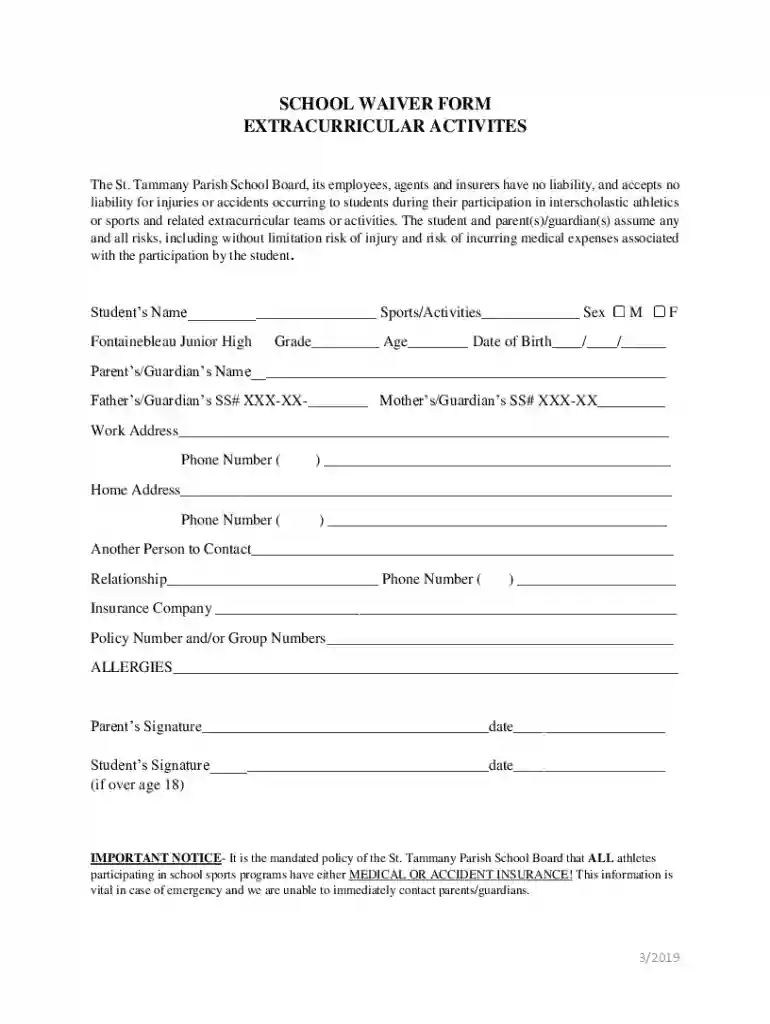
The school waiver form for extracurricular activities is an official document used primarily by educational institutions, such as Fontainebleau Junior High. Its purpose is to clearly state that the St. Tammany Parish School Board, along with its affiliates, are not accountable for any injuries or accidents that might take place during a student's participation in sports or other related activities. By signing this form, parents or guardians acknowledge and assume all associated risks, essentially releasing the school from liability.
The waiver form includes several critical sections that ensure comprehensive coverage and clarity:
Completing the school waiver form for extracurricular activities involves precise steps to ensure accuracy and compliance:
Understanding terminology is crucial when dealing with such legal documents:
This form is legally binding, meant to protect the school from legal claims related to injuries sustained during extracurricular activities. Its enforceability can vary by state depending on local laws governing minors and contracts.
This form is predominantly used by:


In a real-world scenario, a school offers a science club involving field trips and requires all student participants to have a signed waiver form before joining any off-campus activities.
Different states have varied requirements concerning school waiver forms:
In California, waivers for minors can be scrutinized closely, requiring careful language to ensure legal standing, while in Texas, the enforceability might differ, leading schools to adopt tailored versions of the form.
With advancements in technology, schools can utilize both digital and paper versions of the waiver form, each having distinct benefits:
A middle school organizes a day trip to a local nature reserve as part of an environmental studies program. The school waiver form is mandatory for each student, clearly stating potential risks like hiking and exposure to natural elements. The process ensures that all parties are aware and accept these terms, enabling the trip to proceed smoothly and without legal ambiguity.
At DocHub, your data security is our priority. We follow HIPAA, SOC2, GDPR, and other standards, so you can work on your documents with confidence.

BIE-operated schools are to use the Permission Slip for Extracurricular. Activities form for all proposed trips and extracurricular activities.Read more
On August 22, 2023, our team promoted the extraordinary extra-curricular activity, the iGEM competition at Shenzhen College of International Education (SCIE).Read more
Sep 24, 2025 A private school student, may participate in extracurricular activities pays the associated fees or receives a fee waiver.


