




01. Edit your form online
Type text, add images, blackout confidential details, add comments, highlights and more.

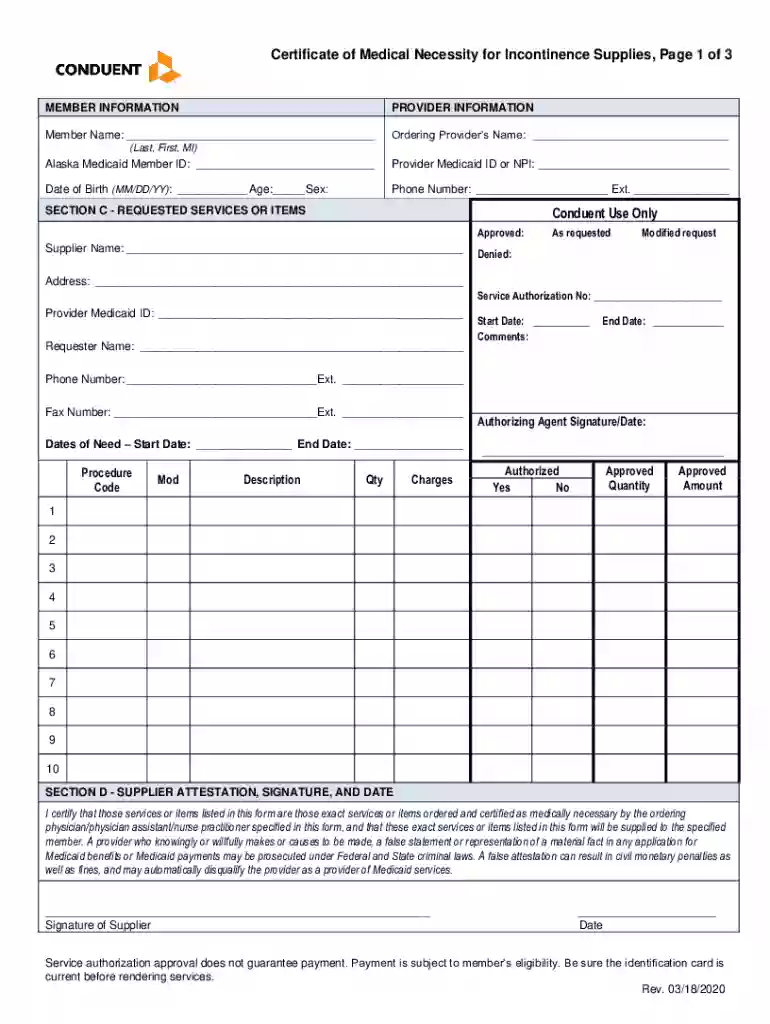
Type text, add images, blackout confidential details, add comments, highlights and more.

Draw your signature, type it, upload its image, or use your mobile device as a signature pad.

Send it via email, link, or fax. You can also download it, export it or print it out.
The Certificate of Medical Necessity for Incontinence Supplies serves as a vital document when requesting Medicaid coverage for incontinence-related products. It functions to justify the medical need for these supplies by requiring detailed medical information and clinical assessments. The form is structured to gather comprehensive data including diagnosis, treatment plans, and physician attestation, ensuring that the supplies are essential for the patient’s well-being. The certificate not only assists Medicaid in establishing eligibility for coverage but also provides a standardized approach for healthcare providers to document the necessity of specific incontinence products.
Understanding the core components of the certificate is crucial when preparing to fill out the form. These elements include:
When using the Certificate of Medical Necessity for Incontinence Supplies, it’s essential to follow a structured process. Begin by collecting all necessary patient information and medical records. Work with healthcare professionals to ensure an accurate clinical assessment is documented. Review Medicaid guidelines to ensure that the form will meet coverage requirements, paying special attention to any state-specific variances that may apply.
Filling out the Certificate of Medical Necessity entails several critical steps:
This certificate is primarily used by healthcare providers and professionals who work with patients experiencing incontinence issues. These include:


The legal use of the Certificate of Medical Necessity is to affirm to Medicaid the essential requirement of the incontinence supplies. This document is legally binding and must accurately reflect the medical condition of the patient requiring coverage. Submitting false information can result in denial of Medicaid claims and may have legal consequences for both the patient and healthcare provider.
While the overall structure of the certificate remains consistent across the United States, specific states may have additional requirements or variations in the form based on local Medicaid regulations. It is advisable to check specific state guidelines to ensure compliance when completing the form.
To illustrate the application of this certificate, consider the scenario of an elderly patient with chronic urinary incontinence requiring adult diapers. A detailed assessment by the primary care physician, including diagnostic codes and treatment recommendations, must be included in the certificate to justify Medicaid coverage. This proactive documentation facilitates the approval process and ensures that the patient receives the necessary support in managing their condition.
The certificate can be obtained through healthcare providers or by accessing Medicaid’s portal, depending on the state-specific processes. The form is often available in both digital and paper formats, offering flexibility in submission methods tailored to patient and provider convenience.
Understanding these key terms and steps is instrumental in successfully completing and submitting the Certificate of Medical Necessity for Incontinence Supplies, ensuring that patients receive the products they need.
We've got more versions of the Certificate of Medical Necessity for Incontinence Supplies, Page 1 of 3 form. Select the right Certificate of Medical Necessity for Incontinence Supplies, Page 1 of 3 version from the list and start editing it straight away!
| Versions | Form popularity | Fillable & printable |
|---|---|---|
| 2020 | 4.2 Satisfied (42 Votes) |
At DocHub, your data security is our priority. We follow HIPAA, SOC2, GDPR, and other standards, so you can work on your documents with confidence.
A completed Incontinence Supplies Medical Necessity Certification (DHCS 6187) form must accompany the authorization request. A provider-generated form is not
The physician must order all incontinence garments and supplies and maintain documentation of the medical necessity and diagnosis of incontinence in theRead more


