
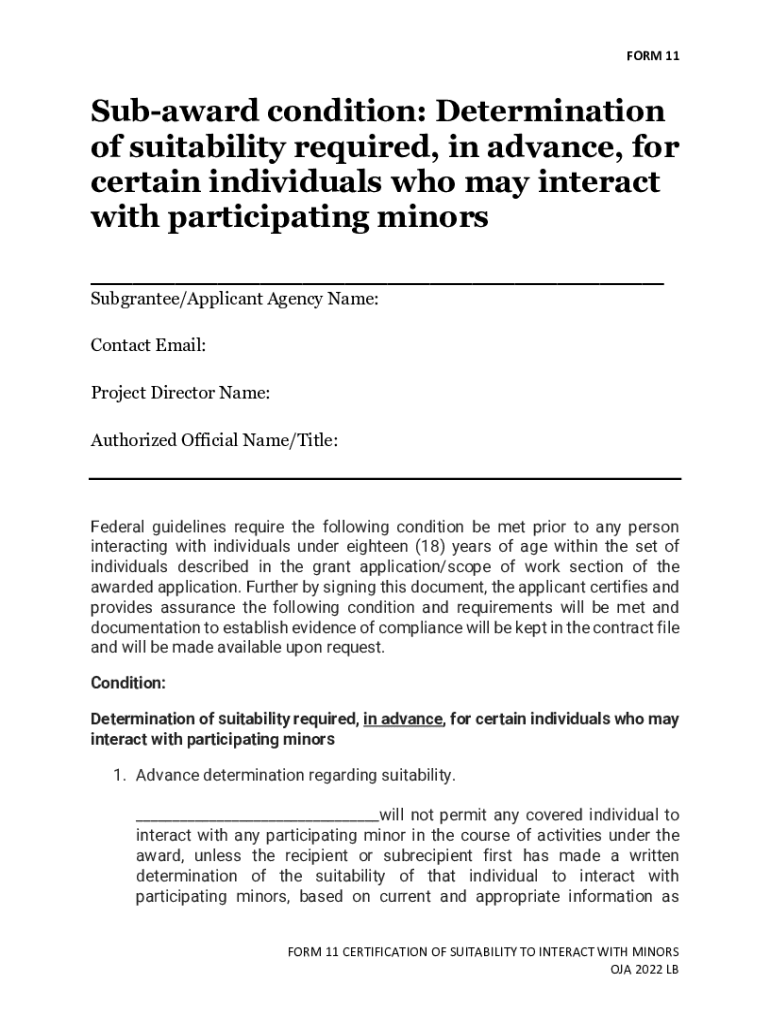







Definition and Purpose of the Form
The "2-Sample-Policy-Form-Suitability-to-Interact-with-Minors" is a critical document designed to assess the eligibility of individuals who will engage in activities involving minors. It primarily serves as a safeguard to ensure that only suitable individuals interact with minors, especially in contexts funded by federal grants. This involves evaluating the background and circumstances of individuals to mitigate any potential risks, maintaining compliance with stringent federal guidelines. The document stipulates that a suitability determination must be formalized and documented ahead of any engagement, emphasizing the importance of due diligence in these sensitive interactions.
How to Use the Form
To effectively utilize the form, organizations must follow specific procedures that include detailing personal information and assessing relevant criteria. These steps ensure comprehensive coverage in evaluating an individual's suitability:
- Identification of Covered Individuals: Clearly list all individuals who will interact with minors, ensuring no potential omissions.
- Background Verification: Conduct thorough background checks, including criminal history, to match against the criteria outlined.
- Documentation Requirements: Ensure all findings are documented in alignment with the established guidelines for record-keeping.
Steps to Complete the Form
Completing the form involves several precise steps to ensure accuracy and compliance with federal standards:
- Gather Required Information: Collect personal and professional details of the individual being assessed.
- Conduct Background Checks: Use federal and state databases to verify any past criminal history.
- Evaluation Against Criteria: Compare the findings with the form’s criteria for suitability.
- Documentation and Sign-off: Compile findings in a report format, obtain necessary approvals, and file documentation securely.
Key Elements of the Form
The form comprises several key sections aimed at thoroughly assessing suitability:
- Personal Identification Information: Includes the name, contact information, and position of the individual.
- Background and Criminal History: Documents any previous criminal offenses or allegations.
- Suitability Criteria: Defined benchmarks that the individual must meet to be considered eligible for interaction with minors.
- Compliance and Reporting: Sections for confirming adherence to federal guidelines and maintaining a report for inspections.
Important Terms and Definitions
Understanding specific terminology is essential for proper form usage:
- Covered Individual: Any person required to undergo a suitability evaluation due to potential minor interactions.
- Participating Minor: Minors who are involved in activities under the supervision of the covered individuals.
- Suitability Determination: The process and outcome of assessing an individual’s eligibility based on pre-defined criteria.
Eligibility Criteria for Suitability
Eligibility is determined through various factors reflecting individual characteristics and history:
- Legal Compliance: No significant legal issues that could compromise the integrity of interactions.
- Criminal Record Check: Must be free of disqualifying criminal offenses.
- Professional Conduct and History: Evaluation of work history and past professional conduct.


Who Typically Uses the Form
The form is widely used across various settings where minor interaction is prevalent:
- Educational Institutions: To vet teachers, tutors, and volunteers.
- Youth Organizations: For assessing individuals working in coaching or mentorship roles.
- Healthcare Providers: Evaluating staff in pediatric care settings.

Legal Use and Compliance
Legal compliance is non-negotiable when handling this form:
- Federal Guidelines: Adherence to federal requirements concerning the protection of minors.
- State Regulations: Understanding variations in state-specific rules and adjusting practices accordingly.
- Privacy Laws: Ensuring all data handling complies with privacy standards.
Examples of Using the Form
To illustrate the application of the form, consider these scenarios:
- A School Hiring a New Teacher: The school uses the form to ensure the candidate has no disqualifying history that would endanger minors.
- A Non-Profit Organizing a Youth Camp: Ensuring that all camp counselors and volunteers are vetted using the form minimizes risks during the camp activities.
Maintaining Compliance and Documentation
Maintaining compliance is ongoing and necessitates regular checks:
- Periodic Re-Evaluation: Scheduled reviews every five years or when significant changes in the individual's circumstances occur.
- Secure Record Keeping: Keeping all records in a secure format, accessible for federal inspections and audits.
By following these detailed descriptions and processes, organizations can safely and effectively manage the suitability of individuals interacting with minors, ensuring compliance with all applicable guidelines and laws.




