




01. Edit your form online
Type text, add images, blackout confidential details, add comments, highlights and more.

Type text, add images, blackout confidential details, add comments, highlights and more.

Draw your signature, type it, upload its image, or use your mobile device as a signature pad.

Send it via email, link, or fax. You can also download it, export it or print it out.
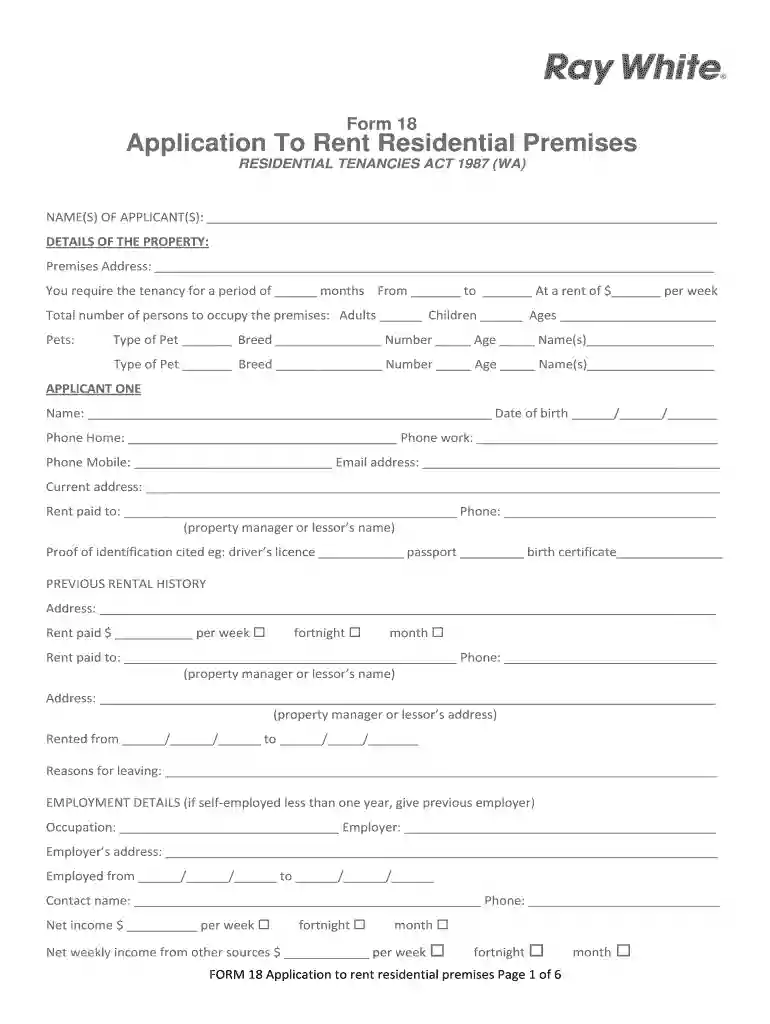
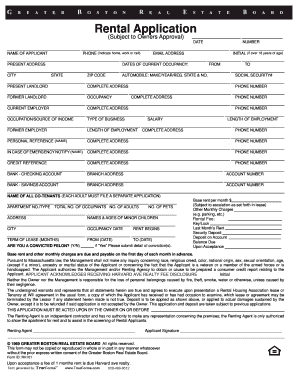
The Application to Rent Residential Premises, often referred to as Form 18 under the Residential Tenancies Act 1987 (WA), is a detailed document used by prospective tenants to formally apply for renting a residential property. This form collects essential information about applicants, including personal identification details, rental history, employment information, and references. It serves as a comprehensive profile to help landlords in selecting suitable tenants. The application also details the process for handling tenant selection, specifying information about option fees, tenancy database considerations, and equal opportunity guidelines. Required supporting documents for verifying an applicant's identity are also outlined within the form.
The process of using the Application to Rent Residential Premises involves several critical steps. First, prospective tenants must carefully read and complete all relevant sections of the form. This includes filling out personal information, detailing previous rental history, and providing employment details alongside references. Once all sections have been completed accurately, applicants are typically required to attach supporting documents, such as proof of income and identification verification. After ensuring all information is complete and correct, the form can be submitted to the landlord or property manager for consideration. Landlords often utilize this information to conduct background checks and verify suitability for tenancy.
Several documents must be collected and submitted alongside the Application to Rent Residential Premises to ensure a comprehensive profile is presented to the landlord. These typically include:
These documents help landlords verify the applicant's identity and gain insights into their financial reliability and rental history.
The primary users of the Application to Rent Residential Premises are individuals or families looking to secure rental housing. This form is essential for potential tenants who wish to demonstrate their eligibility and interest in a property. Additionally, landlords and property managers utilize this application to compare applicants and select the most suitable candidates. In areas with competitive rental markets, providing a detailed and well-documented application can significantly enhance an individual’s chance of securing the desired rental property.


The use of the Application to Rent Residential Premises is governed by various legal standards to protect both tenants and landlords. Under the Residential Tenancies Act 1987 (WA), the application must comply with equal opportunity laws, ensuring that landlords do not discriminate based on race, gender, disability, or other protected characteristics. Furthermore, handling of tenant information must respect privacy laws, requiring that personal data be secured and used solely for tenant selection purposes. Landlords are also obligated to inform applicants of whether a tenancy database may be used for the applicant's assessment.
Completing the Application to Rent Residential Premises involves a meticulous approach to ensure accuracy and completeness. Each section of the application must be filled out with the utmost care, and all accompanying documentation should be current and legible.
This form is a vital tool for establishing a formal request to rent a residential property. It allows landlords to assess a candidate's suitability based on tangible data, such as rental history and financial stability. Completed forms help landlords make informed decisions while giving applicants a structured way to present relevant details. Successful completion and submission of this application are often the first step toward securing a rental agreement, connecting qualified tenants with their desired residential properties.
Consider a young professional moving to a new city for work. They would complete an Application to Rent Residential Premises by detailing their stable employment history and providing positive references from previous landlords. This profile positions them as a reliable tenant, likely to meet rental obligations timely. Another example might involve a family seeking a larger home. By demonstrating consistent rental payments and providing a thorough application, they can appeal to landlords as responsible long-term tenants. These scenarios underscore the form's importance in various rental contexts.
At DocHub, your data security is our priority. We follow HIPAA, SOC2, GDPR, and other standards, so you can work on your documents with confidence.
1. RENT: To pay as rental the sum of $. per month, due and payable in advance from the first day of every month.Read more
The rental application is like a job or credit application that the landlord will use to decide whether to rent to you.
RTI to Rent Authority + parallel police complaint + civil suit typically resolves disputes in 30-90 days. possession is 9/10ths of the law. Send a written


