Definition and Meaning of a Legal Services Agreement - Retainer Form
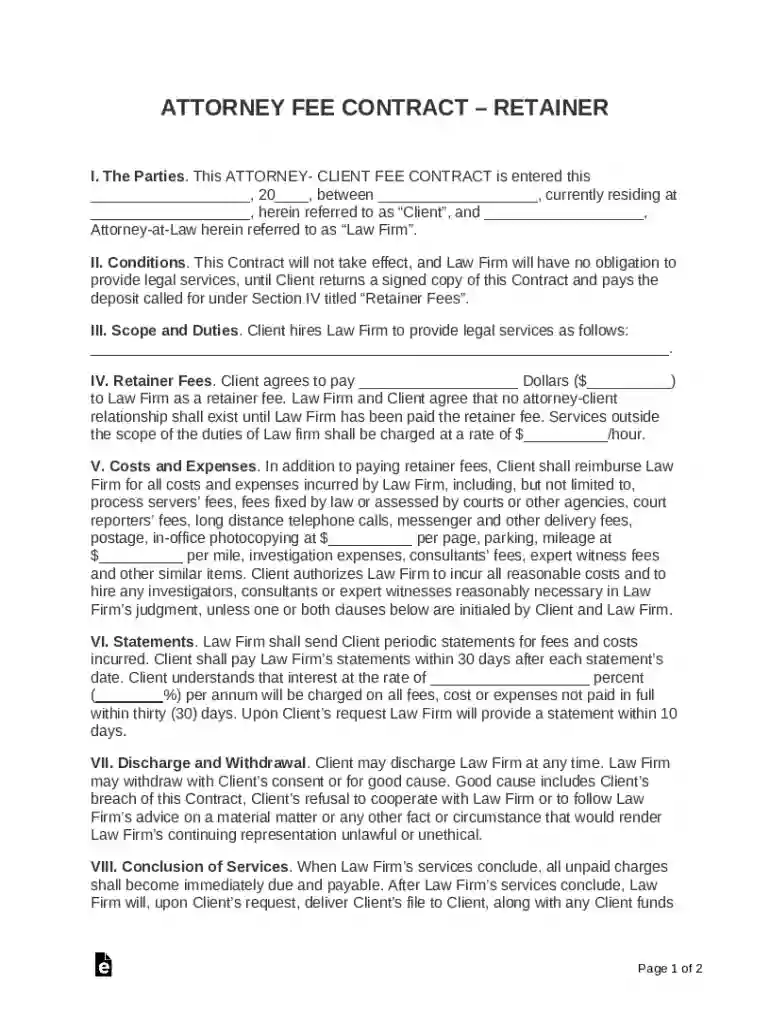
A Legal Services Agreement - Retainer Form is a formal contract between a client and a law firm detailing the terms of legal services to be provided. This document outlines critical aspects such as the scope of work, retainer fees, billing procedures, and termination conditions. Its primary function is to ensure transparency and mutual understanding between the involved parties, safeguarding both client interests and the law firm's service expectations. Typically, the agreement requires a signed contract to validate the relationship and a retainer fee payment to commence services.
How to Use the Fill, Edit and Print Legal Services Agreement - Retainer Form
Using the Fill, Edit and Print Legal Services Agreement - Retainer Form involves several straightforward steps:
- Access the Form: Begin by obtaining the form from a reliable source like DocHub, which allows easy importation and management.
- Complete the Details: Use the platform's editing tools to fill in essential details such as client information, scope of legal services, and fee structures.
- Modify as Necessary: Edit sections to fit specific agreements between the client and law firm, ensuring all parties understand and agree to the terms.
- Review and Collaborate: Collaborate with involved parties to input further annotations or comments, ensuring all conditions are agreed upon.
- Finalize and Sign: Once finalized, use the platform's legally binding electronic signature feature to authorize the agreement.
Steps to Complete the Legal Services Agreement - Retainer Form
Completing the Legal Services Agreement - Retainer Form efficiently involves the following pivotal steps:
- Input Client Information: Begin with entering accurate client details to avoid any identification issues later.
- Define Scope of Services: Clearly outline what legal services the law firm will provide to manage client expectations.
- Set Financial Terms: Specify the retainer fee amount, billing procedures, and potential additional costs.
- Establish Service Duration: Detail the length of the agreement and conditions for renewal or termination.
- Agree on Confidentiality: Include terms regarding the confidentiality of client information as part of ethical legal practices.
- Check Legal Compliance: Ensure the form complies with state-specific laws and regulations to maintain its enforceability.
- Review for Accuracy: Thoroughly review the form, ensuring all entered data is correct and reflective of the mutual understanding between parties.
Key Elements of the Legal Services Agreement - Retainer Form
This form includes several critical components that must be accurately filled out to establish a comprehensive agreement:
- Client and Attorney Identification: Names, addresses, and contact details to precisely identify both parties.
- Legal Services Description: Detailed descriptions of the legal assistance to be provided.
- Retainer Fee Details: A clear outline of initial payment required and any further cost implications.
- Responsibilities and Expectations: Clearly articulated duties of the law firm and rights of the client.
- Dispute Resolution Mechanism: Predefined paths to manage disagreements that might arise during the term.
Who Typically Uses the Legal Services Agreement - Retainer Form
Various entities and individuals utilize this type of agreement to formalize their legal service engagements, including:

- Individual Clients: People requiring legal assistance for personal matters such as estate planning or family law.
- Businesses: Companies engaging legal services for business operations, compliance, or contractual matters.
- Non-Profits: Organizations seeking legal aid for governance, donations, or other organizational matters.
- Government Entities: Agencies requiring external legal counsel for compliance or representation.
Important Terms Related to the Legal Services Agreement - Retainer Form
Understanding specific legal terms related to this form is crucial for both parties:
- Retainer Fee: A payment made in advance to secure legal services, often held in a trust account.
- Billing Cycle: The regular interval at which the client is invoiced for services provided.
- Withdrawal Conditions: Terms under which the law firm can cease providing services.
- Confidentiality Clause: Provisions ensuring the non-disclosure of client information.
State-Specific Rules for the Legal Services Agreement - Retainer Form
Legal regulations vary across states, impacting the drafting and enforcement of these forms:
- Governing Law: Contracts often specify which state's laws apply in legal disputes.
- Fee Structures: Some states may have limitations or stipulations on retainer fees and billing practices.
- Termination Clauses: Specific conditions under which either party can terminate the agreement may differ, requiring localization.
- Discipline and Reporting: State bar guidelines may require the reporting of certain actions within these agreements.
Examples of Using the Legal Services Agreement - Retainer Form
Practical application scenarios can include:
- Estate Planning: A family selects a law firm to draft wills, utilizing the form to detail all involved services.
- Corporate Agreements: A company retains legal counsel for ongoing business operations, specifying regular reviews and service levels.
- Real Estate Transactions: Buyers or sellers retaining an attorney for property transactions expect clearly laid out services and costs.
Legally Binding Electronic Signatures in Retainer Forms
Utilizing electronic signatures to finalize the retainer form ensures compliance with the ESIGN Act, which validates electronically signed documents. This approach:
- Saves Time: Allows immediate signing and storage without physical document exchanges.
- Ensures Traceability: Offers audit trails verifying the sequence of signing and viewing actions.
- Enhances Security: Leverages advanced authentication methods ensuring signatory identity.
Why Fill, Edit and Print the Legal Services Agreement - Retainer Form?
Engaging in the fill, edit, and print process for this form ensures each party contributes to and acknowledges the specificities of the agreement:
- Customizes Client Needs: Tailors services to individual or business requirements, embedding changes directly into the document.
- Facilitates Easy Updates: Amendments and revisions are straightforward, enhancing adaptability to evolving client needs.
- Enhances Transparency: Allows all stakeholders to have clear, co-created content, reducing misunderstandings.