




01. Edit your form online
Type text, add images, blackout confidential details, add comments, highlights and more.

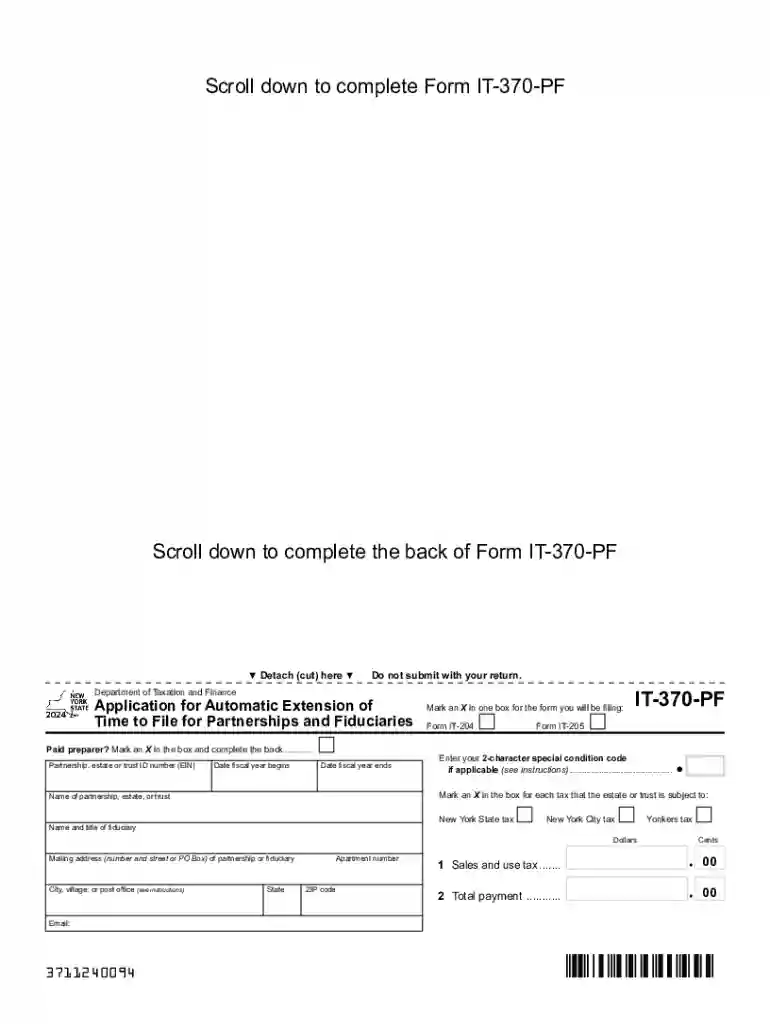
Type text, add images, blackout confidential details, add comments, highlights and more.

Draw your signature, type it, upload its image, or use your mobile device as a signature pad.

Send it via email, link, or fax. You can also download it, export it or print it out.
Form IT-370 is an official request enabling taxpayers in New York to obtain an automatic six-month extension for filing income tax returns. This form is primarily utilized by individuals who require additional time to compile essential documentation without incurring late filing penalties. The application must be submitted prior to the initial filing deadline to ensure timely acknowledgment of the extension request by the New York State Department of Taxation and Finance.
Form IT-370 can be accessed and submitted through various methods. Taxpayers can download the form directly from the New York State Department of Taxation and Finance's official website. Additionally, tax professionals often provide this form as part of their services.
Accurate completion of Form IT-370 is essential for obtaining an extension. Below is a streamlined process to guide taxpayers through the form's completion.
To qualify for an automatic extension using Form IT-370, taxpayers must meet specific eligibility criteria ensuring they are not already obligated to file a different type of extension form. Taxpayers should demonstrate a clear intention to file a complete return by the extended deadline.


New York has distinctive regulations regarding tax extensions compared to federal tax guidelines or those of other states. Understanding these state-specific nuances is crucial for compliance.
Taxpayers intending to submit Form IT-370 must keep in mind critical deadlines to ensure timely processing and acknowledgment of their extension request.
Several submission methods ensure that taxpayers can file Form IT-370 via a channel that best suits their needs.
While Form IT-370 offers an extension on filing deadlines, strict adherence to the process protects against penalties. Taxpayers who fail to comply with requirements may incur various financial penalties.
Providing this comprehensive evaluation of the Form IT-370 ensures that taxpayers are better equipped to manage their tax obligations effectively while optimizing the process of requesting additional time for filing.
We've got more versions of the Form IT-370: Application for Automatic Six-Month form. Select the right Form IT-370: Application for Automatic Six-Month version from the list and start editing it straight away!
| Versions | Form popularity | Fillable & printable |
|---|---|---|
| 2025 | 4.4 Satisfied (58 Votes) | |
| 2024 | 4.2 Satisfied (20 Votes) | |
| 2023 | 4.5 Satisfied (48 Votes) | |
| 2022 | 4.5 Satisfied (32 Votes) | |
| 2021 | 4.8 Satisfied (124 Votes) | |
| 2020 | 4.4 Satisfied (152 Votes) | |
| 2019 | 4.4 Satisfied (66 Votes) | |
| 2017 | 4.4 Satisfied (116 Votes) | |
| 2013 | 4.3 Satisfied (28 Votes) | |
| 2009 | 4.2 Satisfied (65 Votes) |
At DocHub, your data security is our priority. We follow HIPAA, SOC2, GDPR, and other standards, so you can work on your documents with confidence.


Dec 12, 2025 If you qualify for an extension of time to file beyond six months, you must file Form IT-370 on or before the filing deadline for your return.Read more
The filing date for your income tax return and Form IT-214 will be automatically extended for six months if you file Form IT-370 on time and pay any tax owedRead more
It is designed to swell and form a continuous and highly impermeable isolation barrier between contaminated sediments and the overlying water column,


